The QLIM Procedure

Prior Distributions

The PRIOR statement is used to specify the prior distribution of the model parameters. You must specify a list of parameters, a tilde ~, and then a distribution with its parameters. You can specify multiple PRIOR statements to define independent priors. Parameters that are associated with a regressor variable are referred to by the name of the corresponding regressor variable.

You can specify the special keyword _REGRESSORS to consider all the regressors of a model. If multiple prior statements affect the same parameter, the prior that is specified is used. For example, in a regression with three regressors (X1, X2, X3) the following statements imply that the prior on X1 is NORMAL(MEAN=0, VAR=1), the prior on X2 is GAMMA(SHAPE=3, SCALE=4), and the prior on X3 is UNIFORM(MIN=0, MAX=1):

...
prior _Regressors ~ uniform(min=0, max=1);
prior X1 X2 ~ gamma(shape=3, scale=4);
prior X1 ~ normal(mean=0, var=1);
...

If a parameter is not associated with a PRIOR statement or if some of the prior hyperparameters are missing, then the default choices shown in Table 2 are considered.

Table 2: Default Values for Prior Distributions

PRIOR distribution sans-serif upper H sans-serif y sans-serif p sans-serif e sans-serif r sans-serif p sans-serif a sans-serif r sans-serif a sans-serif m sans-serif e sans-serif t sans-serif e sans-serif r Subscript 1 sans-serif upper H sans-serif y sans-serif p sans-serif e sans-serif r sans-serif p sans-serif a sans-serif r sans-serif a sans-serif m sans-serif e sans-serif t sans-serif e sans-serif r Subscript 2 sans-serif upper M sans-serif i sans-serif n sans-serif upper M sans-serif a sans-serif x Parameters Default Choice
NORMAL MEAN=0 VAR=1E6 negative normal infinity normal infinity sans-serif upper R sans-serif e sans-serif g sans-serif r sans-serif e sans-serif s sans-serif s sans-serif i sans-serif o sans-serif n minus sans-serif upper L sans-serif o sans-serif c sans-serif a sans-serif t sans-serif i sans-serif o sans-serif n minus sans-serif upper T sans-serif h sans-serif r sans-serif e sans-serif s sans-serif h sans-serif o sans-serif l sans-serif d
IGAMMA SHAPE=2.000001 SCALE=1 greater-than 0 normal infinity sans-serif upper S sans-serif c sans-serif a sans-serif l sans-serif e
SQIGAMMA SHAPE=2.000001 SCALE=1 greater-than 0 normal infinity sans-serif upper S sans-serif c sans-serif a sans-serif l sans-serif e
GAMMA SHAPE=1 SCALE=1 sans-serif 0 normal infinity
SQGAMMA SHAPE=1 SCALE=1 sans-serif 0 normal infinity
UNIFORM negative normal infinity normal infinity
UNIFORM greater-than negative 1 less-than 1 sans-serif upper C sans-serif r sans-serif o sans-serif s sans-serif s minus sans-serif c sans-serif o sans-serif r sans-serif r sans-serif e sans-serif l sans-serif a sans-serif t sans-serif i sans-serif o sans-serif n
BETA SHAPE1=1 SHAPE2=1 negative normal infinity normal infinity
T LOCATION=0 DF=3 negative normal infinity normal infinity


For density specification, see the section Standard Distributions.

Priors for Heteroscedastic Models

The choice of the prior distribution for a heteroscedastic model is particularly interesting. Based on the notation provided in section HETERO Statement, you need to provide a prior for bold-italic gamma. This prior is enough to induce different sigma Subscript i Superscript 2 into the analysis. The resulting inference is a compromise between two cases: the inference based on the entire sample and the inference based on a single unit bold z Subscript i. The degree of compromise is determined by pi left-parenthesis bold-italic gamma right-parenthesis.

This type of modeling is similar to a method called "hierarchical Bayes," in which the prior is characterized by two levels: one for each individual pi left-parenthesis sigma Subscript i Superscript 2 Baseline vertical-bar bold-italic gamma right-parenthesis and one for the entire population pi left-parenthesis bold-italic gamma right-parenthesis. In this scenario the degree of compromise between the information provided by a unit and the information provided by the entire sample is determined by the data.

The choice of the prior might not be straightforward, and it can heavily affect sampling performance. Depending on how the heteroscedastic effects are modeled, the default priors are
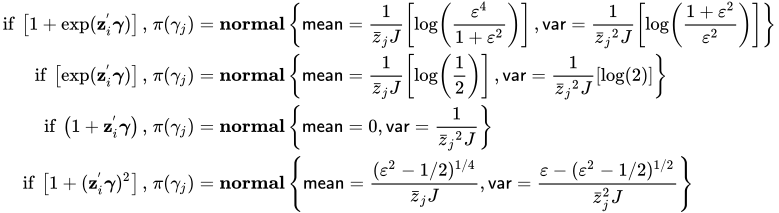
StartLayout 1st Row 1st Column if left-bracket 1 plus exp left-parenthesis bold z Subscript i Superscript Super Superscript prime Superscript Baseline bold-italic gamma right-parenthesis right-bracket comma 2nd Column Blank 3rd Column pi left-parenthesis gamma Subscript j Baseline right-parenthesis equals bold n bold o bold r bold m bold a bold l StartSet sans-serif m sans-serif e sans-serif a sans-serif n equals StartFraction 1 Over z overbar Subscript j Baseline upper J EndFraction left-bracket log left-parenthesis StartFraction epsilon Superscript 4 Baseline Over 1 plus epsilon squared EndFraction right-parenthesis right-bracket comma sans-serif v sans-serif a sans-serif r equals StartFraction 1 Over z overbar Subscript j Baseline Superscript 2 Baseline upper J EndFraction left-bracket log left-parenthesis StartFraction 1 plus epsilon squared Over epsilon squared EndFraction right-parenthesis right-bracket EndSet 2nd Row 1st Column if left-bracket exp left-parenthesis bold z Subscript i Superscript Super Superscript prime Superscript Baseline bold-italic gamma right-parenthesis right-bracket comma 2nd Column Blank 3rd Column pi left-parenthesis gamma Subscript j Baseline right-parenthesis equals bold n bold o bold r bold m bold a bold l StartSet sans-serif m sans-serif e sans-serif a sans-serif n equals StartFraction 1 Over z overbar Subscript j Baseline upper J EndFraction left-bracket log left-parenthesis one-half right-parenthesis right-bracket comma sans-serif v sans-serif a sans-serif r equals StartFraction 1 Over z overbar Subscript j Baseline Superscript 2 Baseline upper J EndFraction left-bracket log left-parenthesis 2 right-parenthesis right-bracket EndSet 3rd Row 1st Column if left-parenthesis 1 plus bold z Subscript i Superscript Super Superscript prime Superscript Baseline bold-italic gamma right-parenthesis comma 2nd Column Blank 3rd Column pi left-parenthesis gamma Subscript j Baseline right-parenthesis equals bold n bold o bold r bold m bold a bold l StartSet sans-serif m sans-serif e sans-serif a sans-serif n equals 0 comma sans-serif v sans-serif a sans-serif r equals StartFraction 1 Over z overbar Subscript j Baseline Superscript 2 Baseline upper J EndFraction EndSet 4th Row 1st Column if left-bracket 1 plus left-parenthesis bold z Subscript i Superscript Super Superscript prime Superscript Baseline bold-italic gamma right-parenthesis squared right-bracket comma 2nd Column Blank 3rd Column pi left-parenthesis gamma Subscript j Baseline right-parenthesis equals bold n bold o bold r bold m bold a bold l StartSet sans-serif m sans-serif e sans-serif a sans-serif n equals StartFraction left-parenthesis epsilon squared minus 1 slash 2 right-parenthesis Superscript 1 slash 4 Baseline Over z overbar Subscript j Baseline upper J EndFraction comma sans-serif v sans-serif a sans-serif r equals StartFraction epsilon minus left-parenthesis epsilon squared minus 1 slash 2 right-parenthesis Superscript 1 slash 2 Baseline Over z overbar Subscript j Superscript 2 Baseline upper J EndFraction EndSet EndLayout

where z overbar Subscript j Baseline equals StartFraction 1 Over n EndFraction sigma-summation Underscript i equals 1 Overscript n Endscripts z Subscript i j, for-all j, and epsilon is a small number (by default, epsilon equals 0.1 for the EXPONENTIAL link function and epsilon equals 0.71 for the QUADRATIC link function).

The priors for the EXPONENTIAL and QUADRATIC link functions are not straightforward. To understand the choices, do the following:

  1. Assume that

    bold z Subscript i Superscript Super Superscript prime Superscript Baseline bold-italic gamma equals z Subscript i Baseline 1 Baseline gamma 1 plus midline-horizontal-ellipsis plus z Subscript i upper J Baseline gamma Subscript upper J Baseline almost-equals z overbar Subscript 1 Baseline gamma 1 plus midline-horizontal-ellipsis plus z overbar Subscript upper J Baseline gamma Subscript upper J Baseline comma for-all i
  2. Set the priors according to the link function type:

    • For the EXPONENTIAL link function, set

      StartLayout 1st Row 1st Column upper E left-bracket exp left-parenthesis bold z Subscript i Superscript Super Superscript prime Superscript Baseline bold-italic gamma right-parenthesis right-bracket 2nd Column almost-equals 3rd Column upper E left-bracket exp left-parenthesis z overbar Subscript 1 Baseline gamma 1 right-parenthesis right-bracket times midline-horizontal-ellipsis times upper E left-bracket exp left-parenthesis z overbar Subscript upper J Baseline gamma Subscript upper J Baseline right-parenthesis right-bracket equals epsilon 2nd Row 1st Column upper V left-bracket exp left-parenthesis bold z Subscript i Superscript Super Superscript prime Superscript Baseline bold-italic gamma right-parenthesis right-bracket 2nd Column almost-equals 3rd Column upper E left-bracket exp left-parenthesis 2 z overbar Subscript 1 Baseline gamma 1 right-parenthesis right-bracket times midline-horizontal-ellipsis times upper E left-bracket exp left-parenthesis 2 z overbar Subscript upper J Baseline gamma Subscript upper J Baseline right-parenthesis right-bracket minus epsilon squared equals 1 EndLayout

      Assume a normal prior for pi left-parenthesis gamma Subscript j Baseline right-parenthesis, and set

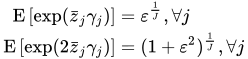
      StartLayout 1st Row 1st Column upper E left-bracket exp left-parenthesis z overbar Subscript j Baseline gamma Subscript j Baseline right-parenthesis right-bracket 2nd Column equals 3rd Column epsilon Superscript StartFraction 1 Over upper J EndFraction Baseline comma for-all j 2nd Row 1st Column upper E left-bracket exp left-parenthesis 2 z overbar Subscript j Baseline gamma Subscript j Baseline right-parenthesis right-bracket 2nd Column equals 3rd Column left-parenthesis 1 plus epsilon squared right-parenthesis Superscript StartFraction 1 Over upper J EndFraction Baseline comma for-all j EndLayout

      Based on the properties of the lognormal distribution, the prior hyperparameters for gamma Subscript j can be derived. Notice that J is the number of regressors that are used in the heterogeneous regression. If the intercept is excluded, then epsilon equals 1.

    • For the QUADRATIC link function, set

      StartLayout 1st Row 1st Column upper E left-bracket left-parenthesis bold z Subscript i Superscript Super Superscript prime Superscript Baseline bold-italic gamma right-parenthesis squared right-bracket 2nd Column almost-equals 3rd Column left-bracket upper E left-parenthesis z overbar Subscript 1 Baseline gamma 1 plus midline-horizontal-ellipsis plus z overbar Subscript upper J Baseline gamma Subscript upper J Baseline right-parenthesis right-bracket squared plus upper V left-bracket z overbar Subscript 1 Baseline gamma 1 plus midline-horizontal-ellipsis plus z overbar Subscript upper J Baseline gamma Subscript upper J Baseline right-bracket equals epsilon 2nd Row 1st Column upper V left-bracket left-parenthesis bold z Subscript i Superscript Super Superscript prime Superscript Baseline bold-italic gamma right-parenthesis squared right-bracket 2nd Column almost-equals 3rd Column upper E left-bracket left-parenthesis z overbar Subscript 1 Baseline gamma 1 plus midline-horizontal-ellipsis plus z overbar Subscript upper J Baseline gamma Subscript upper J Baseline right-parenthesis Superscript 4 Baseline right-bracket minus epsilon squared equals 1 EndLayout

      Assume a normal prior for pi left-parenthesis gamma Subscript j Baseline right-parenthesis. Based on the properties of the normal distribution, the preceding expressions return
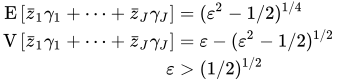
      StartLayout 1st Row 1st Column upper E left-bracket z overbar Subscript 1 Baseline gamma 1 plus midline-horizontal-ellipsis plus z overbar Subscript upper J Baseline gamma Subscript upper J Baseline right-bracket 2nd Column equals 3rd Column left-parenthesis epsilon squared minus 1 slash 2 right-parenthesis Superscript 1 slash 4 2nd Row 1st Column upper V left-bracket z overbar Subscript 1 Baseline gamma 1 plus midline-horizontal-ellipsis plus z overbar Subscript upper J Baseline gamma Subscript upper J Baseline right-bracket 2nd Column equals 3rd Column epsilon minus left-parenthesis epsilon squared minus 1 slash 2 right-parenthesis Superscript 1 slash 2 3rd Row 1st Column epsilon 2nd Column greater-than 3rd Column left-parenthesis 1 slash 2 right-parenthesis Superscript 1 slash 2 EndLayout

      The prior hyperparameters for gamma Subscript j can be derived by setting

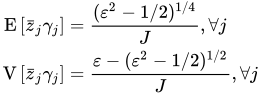
      StartLayout 1st Row 1st Column upper E left-bracket z overbar Subscript j Baseline gamma Subscript j Baseline right-bracket 2nd Column equals 3rd Column StartFraction left-parenthesis epsilon squared minus 1 slash 2 right-parenthesis Superscript 1 slash 4 Baseline Over upper J EndFraction comma for-all j 2nd Row 1st Column upper V left-bracket z overbar Subscript j Baseline gamma Subscript j Baseline right-bracket 2nd Column equals 3rd Column StartFraction epsilon minus left-parenthesis epsilon squared minus 1 slash 2 right-parenthesis Superscript 1 slash 2 Baseline Over upper J EndFraction comma for-all j EndLayout

      Notice that J is the number of regressors that are used in the heterogeneous regression. It is important to emphasize that the restriction epsilon greater-than left-parenthesis 1 slash 2 right-parenthesis Superscript 1 slash 2 Baseline almost-equals 0.71 is likely to introduce some distortion because epsilon cannot be any "small" number.

Last updated: August 08, 2024