The BGLIMM Procedure
Prior for the G-Side Covariance
PROC BGLIMM supports the following prior distributions of  :
:
-
Inverse Wishart distribution:
 . You can specify this distribution as follows:
 random x / sub=Id covprior=iwishart(df=a, scale=b);The inverse Wishart distribution is a generalization of the inverse gamma distribution; when the dimension is 1, the inverse Wishart distribution is equivalent to an inverse gamma distribution. The inverse Wishart prior is frequently used in Bayesian analysis, in part because it is a conjugate prior for a normal covariance, which leads to efficient sampling. An inverse Wishart prior that has small degrees of freedom (interpreted as prior sample size) and small diagonal values of the scale matrix is considered to be weakly informative.
The inverse Wishart prior applies to the covariance types UN, UN(1), VC, and TOEP. It is the default prior for the UN type.
-
Inverse gamma distribution:
 . You can specify this distribution as follows:
 random x / sub=Id covprior=igamma(shape=a, scale=b);The inverse gamma prior applies to the diagonal variance terms of a covariance that is of type UN, UN(1), VC, or TOEP. It is the default prior for the covariance types UN(1), VC, and TOEP.
-
Uniform distribution:
 . You can specify this distribution as follows:
 random x / sub=Id covprior=uniform(lower=, upper=);The uniform prior is on the standard deviation, not the variance, terms of
. This prior applies to the diagonal standard deviation terms of a covariance that is of type UN, UN(1), VC, or TOEP. -
Half-Cauchy distribution:
 . You can specify this distribution as follows:
 random x / sub=Id covprior=halfcauchy(scale=a);The half-Cauchy prior is a truncated prior whose lower bound is equal to zero. The prior applies to the variance terms of a covariance that is of type UN, UN(1), VC, or TOEP.
The half-Cauchy prior is a special case of the conditionally conjugate folded-noncentral-t distribution. The right tail of the half-Cauchy distribution is thick and decays slowly. Large a translates to weakly informative, a goes to infinity, and the half-Cauchy distribution becomes a uniform distribution.
-
Half-normal distribution:
 . You can specify this distribution as follows:
 random x / sub=Id covprior=halfnormal(var=a);The half-normal prior is a truncated prior whose lower bound is equal to zero. The prior applies to the variance terms of a covariance that is of type UN, UN(1), VC, or TOEP.
-
Scaled inverse Wishart distribution. You can specify this distribution as follows:
random x / sub=Id covprior=siwishart(df=a, scale=b, var=c);This is a generalization of the inverse Wishart prior. The distribution decomposes the
 matrix into variance and correlation components and specifies separate priors for each component (O’Malley and Zaslavsky 2008). Define
 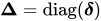 , where
  and
and  ; let
; let  be a positive definite matrix; and write
  ,
, 
where the hyperparameters a and b are the degrees of freedom and scale parameters, respectively, of the inverse Wishart prior;
 is the variance of the normal prior; and the default variance is 1. You can choose values for the hyperparameters a and b, and the default is the dimension of the matrix plus 3 for both a and b.
 Although
determines the correlations, it is not constrained to be a correlation matrix, so the model is overparameterized. The associated correlation matrix is  , where
  retains the diagonal elements of but has zeros elsewhere.
 Like the inverse Wishart prior, the scaled inverse Wishart prior applies to types UN, UN(1), VC, and TOEP.