The GLIMMIX Procedure
The Likelihood Ratio Test
The likelihood ratio test (LRT) compares the likelihoods of two models where parameter estimates are obtained in two parameter spaces, the space  and the restricted subspace
  . In the GLIMMIX procedure, the full model defines and the test-specification in the COVTEST statement determines the null parameter space . The likelihood ratio procedure consists of the following steps (see, for example, Bickel and Doksum 1977, p. 210):
Find the estimate
 of
of  . Compute the likelihood
  .
. Find the estimate
 of
of  . Compute the likelihood
  .
. -
Form the likelihood ratio

Find a function
 that has a known distribution.
  serves as the test statistic for the likelihood ratio test.
Please note the following regarding the implementation of these steps in the COVTEST statement of the GLIMMIX procedure.
-
The function
in step 4 is always taken to be 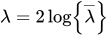
which is twice the difference between the log likelihoods for the full model and the model under the COVTEST restriction.
For METHOD=RSPL and METHOD=RMPL, the test statistic is based on the restricted likelihood.
For GLMMs involving pseudo-data, the test statistics are based on the pseudo-likelihood or the restricted pseudo-likelihood and are based on the final pseudo-data.
The parameter space
for the full model is typically not an unrestricted space. The GLIMMIX procedure imposes boundary constraints for variance components and scale parameters, for example. The specification of the subspace must be consistent with these full-model constraints; otherwise the test statistic  does not have the needed distribution. You can remove the boundary restrictions with the NOBOUND option in the PROC GLIMMIX statement or the NOBOUND option in the PARMS statement.