The ICPHREG Procedure

Residuals and Diagnostic Statistics

The ICPHREG procedure computes two types of residuals. Residuals are available for the piecewise constant hazard model and the cubic splines model.

For the ith subject whose observed interval is left-parenthesis upper L Subscript i Baseline comma upper R Subscript i Baseline right-parenthesis, the Lagakos residual is defined in Farrington (2000) as

r Subscript i Superscript upper L Baseline equals StartFraction ModifyingAbove upper S With caret Subscript i Baseline left-parenthesis upper L Subscript i Baseline right-parenthesis log left-bracket ModifyingAbove upper S With caret Subscript i Baseline left-parenthesis upper L Subscript i Baseline right-parenthesis right-bracket minus ModifyingAbove upper S With caret Subscript i Baseline left-parenthesis upper R Subscript i Baseline right-parenthesis log left-bracket ModifyingAbove upper S With caret Subscript i Baseline left-parenthesis upper R Subscript i Baseline right-parenthesis right-bracket Over ModifyingAbove upper S With caret Subscript i Baseline left-parenthesis upper L Subscript i Baseline right-parenthesis minus ModifyingAbove upper S With caret Subscript i Baseline left-parenthesis upper R Subscript i Baseline right-parenthesis EndFraction

You can request Lagakos residuals in an output data set by using the keyword RESLAG in the OUTPUT statement.

The deviance residual is defined as

r Subscript i Superscript upper D Baseline equals normal s normal i normal g normal n left-parenthesis r Subscript i Superscript upper L Baseline right-parenthesis StartSet 2 log left-bracket StartFraction ModifyingAbove upper S With caret Subscript 0 Baseline left-parenthesis upper L Subscript i Baseline right-parenthesis Superscript eta Super Subscript i Superscript Baseline minus ModifyingAbove upper S With caret Subscript 0 Baseline left-parenthesis upper R Subscript i Baseline right-parenthesis Superscript eta Super Subscript i Superscript Baseline Over ModifyingAbove upper S With caret Subscript 0 Baseline left-parenthesis upper L Subscript i Baseline right-parenthesis Superscript exp left-parenthesis bold upper Z prime Super Subscript i Superscript ModifyingAbove bold-italic beta With caret right-parenthesis Baseline minus ModifyingAbove upper S With caret Subscript 0 Baseline left-parenthesis upper R Subscript i Baseline right-parenthesis Superscript exp left-parenthesis bold upper Z prime Super Subscript i Superscript ModifyingAbove bold-italic beta With caret right-parenthesis Baseline EndFraction right-bracket Superscript 1 slash 2 Baseline EndSet

where

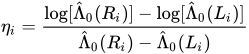
eta Subscript i Baseline equals StartFraction log left-bracket ModifyingAbove normal upper Lamda With caret Subscript 0 Baseline left-parenthesis upper R Subscript i Baseline right-parenthesis right-bracket minus log left-bracket ModifyingAbove normal upper Lamda With caret Subscript 0 Baseline left-parenthesis upper L Subscript i Baseline right-parenthesis right-bracket Over ModifyingAbove normal upper Lamda With caret Subscript 0 Baseline left-parenthesis upper R Subscript i Baseline right-parenthesis minus ModifyingAbove normal upper Lamda With caret Subscript 0 Baseline left-parenthesis upper L Subscript i Baseline right-parenthesis EndFraction

and where eta Subscript i Baseline equals 0 if upper R Subscript i Baseline equals normal infinity and eta Subscript i Baseline equals normal infinity if upper L Subscript i Baseline equals 0.

You can request deviance residuals in an output data set by using the keyword RESDEV in the OUTPUT statement.

The ICPHREG procedure computes the length of input intervals. For the ith subject whose observed interval is left-parenthesis upper L Subscript i Baseline comma upper R Subscript i Baseline right-parenthesis, the length is defined as

StartLayout 1st Row  normal upper L normal e normal n Subscript i Baseline equals StartLayout Enlarged left-brace 1st Row 1st Column upper R Subscript i Baseline minus upper L Subscript i Baseline 2nd Column normal i normal f upper R Subscript i Baseline greater-than-or-equal-to upper L Subscript i Baseline greater-than 0 2nd Row 1st Column upper R Subscript i Baseline 2nd Column normal i normal f upper R Subscript i Baseline greater-than 0 normal a normal n normal d upper L Subscript i Baseline equals 0 normal o normal r upper L Subscript i Baseline normal i normal s normal m normal i normal s normal s normal i normal n normal g 3rd Row 1st Column negative 1 2nd Column normal o normal t normal h normal e normal r normal w normal i normal s normal e EndLayout EndLayout

You can request interval lengths in an output data set by using the keyword INTERVAL in the OUTPUT statement.

Last updated: March 08, 2022