The PHREG Procedure
Diagnostics Based on Weighted Residuals
ZPH Diagnostics
The vector of weighted Schoenfeld residuals,  ,
is computed as
,
is computed as

where  is the total number of events and
  is the vector of Schoenfeld residuals at event time
  . The components of are output to the WTRESSCH= variables in the OUTPUT statement.
The weighted Schoenfeld residuals are useful in assessing the proportional hazards assumption. The idea is that most of the common alternatives to the proportional hazards can be cast in terms of a time-varying coefficient model,

where  and
and  are hazard rates. Let
  and
and  be the jth component of
  and , respectively. Grambsch and Therneau (1994) suggest using a smoothed plot of (
 ) versus to discover the functional form of the time-varying coefficient
  . A zero slope indicates that the coefficient does not vary with time.
DFBETA Diagnostics
The weighted score residuals
are used more often than their unscaled counterparts in assessing local influence.
Let  be the estimate of
  when the ith subject is left out, and let
 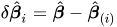 . The jth component of
  can be used to assess any untoward effect of the ith subject on . The exact computation of involves refitting the model each time a subject is omitted. Cain and Lange (1984) derived the following approximation of
  as weighted score residuals:

Here,  is the vector of the score residuals for the ith subject. Values of are output to the DFBETA= variables. Again, when the counting process MODEL specification is used, the DFBETA= variables contain the component
  , where the score process
  is defined in the section Residuals. The vector for the ith subject can be obtained by summing these components within the subject.
Note that these DFBETA statistics are a transform of the score residuals. In computing the robust sandwich variance estimators of Lin and Wei (1989) and Wei, Lin, and Weissfeld (1989), it is more convenient to use the DFBETA statistics than the score residuals (see Example 92.10).