The PHREG Procedure
Time-Dependent ROC Curves
In the context of logistic regression with binary outcomes, receiver operator characteristic (ROC) curves and AUC (area under the ROC curve) statistics are commonly used to assess the ability of the model to discriminate between the two outcomes. To adapt the concept of ROC curves to the survival setting, various definitions and estimators of time-dependent ROC curves and AUC functions have been proposed. See Blanche, Latouche, and Viallon (2013) for a comprehensive survey of different methods. Time-dependent ROC curves and AUC functions characterize how well the fitted model can distinguish between subjects who experience an event from subjects who are event-free.
Whereas C-statistics provide overall measures of predictive accuracy, time-dependent ROC curves and AUC functions summarize the predictive accuracy at specific times. In practice, it is common to use several time points within the support of the observed event times.
Let T denote the event-time variable, and let Y denote the continuous variable to be assessed. At time t, a binary outcome can be defined as follows:

Suppose c denotes a specific value within the support of Y. The sensitivity (SE) and specificity (SP) can be defined as


The ROC curve at time t is defined to be

This definition is often referred to as the "cumulative/dynamic" ROC curve in the literature. "Cumulative" means all events that occurred before time t are considered as "cases." Other types of time-dependent ROC curves are available in the literature—for example, in Heagerty and Zheng (2005).
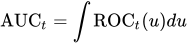
The AUC statistic at time t is the area under the ROC curve at time t:
Let  denote the vector of regression parameters. For the ith individual (
 ), let
  and
and  be the observed time, event indicator (1 for death and 0 for censored), and covariate vector, respectively. Let
  denote the maximum partial likelihood estimates of . The estimated linear predictor for the ith individual is
  . PROC PHREG supports the approaches that are described in the following sections for estimating time-dependent ROC curves.
Inverse Probability of Censoring Weighting Approach
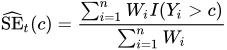
Let  be the Kaplan-Meier estimate of the censoring distribution (assuming no covariates). Assuming that the censoring distribution is independent of the failure time distribution, the sensitivity and specificity under a specific threshold value c can be consistently estimated by


 can be estimated by substituting in these estimated sensitivities and specificities. The estimated
  is calculated by using the trapezoidal rule to integrate the estimated curve.
Uno et al. (2007) propose estimating the standard errors of the estimator by using the perturbation-resampling method. Let  be a set of independent samples from an exponential distribution with mean of 1 and variance of 1. The perturbed versions of
  and
and  are
are


where  and
and  represent the perturbed versions of
  and . is calculated as

where  and
and  is a consistent estimator of the cumulative hazard function for the censoring time variable. is calculated as

where  is the estimated variance-covariance matrix of divided by n and
  is the partial likelihood contribution from the ith individual.
The perturbed estimate is obtained by substituting in the perturbed sensitivities and specificities. Suppose  is the sample variance based on M realizations of the perturbed . The
  % confidence limits for are
 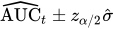 , where
  is the estimated and
  is the upper
  percentile of the standard normal distribution.
To choose this method of computing the time-dependent ROC curve, specify METHOD=IPCW in the ROCOPTIONS option in the PROC PHREG statement.
Note: This perturbation approach of estimating the standard error of the statistic does not apply to a model that is specified by the PRED= option or SOURCE= option in an ROC statement.
Conditional Kaplan-Meier Approach
By using Bayes’ theorem, sensitivity and the specificity can be written as


where  is the survivor function and
  is the conditional survivor function for
  .
.
Heagerty, Lumley, and Pepe (2000) use the Kaplan-Meier method to estimate the survivor function  and the conditional survivor function
  . The latter was estimated using subjects where the condition is met. The sensitivity and the specificity are estimated by

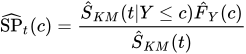
where  is the Kaplan-Meier estimator and
  .
.
To choose this method of computing ROC curves, specify METHOD=KM in the ROCOPTIONS in the PROC PHREG statement.
Nearest Neighbors Approach
Following Akritas (1994), the bivariate survival function,  , can be estimated by

where 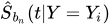 is a smoothed estimate of the conditional survival function. Define the weighted Kaplan-Meier estimator as

where  is a kernel function that depends on the parameter
  . Akritas (1994) uses the nearest neighbor kernel,
  , where
  ; this effectively selects the nearest
  proportion of observations in the neighborhood. The default value for is 0.05. You can specify a different value by using the SPAN= suboption in METHOD=NNE in the ROCOPTIONS option in the PHREG statement.
The sensitivity and specificity can then be estimated as
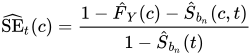
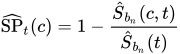
where  . For more information, see Heagerty, Lumley, and Pepe (2000).
To choose this method of computing time-dependent ROC curves, specify METHOD=NNE in the ROCOPTIONS option in the PROC PHREG statement.
Recursive Approach
Chambless and Diao (2006) propose estimating time-dependent ROC curves by using a recursive approach akin to the Kaplan-Meier method. Let  be the distinct event times in the data. The area under the curve at time
  , can be derived as

where is the survivor function,  is the hazard function,
  ,
,  , and
, and


In a recursive fashion, the sensitivity and specificity at time  can be shown to be


where  .
.
Define  to be the risk set at time
  , and let
  be the number of subjects in . Let
  be the covariate vector for the subject whose event time is . The unknown parameters
  ,
,  , and
, and  can be estimated by
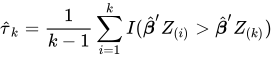


When there is only one event at each event time,  is estimated by
 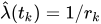 and
and  is estimated by the Kaplan-Meier method as
  . In the case of a tie, the order of the events in the calculation is the same as the order of their appearance in the input data set.
To choose this method of computing time-dependent ROC curves, specify METHOD=RECURSIVE in the ROCOPTIONS option in the PROC PHREG statement.
Weighted Kernel Kaplan-Meier Approach
Let  denote the conditional survival function of
  given
given  . For the ith subject, define the weight
  to be the probability of being a nonsurvivor at time
  . Table 15 displays how can be computed.
Table 15: Probability of Being a Nonsurvivor for the ith Subject
 |
Status |
|
|---|---|---|
 |
 or or  |
0 |
 |
|
1 |
 |
|
0 |
 |
|

|
You can estimate  by using a kernel-based Kaplan-Meier-type method:
where is a kernel function that depends on the parameter . PROC PHREG uses the nearest-neighbors kernel, , where ; this effectively selects the nearest proportion of observations in the neighborhood. The default value for is 0.05. You can specify a different value by using the SPAN= suboption of the METHOD=WKKM option, which you specify in the ROCOPTIONS option in the PHREG statement.
At time , you can estimate the sensitivity and specificity as