The ACECLUS Procedure
PROC ACECLUS Statement
PROC ACECLUS PROPORTION=p THRESHOLD=t <options>;
The PROC ACECLUS statement invokes the ACECLUS procedure. Table 2 summarizes the options available in the PROC ACECLUS statement. These options are also discussed in the following sections. Note that, if you specify the METHOD=COUNT option, you must specify either the PROPORTION= or the MPAIRS= option. Otherwise, you must specify either the PROPORTION= or THRESHOLD= option.
Table 2: Summary of PROC ACECLUS Statement Options
| Options | Description |
|---|---|
| Specify Clustering Options | |
| METHOD= | Specifies the clustering method |
| MPAIRS= | Specifies number of pairs for estimating within-cluster covariance (when you specify the option METHOD=COUNT) |
| PROPORTION= | Specifies proportion of pairs for estimating within-cluster covariance |
| THRESHOLD= | Specifies the threshold for including pairs in the estimation of the within-cluster covariance |
| Specify Input and Output Data Sets | |
| DATA= | Specifies input data set name |
| OUT= | Specifies output data set name |
| OUTSTAT= | Specifies output data set name containing various statistics |
| Specify Iteration Options | |
| ABSOLUTE | Uses absolute instead of relative threshold |
| CONVERGE= | Specifies convergence criterion |
| INITIAL= | Specifies initial estimate of within-cluster covariance matrix |
| MAXITER= | Specifies maximum number of iterations |
| METRIC= | Specifies metric in which computations are performed |
| SINGULAR= | Specifies singularity criterion |
| Specify Canonical Analysis Options | |
| N= | Specifies number of canonical variables |
| PREFIX= | Specifies prefix for naming canonical variables |
| Control Displayed Output | |
| NOPRINT | Suppresses the display of the output |
| PLOTS= | Specifies ODS Graphics details |
| PP | Produces a P-P plot of distances between pairs from last iteration |
| Produces a Q-Q plot of power transformation of distances between pairs from last iteration | |
| SHORT | Omits all output except for iteration history and eigenvalue table |
The following list provides details about the options.
- ABSOLUTE
causes the THRESHOLD= value or the threshold computed from the PROPORTION= option to be treated absolutely rather than relative to the root mean square distance between observations. Use the ABSOLUTE option only when you are confident that the initial estimate of the within-cluster covariance matrix is close to the final estimate, such as when the INITIAL= option specifies a data set created by a previous execution of PROC ACECLUS by using the OUTSTAT= option.
- CONVERGE=c
specifies the convergence criterion. By default, CONVERGE= 0.001. Iteration stops when the convergence measure falls below the value specified by the CONVERGE= option or when the iteration limit as specified by the MAXITER= option is exceeded, whichever happens first.
- DATA=SAS-data-set
specifies the SAS data set to be analyzed. By default, PROC ACECLUS uses the most recently created SAS data set.
- INITIAL=name
-
specifies the matrix for the initial estimate of the within-cluster covariance matrix. Valid values for name are as follows:
- DIAGONAL | D
uses the diagonal matrix of sample variances as the initial estimate of the within-cluster covariance matrix.
- FULL | F
uses the total-sample covariance matrix as the initial estimate of the within-cluster covariance matrix.
- IDENTITY | I
uses the identity matrix as the initial estimate of the within-cluster covariance matrix.
- INPUT=SAS-data-set
specifies a SAS data set from which to obtain the initial estimate of the within-cluster covariance matrix. The data set can be TYPE=CORR, COV, UCORR, UCOV, SSCP, or ACE, or it can be an ordinary SAS data set. See Appendix A, Special SAS Data Sets, for descriptions of CORR, COV, UCORR, UCOV, and SSCP data sets. See the section Output Data Sets for a description of ACE data sets.
If you do not specify the INITIAL= option, the default is the matrix specified by the METRIC= option. If neither the INITIAL= nor the METRIC= option is specified, INITIAL=FULL is used if there are enough observations to obtain a nonsingular total-sample covariance matrix; otherwise, INITIAL=DIAGONAL is used.
- MAXITER=n
specifies the maximum number of iterations. By default, MAXITER=10.
- METHOD=COUNT | C | THRESHOLD | T
specifies the clustering method. The METHOD=THRESHOLD option requests a method (also the default) that uses all pairs closer than a given cutoff value to form the estimate at each iteration. The METHOD=COUNT option requests a method that uses a number of pairs, m, with the smallest distances to form the estimate at each iteration.
- METRIC=name
-
specifies the metric in which the computations are performed, implies the default value for the INITIAL= option, and specifies the matrix
 used in the formula for the convergence measure
  and for checking singularity of the
  matrix. Valid values for name are as follows:
 - DIAGONAL | D
uses the diagonal matrix of sample variances diag
 and sets
 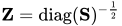 , where the superscript
  indicates an inverse factor.
 - FULL | F
uses the total-sample covariance matrix
 and sets
  .
. - IDENTITY | I
uses the identity matrix
 and sets
  .
.
If you do not specify the METRIC= option, METRIC=FULL is used if there are enough observations to obtain a nonsingular total-sample covariance matrix; otherwise, METRIC=DIAGONAL is used.
The option METRIC= is rather technical. It affects the computations in a variety of ways, but for well-conditioned data the effects are subtle. For most data sets, the METRIC= option is not needed.
- MPAIRS=m
specifies the number of pairs to be included in the estimation of the within-cluster covariance matrix when METHOD=COUNT is requested. The values of m must be greater than 0 but less than or equal to (totfq
 (totfq –1)) / 2, where totfq is the sum of nonmissing frequencies specified in the FREQ statement. If there is no FREQ statement, totfq equals the number of total nonmissing observations.
 - N=n
specifies the number of canonical variables to be computed. The default is the number of variables analyzed. N=0 suppresses the canonical analysis.
- NOPRINT
suppresses the display of all output. Note that this option temporarily disables the Output Delivery System (ODS). For more information, see Chapter 23, Using the Output Delivery System.
- OUT=SAS-data-set
creates an output SAS data set that contains all the original data as well as the canonical variables having an estimated within-cluster covariance matrix equal to the identity matrix. If you want to create a SAS data set in a permanent library, you must specify a two-level name. For more information about permanent libraries and SAS data sets, see SAS Programmers Guide: Essentials.
- OUTSTAT=SAS-data-set
specifies a TYPE=ACE output SAS data set that contains means, standard deviations, number of observations, covariances, estimated within-cluster covariances, eigenvalues, and canonical coefficients. If you want to create a SAS data set in a permanent library, you must specify a two-level name. For more information about permanent libraries and SAS data sets, see SAS Programmers Guide: Essentials.
-
PLOTS <=plot-request>
PLOTS <=(plot-request <…plot-request>)> -
specifies options that control the details of the plots. When you specify only one plot request, you can omit the parentheses.
ODS Graphics must be enabled before plots can be requested. For example:
ods graphics on;

proc aceclus plots=all;
   var _numeric_;
run;

ods graphics off;
For more information about enabling and disabling ODS Graphics, see the section Enabling and Disabling ODS Graphics in Chapter 24, Statistical Graphics Using ODS.
The plot-requests include the following:
When ODS Graphics is not enabled, you can specify the PP and QQ options (but not PLOTS=(PP QQ)) to create printer plots.
By default, no plots are produced.
-
PROPORTION=p
PERCENT=p
P=p -
specifies the percentage of pairs to be included in the estimation of the within-cluster covariance matrix. The value of p must be greater than 0. If p is greater than or equal to 1, it is interpreted as a percentage and divided by 100; PROPORTION=0.02 and PROPORTION=2 are equivalent. When you specify METHOD=THRESHOLD, a threshold value is computed from the PROPORTION= option under the assumption that the observations are sampled from a multivariate normal distribution.
When you specify METHOD=COUNT, the number of pairs, m, is computed from PROPORTION=p as

where totfq is the number of total nonmissing observations.
- PP
produces a P-P plot of distances between pairs of observations computed in the last iteration.
- PREFIX=name
specifies a prefix for naming the canonical variables. By default the names are
Can1,Can2, …,CANN.If you specify PREFIX=ABC, the variables are namedABC1,ABC2,ABC3, and so on. The number of characters in the prefix plus the number of digits required to designate the variables should not exceed the name length defined by the VALIDVARNAME= system option. For more information about the VALIDVARNAME= system option, see SAS System Options: Reference.produces a Q-Q plot of a power transformation of the distances between pairs of observations computed in the last iteration. Caution: The Q-Q plot can require an enormous amount of computer time.
- SHORT
omits all items from the standard output except for the iteration history and the eigenvalue table.
-
SINGULAR=g
SING=g specifies a singularity criterion 0 < g < 1 for the total-sample covariance matrix
and the approximate within-cluster covariance estimate . The default is SINGULAR=1E–4. -
THRESHOLD=t
T=t specifies the threshold for including pairs of observations in the estimation of the within-cluster covariance matrix. A pair of observations is included if the Euclidean distance between them is less than or equal to t times the root mean square distance computed over all pairs of observations.