The BGLIMM Procedure
Multinomial Models
The BGLIMM procedure fits two kinds of models to multinomial data: one that has a cumulative link that applies to ordinal data, and one that has a generalized logit link that applies to nominal data.
PROC BGLIMM models the proportional-odds cumulative probabilities for ordinal data. This model uses cumulative probabilities up to a threshold, thereby making the whole range of ordinal categories binary at that threshold. If the nominal response has J categories and the ordering is natural, the associated probabilities are  , and a cumulative probability of a response less than equal to j is

This describes the log odds of two cumulative probabilities: a less-than type and a greater-than type. This measures how likely the response is to be in category j or below, or how likely it is to be in a category higher than j.
The linear predictor depends on the response category only through the intercepts (cutoffs)  ,
,
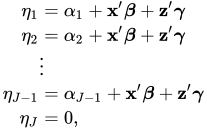
where  to ensure the cumulative property and
  remains the same across all levels of the response variable. The cumulative logits are formed as

The odds ratio that compares two conditions represented by the linear predictors  and
and  is then
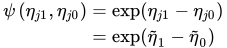
and is independent of category. You might think of this as a set of parallel lines (or hyperplanes) with different intercepts. The proportional-odds condition forces the lines that correspond to each cumulative logit to be parallel.
In the generalized logit model, you model baseline-category logits. By default, the BGLIMM procedure chooses the last category as the baseline category or reference, but you can use another category as the reference. If the nominal response has J categories, both the fixed effects and the random effects in the linear predictor depend on the response category:
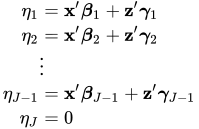
The last category defaults to zero in order to ensure the estimability property. The baseline-category logit for category j is

and
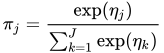
Suppose that the two conditions to be compared are identified using subscripts 1 and 0. The log odds ratio of outcome j versus J for the two conditions is then

Note that the log odds ratios are again differences on the scale of the linear predictor, but they depend on the response category. The BGLIMM procedure determines the estimable functions whose differences represent log odds ratios, but it produces separate estimates for each nonreference response category.