The CALIS Procedure
Output Data Sets
OUTEST= Data Set
The OUTEST= (or OUTVAR=) data set is of TYPE=EST and contains the final parameter estimates, the gradient, the Hessian, and boundary and linear constraints. For METHOD=ML (with or without the ROBUST option), METHOD=FIML, METHOD=GLS, and METHOD=WLS, the OUTEST= data set also contains the approximate standard errors, the information matrix (crossproduct Jacobian), and the approximate covariance matrix of the parameter estimates ((generalized) inverse of the information matrix). If there are linear or nonlinear equality or active inequality constraints at the solution, the OUTEST= data set also contains Lagrange multipliers, the projected Hessian matrix, and the Hessian matrix of the Lagrange function.
The OUTEST= data set can be used to save the results of an optimization by PROC CALIS for another analysis with either PROC CALIS or another SAS procedure. Saving results to an OUTEST= data set is advised for expensive applications that cannot be repeated without considerable effort.
The OUTEST= data set contains the BY variables, two character variables _TYPE_ and _NAME_, t numeric variables corresponding to the parameters used in the model, a numeric variable _RHS_ (right-hand side) that is used for the right-hand-side value  of a linear constraint or for the value
  of the objective function at the final point
  of the parameter space, and a numeric variable
 _ITER_ that is set to zero for initial values, set to the iteration number for the OUTITER output, and set to missing for the result output.
The _TYPE_ observations in Table 1 are available in the OUTEST= data set, depending on the request.
Table 1: _TYPE_ Observations in the OUTEST= Data Set
_TYPE_ |
Description | ||||||||||
|---|---|---|---|---|---|---|---|---|---|---|---|
| ACTBC |
If there are active boundary constraints at the solution
|
||||||||||
| COV | Contains the approximate covariance matrix of the parameter estimates; used in computing the approximate standard errors. | ||||||||||
| COVRANK | contains the rank of the covariance matrix of the parameter estimates. | ||||||||||
| CRPJ_LF | Contains the Hessian matrix of the Lagrange function (based on CRPJAC). | ||||||||||
| CRPJAC | Contains the approximate Hessian matrix used in the optimization process. This is the inverse of the information matrix. | ||||||||||
| EQ | If linear constraints are used, this observation contains the ith linear constraint 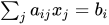 . The parameter variables contain the coefficients . The parameter variables contain the coefficients  , ,  , the , the _RHS_ variable contains , and _NAME_=ACTLC or _NAME_=LDACTLC. |
||||||||||
| GE | If linear constraints are used, this observation contains the ith linear constraint 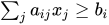 . The parameter variables contain the coefficients , , and the . The parameter variables contain the coefficients , , and the _RHS_ variable contains . If the constraint i is active at the solution , then _NAME_=ACTLC or _NAME_=LDACTLC. |
||||||||||
| GRAD | Contains the gradient of the estimates. | ||||||||||
| GRAD_LF | Contains the gradient of the Lagrange function. The _RHS_ variable contains the value of the Lagrange function. |
||||||||||
| HESSIAN | Contains the Hessian matrix. | ||||||||||
| HESS_LF | Contains the Hessian matrix of the Lagrange function (based on HESSIAN). | ||||||||||
| INFORMAT | Contains the information matrix of the parameter estimates (only for METHOD=ML, METHOD=GLS, or METHOD=WLS). | ||||||||||
| INITGRAD | Contains the gradient of the starting estimates. | ||||||||||
| INITIAL | Contains the starting values of the parameter estimates. | ||||||||||
| JACNLC | Contains the Jacobian of the nonlinear constraints evaluated at the final estimates. | ||||||||||
| LAGM BC |
Contains Lagrange multipliers for masks and active boundary constraints.
|
||||||||||
| LAGM LC |
Contains Lagrange multipliers for linear equality and active inequality constraints in pairs of observations containing the constraint number and the value of the Lagrange multiplier.
|
||||||||||
| LAGM NLC |
contains Lagrange multipliers for nonlinear equality and active inequality constraints in pairs of observations that contain the constraint number and the value of the Lagrange multiplier.
|
||||||||||
| LE | If linear constraints are used, this observation contains the ith linear constraint 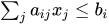 . The parameter variables contain the coefficients , , and the . The parameter variables contain the coefficients , , and the _RHS_ variable contains . If the constraint i is active at the solution , then _NAME_=ACTLC or _NAME_=LDACTLC. |
||||||||||
| LOWERBD | LB |
If boundary constraints are used, this observation contains the lower bounds. Those parameters not subjected to lower bounds contain missing values. The _RHS_ variable contains a missing value, and the _NAME_ variable is blank. |
||||||||||
| NACTBC | All parameter variables contain the number  of active boundary constraints at the solution . The of active boundary constraints at the solution . The _RHS_ variable contains a missing value, and the _NAME_ variable is blank. |
||||||||||
| NACTLC | All parameter variables contain the number  of active linear constraints at the solution that are recognized as linearly independent. The of active linear constraints at the solution that are recognized as linearly independent. The _RHS_ variable contains a missing value, and the _NAME_ variable is blank. |
||||||||||
| NLC_EQ NLC_GE NLC_LE |
Contains values and residuals of nonlinear constraints. The
|
||||||||||
| NLDACTBC | Contains the number of active boundary constraints at the solution that are recognized as linearly dependent. The _RHS_ variable contains a missing value, and the _NAME_ variable is blank. |
||||||||||
| NLDACTLC | Contains the number of active linear constraints at the solution that are recognized as linearly dependent. The _RHS_ variable contains a missing value, and the _NAME_ variable is blank. |
||||||||||
| _NOBS_ | Contains the number of observations. | ||||||||||
| PARMS | Contains the final parameter estimates. The _RHS_ variable contains the value of the objective function. |
||||||||||
| PCRPJ_LF | Contains the projected Hessian matrix of the Lagrange function (based on CRPJAC). | ||||||||||
| PHESS_LF | Contains the projected Hessian matrix of the Lagrange function (based on HESSIAN). | ||||||||||
| PROJCRPJ | Contains the projected Hessian matrix (based on CRPJAC). | ||||||||||
| PROJGRAD | If linear constraints are used in the estimation, this observation contains the  values of the projected gradient values of the projected gradient  in the variables corresponding to the first in the variables corresponding to the first  parameters. The parameters. The _RHS_ variable contains a missing value, and the _NAME_ variable is blank. |
||||||||||
| PROJHESS | Contains the projected Hessian matrix (based on HESSIAN). | ||||||||||
| STDERR | Contains approximate standard errors (only for METHOD=ML, METHOD=GLS, or METHOD=WLS). | ||||||||||
| TERMINAT | The _NAME_ variable contains the name of the termination criterion. |
||||||||||
| UPPERBD | UB |
If boundary constraints are used, this observation contains the upper bounds. Those parameters not subjected to upper bounds contain missing values. The _RHS_ variable contains a missing value, and the _NAME_ variable is blank. |
If the technique specified by the OMETHOD= option cannot be performed (for example, no feasible initial values can be computed or the function value or derivatives cannot be evaluated at the starting point), the OUTEST= data set can contain only some of the observations (usually only the PARMS and GRAD observations).
OUTMODEL= or OUTRAM= Data Set
The OUTMODEL= (or OUTRAM=) data set is of TYPE=CALISMDL and contains the model specification, the computed parameter estimates, and the standard error estimates. This data set is intended to be reused as an INMODEL= data set to specify good initial values in a subsequent analysis by PROC CALIS.
The OUTMODEL= data set contains the following variables:
the BY variables, if any
an
_MDLNUM_variable for model numbers, if useda character variable
_TYPE_, which takes various values that indicate the type of model specificationa character variable
_NAME_, which indicates the model type, parameter name, or variable namea character variable
_MATNR_, which indicates the matrix number (COSAN models only)a character variable
_VAR1_, which is the name or number of the first variable in the specificationa character variable
_VAR2_, which is the name or number of the second variable in the specificationa numerical variable
_ESTIM_for the final estimate of the parameter locationa numerical variable
_STDERR_for the standard error estimate of the parameter locationa numerical variable
_SDEST_for the final standardized estimate of the parameter locationa numerical variable
_SDSE_for the standard error of the standardized estimate of the parameter location
Although the _SDEST_ and _SDSE_ variables are created for COSAN models, the values for these two variables are always missing because there are no rules to carry out the standardization of COSAN models.
Each observation (record) of the OUTMODEL= data set contains a piece of information regarding the model specification. Depending on the type of the specification indicated by the value of the _TYPE_ variable, the meanings of _NAME_, _VAR1_, and _VAR2_ differ. The following tables summarize the meanings of the _NAME_, _MATNR_ (COSAN models only), _VAR1_, and _VAR2_ variables for each value of the _TYPE_ variable, given the type of the model.
COSAN Models
_TYPE_= |
Description | _NAME_ |
_MATNR_ |
_VAR1_ |
_VAR2_ |
|---|---|---|---|---|---|
| MDLTYPE | Model type | COSAN | |||
| VAR | Variable | Variable name | Matrix number | Column location | |
| MATRIX | Matrix | Matrix name | Matrix number | Number of rows | Number of columns |
| MODEL | Model formula | COV or MEAN | Matrix number | Term number | Location in term |
| ESTIM | Parameters | Parameter name | Matrix number | Row number | Column number |
The value of the _NAME_ variable is COSAN for the _TYPE_=MDLTYPE observation.
The _TYPE_=VAR observations store the information about the column variables in matrices. The _NAME_ variable stores the variable names. The value of _VAR1_ indicates the column location of the variable in the matrix with the matrix number stored in _MATNR_.
The _TYPE_=MATRIX observations store the information about the model matrices. The _NAME_ variable stores the matrix names. The value of _MATNR_ indicates the corresponding matrix number. The values of_VAR1_ and _VAR2_ indicates the numbers of rows and columns, respectively, of the matrix.
The _TYPE_=MODEL observations store the covariance and mean structure formulas. The _NAME_ variable indicates whether the mean (MEAN) or covariance (COV) structure information is stored. The value of _MATNR_ indicates the matrix number in the mean or covariance structure formula. The _VAR1_ variable indicates the term number, and the _VAR2_ variable indicates the location of the matrix in the term.
The _TYPE_=ESTIM observations store the information about the parameters and their estimates. The _NAME_ variable stores the parameter names. The value of _MATNR_ indicates the matrix number. The values of _VAR1_ and _VAR2_ indicate the associated row and column numbers, respectively, of the parameter.
FACTOR Models
_TYPE_= |
Description | _NAME_ |
_VAR1_ |
_VAR2_ |
|---|---|---|---|---|
| MDLTYPE | Model type | Model type | ||
| FACTVAR | Variable | Variable name | Variable number | Variable type |
| LOADING | Factor loading | Parameter name | Manifest variable | Factor variable |
| COV | Covariance | Parameter name | First variable | Second variable |
| PVAR | (Partial) variance | Parameter name | Variable | |
| MEAN | Mean or intercept | Parameter name | Variable | |
| ADDCOV | Added covariance | Parameter name | First variable | Second variable |
| ADDPVAR | Added (partial) variance | Parameter name | Variable | |
| ADDMEAN | Added mean or intercept | Parameter name | Variable |
For factor models, the value of the _NAME_ variable is either EFACTOR (exploratory factor model) or CFACTOR (confirmatory factor model) for the _TYPE_=MDLTYPE observation.
The _TYPE_=FACTVAR observations store the information about the variables in the model. The _NAME_ variable stores the variable names. The value of _VAR1_ indicates the variable number. The value of _VAR2_ indicates the type of the variable: either DEPV for dependent observed variables or INDF for latent factors.
Other observations specify the parameters and their estimates in the model. The _NAME_ values for these observations are the parameter names. Observation with _TYPE_=LOADING, _TYPE_=COV, or _TYPE_=ADDCOV are for parameters that are associated with two variables. The _VAR1_ and _VAR2_ values of these two types of observations indicate the variables involved.
Observations with _TYPE_=PVAR, _TYPE_=MEAN, _TYPE_=ADDPVAR, or _TYPE_=ADDMEAN are for parameters that are associated with a single variable. The value of _VAR1_ indicates the variable involved.
LINEQS Models
_TYPE_= |
Description | _NAME_ |
_VAR1_ |
_VAR2_ |
|---|---|---|---|---|
| MDLTYPE | Model type | LINEQS | ||
| EQSVAR | Variable | Variable name | Variable number | Variable type |
| EQUATION | Path coefficient | Parameter | Outcome variable | Predictor variable |
| COV | Covariance | Parameter | First variable | Second variable |
| VARIANCE | Variance | Parameter | Variable | |
| MEAN | Mean | Parameter | Variable | |
| ADDCOV | Added covariance | Parameter | First variable | Second variable |
| ADDVARIA | Added variance | Parameter | Variable | |
| ADDINTE | Added intercept | Parameter | Variable | |
| ADDMEAN | Added mean | Parameter | Variable |
The value of the _NAME_ variable is LINEQS for the _TYPE_=MDLTYPE observation.
The _TYPE_=EQSVAR observations store the information about the variables in the model. The _NAME_ variable stores the variable names. The value of _VAR1_ indicates the variable number. The value of _VAR2_ indicates the type of the variable. There are six types of variables in the LINEQS model:
DEPVfor dependent observed variablesINDVfor independent observed variablesDEPFfor dependent latent factorsINDFfor independent latent factorsINDDfor independent error termsINDEfor independent disturbance terms
Other observations specify the parameters and their estimates in the model. The _NAME_ values for these observations are the parameter names. Observation with _TYPE_=EQUATION, _TYPE_=COV, or _TYPE_=ADDCOV are for parameters that are associated with two variables. The _VAR1_ and _VAR2_ values of these two types of observations indicate the variables involved.
Observations with _TYPE_=VARIANCE, _TYPE_=MEAN, _TYPE_=ADDVARIA, _TYPE_=ADDINTE, or _TYPE_=ADDMEAN are for parameters associated with a single variable. The value of _VAR1_ indicates the variable involved.
LISMOD Models
_TYPE_= |
Description | _NAME_ |
_VAR1_ |
_VAR2_ |
|---|---|---|---|---|
| MDLTYPE | model type | LISMOD | ||
| XVAR |  -variable -variable |
Variable | Variable number | |
| YVAR |  -variable -variable |
Variable | Variable number | |
| ETAVAR |  -variable -variable |
Variable | Variable number | |
| XIVAR |  -variable -variable |
Variable | Variable number | |
| ALPHA | _ALPHA_ entry | Parameter | Row number | |
| BETA | _BETA_ entry | Parameter | Row number | Column number |
| GAMMA | _BETA_ entry | Parameter | Row number | Column number |
| KAPPA | _KAPPA_ entry | Parameter | Row number | |
| LAMBDAX | _LAMBDAX_ entry | Parameter | Row number | Column number |
| LAMBDAY | _LAMBDAY_ entry | Parameter | Row number | Column number |
| NUX | _NUX_ entry | Parameter | Row number | |
| NUY | _NUY_ entry | Parameter | Row number | |
| PHI | _PHI_ entry | Parameter | Row number | Column number |
| PSI | _PSI_ entry | Parameter | Row number | Column number |
| THETAX | _THETAX_ entry | Parameter | Row number | Column number |
| THETAY | _THETAY_ entry | Parameter | Row number | Column number |
| ADDALPHA | Added _ALPHA_ entry | Parameter | Row number | |
| ADDKAPPA | Added _KAPPA_ entry | Parameter | Row number | |
| ADDNUX | Added _NUX_ entry | Parameter | Row number | |
| ADDNUY | Added _NUY_ entry | Parameter | Row number | |
| ADDPHI | Added _PHI_ entry | Parameter | Row number | Column number |
| ADDPSI | Added _PSI_ entry | Parameter | Row number | Column number |
| ADTHETAX | Added _THETAX_ entry | Parameter | Row number | Column number |
| ADTHETAY | Added _THETAY_ entry | Parameter | Row number | Column number |
The value of the _NAME_ variable is LISMOD for the _TYPE_=MDLTYPE observation. Other observations specify either the variables or the parameters in the model.
Observations with _TYPE_ values equal to XVAR, YVAR, ETAVAR, and XIVAR indicate the variables in the respective lists in the model. The _NAME_ variable of these observations stores the names of the variables, and the _VAR1_ variable stores the variable numbers in the respective list. The variable numbers in this data set are not arbitrary—that is, they define the variable orders in the rows and columns of the LISMOD model matrices. The _VAR2_ variable of these observations is not used.
All other observations in this data set specify the parameters in the model. The _NAME_ values of these observations are the parameter names. The corresponding _VAR1_ and _VAR2_ values of these observations indicate the row and column locations of the parameters in the LISMOD model matrices that are specified in the _TYPE_ variable. For example, when the value of _TYPE_ is ADDPHI or PHI, the parameter specified is located in the _PHI_ matrix, with its row and column numbers indicated by the _VAR1_ and _VAR2_ values, respectively. Some observations for specifying parameters do not have values in the _VAR2_ variable. This means that the associated LISMOD matrices are vectors so that the column numbers are always 1 for these observations.
MSTRUCT Models
_TYPE_= |
Description | _NAME_ |
_VAR1_ |
_VAR2_ |
|---|---|---|---|---|
| MDLTYPE | Model type | MSTRUCT | ||
| VAR | Variable | Variable | Variable number | |
| COVMAT | Covariance | Parameter | Row number | Column number |
| MEANVEC | Mean | Parameter | Row number | |
| ADCOVMAT | Added covariance | Parameter | Row number | Column number |
| AMEANVEC | Added mean | Parameter | Row number |
The value of the _NAME_ variable is MSTRUCT for the _TYPE_=MDLTYPE observation. Other observations specify either the variables or the parameters in the model.
Observations with _TYPE_ values equal to VAR indicate the variables in the model. The _NAME_ variable of these observations stores the names of the variables, and the _VAR1_ variable stores the variable numbers in the variable list. The variable numbers in this data set are not arbitrary—that is, they define the variable orders in the rows and columns of the mean and covariance matrices. The _VAR2_ variable of these observations is not used.
All other observations in this data set specify the parameters in the model. The _NAME_ values of these observations are the parameter names. The corresponding _VAR1_ and _VAR2_ values of these observations indicate the row and column locations of the parameters in the mean or covariance matrix, as specified in the _TYPE_ model. For example, when _TYPE_=COVMAT, the parameter specified is located in the covariance matrix, with its row and column numbers indicated by the _VAR1_ and _VAR2_ values, respectively. For observations with _TYPE_=MEANVEC, the _VAR2_ variable is not used because the column numbers are always 1 for parameters in the mean vector.
PATH Models
_TYPE_= |
Description | _NAME_ |
_VAR1_ |
_VAR2_ |
|---|---|---|---|---|
| MDLTYPE | Model type | PATH | ||
| PATHVAR | Variable | Variable name | Variable number | Variable type |
| LEFT | Path coefficient | Parameter | Outcome variable | Predictor variable |
| RIGHT | Path coefficient | Parameter | Predictor variable | Outcome variable |
| PCOV | (Partial) covariance | Parameter | First variable | Second variable |
| PCOVPATH | (Partial) covariance path | Parameter | First variable | Second variable |
| PVAR | (Partial) variance | Parameter | Variable | |
| PVARPATH | (Partial) variance path | Parameter | Variable | Variable |
| MEAN | Mean or intercept | Parameter | Variable | |
| ONEPATH | Mean or intercept path | Parameter | _ONE_ | Variable |
| ADDPCOV | Added (partial) covariance | Parameter | First variable | Second variable |
| ADDPVAR | Added (partial) variance | Parameter | Variable | |
| ADDMEAN | Added mean | Parameter | Variable |
The value of the _NAME_ variable is PATH for the _TYPE_=MDLTYPE observation.
The _TYPE_=PATHVAR observations store the information about the variables in the model. The _NAME_ variable stores the variable names. The value of _VAR1_ indicates the variable number. The value of _VAR2_ indicates the type of the variable. There are four types of variables in the PATH model:
DEPVfor dependent observed variablesINDVfor independent observed variablesDEPFfor dependent latent factorsINDFfor independent latent factors
Other observations specify the parameters in the model. The _NAME_ values for these observations are the parameter names. Observation with _TYPE_=LEFT, _TYPE_=RIGHT, _TYPE_=PCOV, or _TYPE_=ADDPCOV are for parameters that are associated with two variables. The _VAR1_ and _VAR2_ values of these two types of observations indicate the variables involved.
Observations with _TYPE_=PVAR, _TYPE_=MEAN, _TYPE_=ADDPVAR, or _TYPE_=ADDMEAN are for parameters that are associated with a single variable. The value of _VAR1_ indicates the variable involved.
RAM Models
_TYPE_= |
Description | _NAME_ |
_VAR1_ |
_VAR2_ |
|---|---|---|---|---|
| MDLTYPE | Model type | RAM | ||
| RAMVAR | Variable name | Variable | Variable number | Variable type |
| _A_ | _A_ entry |
Parameter | Row number | Column number |
| _P_ | _P_ entry |
Parameter | Row number | Column number |
| _W_ | _W_ entry |
Parameter | Row number | Column number |
| ADD_P_ | Added _P_ entry |
Parameter | Row number | Column number |
| ADD_W_ | Added _W_ entry |
Parameter | Row number | Column number |
The value of the _NAME_ variable is RAM for the _TYPE_=MDLTYPE observation.
For the _TYPE_=RAMVAR observations, the _NAME_ variable stores the variable names, the _VAR1_ variable stores the variable number, and the _VAR2_ variable stores the variable type. There are four types of variables in the PATH model:
DEPVfor dependent observed variablesINDVfor independent observed variablesDEPFfor dependent latent factorsINDFfor independent latent factors
Other observations specify the parameters in the model. The _NAME_ variable stores the parameter name. The _TYPE_ variable indicates the associated matrix with the row number indicated in _VAR1_ and column number indicated in _VAR2_.
Reading an OUTMODEL= Data Set As an INMODEL= Data Set in Subsequent Analyses
When the OUTMODEL= data set is treated as an INMODEL= data set in subsequent analyses, you need to pay attention to observations with _TYPE_ values prefixed by "ADD", "AD", or "A" (for example, ADDCOV, ADTHETAY, or AMEANVEC). These observations represent default parameter locations that are generated by PROC CALIS in a previous run. Because the context of the new analyses might be different, these observations for added parameter locations might no longer be suitable in the new runs. Hence, these observations are not read as input model information. Fortunately, after reading the INMODEL= specification in the new analyses, CALIS analyzes the new model specification again. It then adds an appropriate set of parameters in the new context when necessary. If you are certain that the added parameter locations in the INMODEL= data set are applicable, you can force the input of these observations by using the READADDPARM option in the PROC CALIS statement. However, you must be very careful about using the READADDPARM option. The added parameters from the INMODEL= data set might have the same parameter names as those for the generated parameters in the new run. This might lead to unnecessary constraints in the model.
OUTSTAT= Data Set
The OUTSTAT= data set is similar to the TYPE=COV, TYPE=UCOV, TYPE=CORR, or TYPE=UCORR data set produced by the CORR procedure. The OUTSTAT= data set contains the following variables:
the BY variables, if any
the _GPNUM_ variable for groups numbers, if used in the analysis
two character variables,
_TYPE_and_NAME_the manifest and the latent variables analyzed
The OUTSTAT= data set contains the following information (when available) in the observations:
the mean and standard deviation
the skewness and kurtosis (if the DATA= data set is a raw data set and the KURTOSIS option is specified)
the number of observations
if the WEIGHT statement is used, sum of the weights
the correlation or covariance matrix to be analyzed
the robust covariances, standard deviations, and means for robust estimation
the predicted correlation or covariance matrix
the standardized or normalized residual correlation or covariance matrix
if the model contains latent variables, the predicted covariances between latent and manifest variables and the latent variable (or factor) score regression coefficients (see the PLATCOV option )
In addition, for FACTOR models the OUTSTAT= data set contains:
If effects are analyzed, the OUTSTAT= data set also contains:
direct, indirect, and total effects and their standard error estimates
standardized direct, indirect, and total effects and their standard error estimates
Each observation in the OUTSTAT= data set contains some type of statistic as indicated by the _TYPE_ variable. The values of the _TYPE_ variable are shown in the following tables:
Basic Descriptive Statistics
Value of _TYPE_ |
Contents |
|---|---|
| ADJCOV | Adjusted covariances |
| ADJSTD | Adjusted standard deviations |
| CORR | Correlations |
| COV | Covariances |
| KURTOSIS | Univariate kurtosis |
| MEAN | Means |
| N | Sample size |
| NPARTIAL | Number of partial variables |
| PARTCOV | Covariances after partialling |
| PARTCORR | Correlations after partialling |
| PARTMEAN | Means after partialling |
| PARTSTD | Standard deviations after partialling |
| ROBCOV | Robust covariances |
| ROBMEAN | Robust means |
| ROBSTD | Robust standard deviations |
| SKEWNESS | Univariate skewness |
| STD | Standard deviations |
| SUMWGT | Sum of weights (if the WEIGHT statement is used) |
| VARDIV | Variance divisor |
| VARDIVAJ | Variance divisor adjustment |
For the _TYPE_=CORR or COV observations, the _NAME_ variable contains the name of the manifest variable that corresponds to each row for the covariance or correlation. For other observations, _NAME_ is blank.
Predicted Moments and Residuals
Value of _TYPE_ |
Contents |
|---|---|
| METHOD=DWLS | |
| DWLSPRED | DWLS predicted moments |
| DWLSRES | DWLS raw residuals |
| DWLSSRES | DWLS variance standardized residuals |
| METHOD=GLS | |
| GLSASRES | GLS asymptotically standardized residuals |
| GLSNRES | GLS normalized residuals |
| GLSPRED | GLS predicted moments |
| GLSRES | GLS raw residuals |
| GLSSRES | GLS variance standardized residuals |
| METHOD=ML or FIML | |
| MAXASRES | ML asymptotically standardized residuals |
| MAXNRES | ML normalized residuals |
| MAXPRED | ML predicted moments |
| MAXRES | ML raw residuals |
| MAXSRES | ML variance standardized residuals |
| METHOD=ULS | |
| ULSPRED | ULS predicted moments |
| ULSRES | ULS raw residuals |
| ULSSRES | ULS variance standardized residuals |
| METHOD=WLS | |
| WLSASRES | WLS asymptotically standardized residuals |
| WLSNRES | WLS normalized residuals |
| WLSPRED | WLS predicted moments |
| WLSRES | WLS raw residuals |
| WLSSRES | WLS variance standardized residuals |
For residuals or predicted moments of means, the _NAME_ variable is a fixed value denoted by _Mean_. For residuals or predicted moments for covariances or correlations, the _NAME_ variable is used for names of variables.
Effects and Latent Variable Scores Regression Coefficients
Value of _TYPE_ |
Contents |
|---|---|
| Unstandardized Effects | |
| DEFFECT | Direct effects |
| DEFF_SE | Standard error estimates for direct effects |
| IEFFECT | Indirect effects |
| IEFF_SE | Standard error estimates for indirect effects |
| TEFFECT | Total effects |
| TEFF_SE | Standard error estimates for total effects |
| Standardized Effects | |
| SDEFF | Standardized direct effects |
| SDEFF_SE | Standard error estimates for standardized direct effects |
| SIEFF | Standardized indirect effects |
| SIEFF_SE | Standard error estimates for standardized indirect effects |
| STEFF | Standardized total effects |
| STEFF_SE | Standard error estimates for standardized total effects |
| Latent Variable Scores Coefficients | |
| LSSCORE | Latent variable (or factor) scores regression coefficients for ULS method |
| SCORE | Latent variable (or factor) scores regression coefficients other than ULS method |
For latent variable or factor scores coefficients, the _NAME_ variable contains factor or latent variables in the observations. For other observations, the _NAME_ variable contains manifest or latent variable names.
You can use the latent variable score regression coefficients with PROC SCORE to compute factor scores.
If the analyzed matrix is a covariance rather than a correlation matrix, the _TYPE_=STD observation is not included in the OUTSTAT= data set. In this case, the standard deviations can be obtained from the diagonal elements of the covariance matrix. Dropping the _TYPE_=STD observation prevents PROC SCORE from standardizing the observations before computing the factor scores.
Factor Analysis Results
Value of _TYPE_ |
Contents |
|---|---|
| ERRVAR | Error variances |
| FCOV | Factor correlations or covariances |
| LOADINGS | Unrotated factor loadings |
| RFCOV | Rotated factor correlations or covariances |
| RLOADING | Rotated factor loadings |
| ROTMAT | Rotation matrix |
| STDERVAR | Error variances in standardized solutions |
| STDFCOV | Standardized factor correlations |
| STDLOAD | Standardized factor loadings |
| STDRFCOV | Standardized rotated factor correlations or covariances |
| STDRLOAD | Standardized rotated factor loadings |
For the _TYPE_=ERRVAR observation, the _NAME_ variable is blank. For all other observations, the _NAME_ variable contains factor names.
OUTWGT= Data Set
You can create an OUTWGT= data set that is of TYPE=WEIGHT and contains the weight matrix used in generalized, weighted, or diagonally weighted least squares estimation. The OUTWGT= data set contains the weight matrix on which the WRIDGE= and the WPENALTY= options are applied. However, if you input the inverse of the weight matrix with the INWGT= and INWGTINV options (or the INWGT(INV)= option alone) in the same analysis, the OUTWGT= data set contains the same elements of the inverse of the weight matrix. For unweighted least squares or maximum likelihood estimation, no OUTWGT= data set can be written. The weight matrix used in maximum likelihood estimation is dynamically updated during optimization. When the ML solution converges, the final weight matrix is the same as the predicted covariance or correlation matrix,
which is included in the OUTSTAT= data set (observations with _TYPE_ =MAXPRED).
For generalized and diagonally weighted least squares estimation, the weight matrices  of the OUTWGT= data set contain all elements
  , where the indices i and j correspond to all manifest variables used in the analysis. Let
  be the name of the ith variable in the analysis. In this case, the OUTWGT= data set contains n observations with the variables shown in the following table:
| Variable | Contents |
|---|---|
_TYPE_ |
WEIGHT (character) |
_NAME_ |
Name of variable (character) |
 |
Weight  for variable (numeric) for variable (numeric) |
 |
|
 |
Weight  for variable (numeric) for variable (numeric) |
For weighted least squares estimation, the weight matrix of the OUTWGT= data set contains only the nonredundant elements  . In this case, the OUTWGT= data set contains
  observations with the variables shown in the following table:
| Variable | Contents |
|---|---|
_TYPE_ |
WEIGHT (character) |
_NAME_ |
Name of variable (character) |
_NAM2_ |
Name of variable  (character) (character) |
_NAM3_ |
Name of variable  (character) (character) |
|
|
Weight  for variable (numeric) for variable (numeric) |
|
|
|
|
|
Weight  for variable (numeric) for variable (numeric) |
Symmetric redundant elements are set to missing values.
OUTFIT= Data Set
You can create an OUTFIT= data set that is of TYPE=CALISFIT and that contains the values of the fit indices of your analysis. If you use two estimation methods such as LSML or LSWLS, the fit indices are for the second analysis. An OUTFIT=data set contains the following variables:
a character variable
_TYPE_for the types of fit indicesa numerical variable
IndexCodefor the codes of the fit indicesa character variable
FitIndexfor the names of the fit indicesa numerical variable
FitValuefor the numerical values of the fit indicesa character variable
PrintCharfor the character-formatted fit index values.
The possible values of _TYPE_ are:
ModelInfo:basic modeling statistics and information
Absolute:stand-alone fit indices
Parsimony:fit indices that take model parsimony into account
Incremental:fit indices that are based on comparison with a baseline model
Possible Values of FitIndex When _TYPE_=ModelInfo
Value of FitIndex |
Description |
|---|---|
| Number of Observations | Number of observations used in the analysis |
| Number of Complete Observations | Number of complete observations (METHOD=FIML) |
| Number of Incomplete Observations | Number of incomplete observations (METHOD=FIML) |
| Number of Variables | Number of variables |
| Number of Moments | Number of mean or covariance elements |
| Number of Parameters | Number of parameters |
| Number of Active Constraints | Number of active constraints in the solution |
| Saturated Model Estimation | Estimation status of the saturated model (METHOD=FIML) |
| Saturated Model Function Value | Saturated model function value (METHOD=FIML) |
| Saturated Model -2 Log-Likelihood | Saturated model –2 log-likelihood function value (METHOD=FIML) |
| Baseline Model Estimation | Estimation status of the baseline model (METHOD=FIML) |
| Baseline Model Function Value | Baseline model function value |
| Baseline Model -2 Log-Likelihood | Baseline model –2 log-likelihood function value (METHOD=FIML) |
| Baseline Model Chi-Square | Baseline model chi-square value |
| Baseline Model Chi-Square DF | Baseline model chi-square degrees of freedom |
| Baseline Model DF | Baseline model degrees of freedom (METHOD=ULS or METHOD=DWLS) |
| Pr > Baseline Model Chi-Square | p-value of the baseline model chi-square |
| SB-Scaled Base Model Chi-Square | Satorra-Bentler scaled chi-square for the baseline model |
| Pr > SB-Scaled Base Model Chi-Square | p-value of the Satorra-Bentler scaled chi-square for the baseline model |
Possible Values of FitIndex When _TYPE_=Absolute
Value of FitIndex |
Description |
|---|---|
| Fit Function | Fit function value |
| -2 Log-Likelihood | –2 log-likelihood function value for the model (METHOD=FIML) |
| Chi-Square | Model chi-square value |
| Chi-Square DF | Degrees of freedom for the model chi-square test |
| Model DF | Degrees of freedom for model (METHOD=ULS or METHOD=DWLS) |
| Pr > Chi-Square | Probability of obtaining a larger chi-square than the observed value |
| SB-Scaled Model Chi-Square | Satorra-Bentler scaled chi-square for the model |
| Pr > SB-Scaled Model Chi-Square | Probability of obtaining a larger chi-square than the observed Satorra-Bentler scaled chi-square value |
| Elliptic Corrected Chi-Square | Elliptic-corrected chi-square value |
| Pr > Elliptic Corr. Chi-Square | Probability of obtaining a larger elliptic-corrected chi-square value |
| Z-test of Wilson and Hilferty | Z-test of Wilson and Hilferty |
| Hoelter Critical N | N value that makes a significant chi-square when multiplied to the fit function value |
| Root Mean Square Residual (RMR) | Root mean square residual |
| Standardized RMR (SRMR) | Standardized root mean square residual |
| Goodness of Fit Index (GFI) | Jöreskog and Sörbom goodness-of-fit index |
Possible Values of FitIndex When _TYPE_=Parsimony
Value of FitIndex |
Description |
|---|---|
| Adjusted GFI (AGFI) | Goodness-of-fit index adjusted for the degrees of freedom of the model |
| Parsimonious GFI | Mulaik et al. (1989) modification of the GFI |
| RMSEA Estimate | Steiger and Lind (1980) root mean square error of approximation |
| RMSEA Lower r% Confidence Limit | Lower r% confidence limit for RMSEA confidence limit for RMSEA |
| RMSEA Upper r% Confidence Limit | Upper r% confidence limit for RMSEA |
| Probability of Close Fit | Browne and Cudeck (1993) test of close fit |
| ECVI Estimate | Expected cross-validation index |
| ECVI Lower r% Confidence Limit | Lower r% confidence limit for ECVI confidence limit for ECVI |
| ECVI Upper r% Confidence Limit | Upper r% confidence limit for ECVI |
| Akaike Information Criterion | Akaike information criterion |
| Bozdogan CAIC | Bozdogan (1987) consistent AIC |
| Schwarz Bayesian Criterion | Schwarz (1978) Bayesian criterion |
| McDonald Centrality | McDonald and Marsh (1988) measure of centrality |
1. The value of r is one minus the ALPHARMS= value. By default, r=90. 2. The value of r is one minus the ALPHAECV= value. By default, r=90.
Possible Values of FitIndex When _TYPE_=Incremental
Value of FitIndex |
Description |
|---|---|
| Bentler Comparative Fit Index | Bentler (1985) comparative fit index |
| Bentler-Bonett NFI | Bentler and Bonett (1980) normed fit index |
| Bentler-Bonett Non-normed Index | Bentler and Bonett (1980) nonnormed fit index |
| Bollen Normed Index Rho1 | Bollen normed  |
| Bollen Non-normed Index Delta2 | Bollen nonnormed  |
| James et al. Parsimonious NFI | James, Mulaik, and Brett (1982) parsimonious normed fit index |