The CALIS Procedure
Standardized Solutions
Standardized solutions are useful when you want to compare parameter values that are measured on quite different scales. PROC CALIS provides standardized solutions routinely. In standardizing a solution, parameters are classified into five groups:
-
path coefficients, regression coefficients, or direct effects With each parameter
 in this group, there is an associated outcome variable and a predictor variable. Denote the predicted variance of the outcome variable by
  and the variance of the predictor variable by
  , the standardized parameter
  is:
is: 
fixed ones for the path coefficients attached to error or disturbance terms These fixed values are unchanged in standardization.
-
variances and covariances among exogenous variables, excluding errors and disturbances Let
 be the covariance between variables i and j. In this notation,
  is the variance of variable i. The standardized covariance
  is:
is: 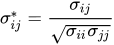
When
 ,
,  takes the value of 1 for all i. Also, is the correlation between the ith and jth variables.
 -
variances and covariances among errors or disturbances Denote the error covariance parameter as
 so that
  represents the variance parameter of error variable i. Associated with each error or disturbance variable i is a unique outcome variable. Let the variance of such an outcome variable be . In the standardized solution, the error covariance is rescaled as: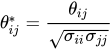
Notice that when
,  is not standardized to 1 in general. In fact, the error (disturbance) variance is simply rescaled by the reciprocal of the variance of the associated dependent variable. As a result, the rescaled error (disturbance) variance represents the proportion of variation of the dependent variable due to the unsystematic source. By the same token,
  does not represent the correlation between errors i and j. It is a rescaled covariance of the errors involved.
 intercepts and means of variablesThese parameters are fixed zeros in the standardized solution.
While formulas for the standardized solution are useful in computing the parameter values in the standardized solution, it is conceptually more useful to explain how variables are being transformed in the standardization process. The following provides a summary of the transformation process:
Observed and latent variables, excluding errors or disturbances, are centered and then divided by their corresponding standard deviations. Therefore, in the standardized solution, all these variables will have variance equal to 1. In other words, these variables are truly standardized.
Errors or disturbances are divided by the standard deviations of the corresponding outcome variables. In the standardized solution, these variables will not have variance equal to 1 in general. However, the rescaled error variances represent the proportion of unexplained or unsystematic variance of the corresponding outcome variables. Therefore, errors or disturbances in the standardized solution are simply rescaled but not standardized.
Standardized total, direct, and indirect effects are computed using formulas presented in the section Total, Direct, and Indirect Effects, but with the standardized parameter values substituted into the formulas.
Although parameter values associated with different scales are made more comparable in the standardized solution, a precaution should be mentioned. In the standardized solution, the original constraints on parameters in the unstandardized solution are usually lost. These constraints, however, might underscore some important theoretical position that needs to be maintained in the model. Destroying these constraints in the standardized solution means that interpretations or comparisons of parameter values in the standardized solution are made without maintaining the original theoretical position. You must judge whether such a departure from the original constraints poses conceptual difficulties for interpreting the standardized solution.