The CALIS Procedure

Measures of Multivariate Kurtosis

In many applications, the manifest variables are not even approximately multivariate normal. If this happens to be the case with your data set, the default generalized least squares and maximum likelihood estimation methods are not appropriate, and you should compute the parameter estimates and their standard errors by an asymptotically distribution-free method, such as the WLS estimation method. If your manifest variables are multivariate normal, then they have a zero relative multivariate kurtosis, and all marginal distributions have zero kurtosis (Browne 1982). If your DATA= data set contains raw data, PROC CALIS computes univariate skewness and kurtosis and a set of multivariate kurtosis values. By default, the values of univariate skewness and kurtosis are corrected for bias (as in PROC UNIVARIATE), but using the BIASKUR option enables you to compute the uncorrected values also. The values are displayed when you specify the PROC CALIS statement option KURTOSIS.

In the following formulas, N denotes the sample size and p denotes the number of variables.

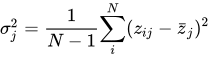
  • corrected variance for variable z Subscript j

    sigma Subscript j Superscript 2 Baseline equals StartFraction 1 Over upper N minus 1 EndFraction sigma-summation Underscript i Overscript upper N Endscripts left-parenthesis z Subscript i j Baseline minus z overbar Subscript j Baseline right-parenthesis squared

  • uncorrected univariate skewness for variable z Subscript j
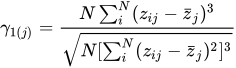
    gamma Subscript 1 left-parenthesis j right-parenthesis Baseline equals StartFraction upper N sigma-summation Underscript i Overscript upper N Endscripts left-parenthesis z Subscript i j Baseline minus z overbar Subscript j Baseline right-parenthesis cubed Over StartRoot upper N left-bracket sigma-summation Underscript i Overscript upper N Endscripts left-parenthesis z Subscript i j Baseline minus z overbar Subscript j Baseline right-parenthesis squared right-bracket cubed EndRoot EndFraction
  • corrected univariate skewness for variable z Subscript j

    gamma Subscript 1 left-parenthesis j right-parenthesis Baseline equals StartFraction upper N Over left-parenthesis upper N minus 1 right-parenthesis left-parenthesis upper N minus 2 right-parenthesis EndFraction StartFraction sigma-summation Underscript i Overscript upper N Endscripts left-parenthesis z Subscript i j Baseline minus z overbar Subscript j Baseline right-parenthesis cubed Over sigma Subscript j Superscript 3 Baseline EndFraction
  • uncorrected univariate kurtosis for variable z Subscript j
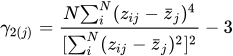
    gamma Subscript 2 left-parenthesis j right-parenthesis Baseline equals StartFraction upper N sigma-summation Underscript i Overscript upper N Endscripts left-parenthesis z Subscript i j Baseline minus z overbar Subscript j Baseline right-parenthesis Superscript 4 Baseline Over left-bracket sigma-summation Underscript i Overscript upper N Endscripts left-parenthesis z Subscript i j Baseline minus z overbar Subscript j Baseline right-parenthesis squared right-bracket squared EndFraction minus 3
  • corrected univariate kurtosis for variable z Subscript j

    gamma Subscript 2 left-parenthesis j right-parenthesis Baseline equals StartFraction upper N left-parenthesis upper N plus 1 right-parenthesis Over left-parenthesis upper N minus 1 right-parenthesis left-parenthesis upper N minus 2 right-parenthesis left-parenthesis upper N minus 3 right-parenthesis EndFraction StartFraction sigma-summation Underscript i Overscript upper N Endscripts left-parenthesis z Subscript i j Baseline minus z overbar Subscript j Baseline right-parenthesis Superscript 4 Baseline Over sigma Subscript j Superscript 4 Baseline EndFraction minus StartFraction 3 left-parenthesis upper N minus 1 right-parenthesis squared Over left-parenthesis upper N minus 2 right-parenthesis left-parenthesis upper N minus 3 right-parenthesis EndFraction
  • Mardia’s multivariate kurtosis

    gamma 2 equals StartFraction 1 Over upper N EndFraction sigma-summation Underscript i Overscript upper N Endscripts left-bracket left-parenthesis z Subscript i Baseline minus z overbar right-parenthesis prime bold upper S Superscript negative 1 Baseline left-parenthesis z Subscript i Baseline minus z overbar right-parenthesis right-bracket squared minus p left-parenthesis p plus 2 right-parenthesis

    where bold upper S is the biased sample covariance matrix with N as the divisor.

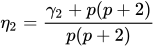
  • relative multivariate kurtosis

    eta 2 equals StartFraction gamma 2 plus p left-parenthesis p plus 2 right-parenthesis Over p left-parenthesis p plus 2 right-parenthesis EndFraction
  • normalized multivariate kurtosis

    kappa 0 equals StartFraction gamma 2 Over StartRoot 8 p left-parenthesis p plus 2 right-parenthesis slash upper N EndRoot EndFraction

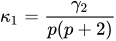
  • Mardia based kappa

    kappa 1 equals StartFraction gamma 2 Over p left-parenthesis p plus 2 right-parenthesis EndFraction
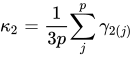
  • mean scaled univariate kurtosis

    kappa 2 equals StartFraction 1 Over 3 p EndFraction sigma-summation Underscript j Overscript p Endscripts gamma Subscript 2 left-parenthesis j right-parenthesis
  • adjusted mean scaled univariate kurtosis
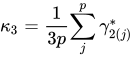
    kappa 3 equals StartFraction 1 Over 3 p EndFraction sigma-summation Underscript j Overscript p Endscripts gamma Subscript 2 left-parenthesis j right-parenthesis Superscript asterisk

    with

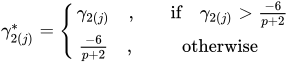
    gamma Subscript 2 left-parenthesis j right-parenthesis Superscript asterisk Baseline equals StartLayout Enlarged left-brace 1st Row 1st Column gamma Subscript 2 left-parenthesis j right-parenthesis Baseline comma 2nd Column if gamma Subscript 2 left-parenthesis j right-parenthesis Baseline greater-than StartFraction negative 6 Over p plus 2 EndFraction 2nd Row 1st Column StartFraction negative 6 Over p plus 2 EndFraction comma 2nd Column otherwise EndLayout

If variable upper Z Subscript j is normally distributed, the uncorrected univariate kurtosis gamma Subscript 2 left-parenthesis j right-parenthesis is equal to 0. If Z has an p-variate normal distribution, Mardia’s multivariate kurtosis gamma 2 is equal to 0. A variable upper Z Subscript j is called leptokurtic if it has a positive value of gamma Subscript 2 left-parenthesis j right-parenthesis and is called platykurtic if it has a negative value of gamma Subscript 2 left-parenthesis j right-parenthesis. The values of kappa 1, kappa 2, and kappa 3 should not be smaller than the following lower bound (Bentler 1985):

ModifyingAbove kappa With caret greater-than-or-equal-to StartFraction negative 2 Over p plus 2 EndFraction

PROC CALIS displays a message if kappa 1, kappa 2, or kappa 3 falls below the lower bound.

If weighted least squares estimates (METHOD=WLS or METHOD=ADF) are specified and the weight matrix is computed from an input raw data set, the CALIS procedure computes two more measures of multivariate kurtosis.
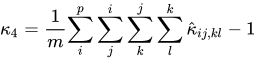
  • multivariate mean kappa

    kappa 4 equals StartFraction 1 Over m EndFraction sigma-summation Underscript i Overscript p Endscripts sigma-summation Underscript j Overscript i Endscripts sigma-summation Underscript k Overscript j Endscripts sigma-summation Underscript l Overscript k Endscripts ModifyingAbove kappa With caret Subscript i j comma k l Baseline minus 1

    where

    ModifyingAbove kappa With caret Subscript i j comma k l Baseline equals StartFraction s Subscript i j comma k l Baseline Over s Subscript i j Baseline s Subscript k l Baseline plus s Subscript i k Baseline s Subscript j l Baseline plus s Subscript i l Baseline s Subscript j k Baseline EndFraction

    and m equals p left-parenthesis p plus 1 right-parenthesis left-parenthesis p plus 2 right-parenthesis left-parenthesis p plus 3 right-parenthesis slash 24 is the number of elements in the vector s Subscript i j comma k l (Bentler 1985).

  • multivariate least squares kappa

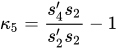
    kappa 5 equals StartFraction s prime 4 s 2 Over s prime 2 s 2 EndFraction minus 1

    where s 2 is the vector of the elements in the denominator of ModifyingAbove kappa With caret (Bentler 1985) and s 4 is the vector of the s Subscript i j comma k l, which is defined as

    s Subscript i j comma k l Baseline equals StartFraction 1 Over upper N EndFraction sigma-summation Underscript r equals 1 Overscript upper N Endscripts left-parenthesis z Subscript r i Baseline minus z overbar Subscript i Baseline right-parenthesis left-parenthesis z Subscript r j Baseline minus z overbar Subscript j Baseline right-parenthesis left-parenthesis z Subscript r k Baseline minus z overbar Subscript k Baseline right-parenthesis left-parenthesis z Subscript r l Baseline minus z overbar Subscript l Baseline right-parenthesis

The occurrence of significant nonzero values of Mardia’s multivariate kurtosis gamma 2 and significant amounts of some of the univariate kurtosis values gamma Subscript 2 left-parenthesis j right-parenthesis indicate that your variables are not multivariate normal distributed. Violating the multivariate normality assumption in (default) generalized least squares and maximum likelihood estimation usually leads to the wrong approximate standard errors and incorrect fit statistics based on the chi squared value. In general, the parameter estimates are more stable against violation of the normal distribution assumption. For more details, see Browne (1974, 1982, 1984).

Last updated: December 09, 2022