The CATMOD Procedure
Example 36.3 Logistic Regression, Standard Response Function
(View the complete code for this example.)
In this data set, from Cox and Snell (1989), ingots are prepared with different heating and soaking times and tested for their readiness to be rolled. The following DATA step creates a response variable Y with value 1 for ingots that are not ready and value 0 otherwise. The explanatory variables are Heat and Soak.
data ingots;
   input Heat Soak nready ntotal @@;
   Count=nready;
   Y=1;
   output;
   Count=ntotal-nready;
   Y=0;
   output;
   drop nready ntotal;
   datalines;
7 1.0 0 10   14 1.0 0 31   27 1.0 1 56   51 1.0 3 13
7 1.7 0 17   14 1.7 0 43   27 1.7 4 44   51 1.7 0  1
7 2.2 0  7   14 2.2 2 33   27 2.2 0 21   51 2.2 0  1
7 2.8 0 12   14 2.8 0 31   27 2.8 1 22   51 4.0 0  1
7 4.0 0  9   14 4.0 0 19   27 4.0 1 16
;
Logistic regression analysis is often used to investigate the relationship between discrete response variables and continuous explanatory variables. For logistic regression, the continuous design-effects are declared in a DIRECT statement. The following statements produce Output 36.3.1 through Output 36.3.6:
title 'Maximum Likelihood Logistic Regression';
proc catmod data=ingots;
   weight Count;
   direct Heat Soak;
   model Y=Heat Soak / freq covb corrb itprint design;
quit;
You can verify that the populations are defined as you intended by looking at the "Population Profiles" table in Output 36.3.1.
Output 36.3.1: Maximum Likelihood Logistic Regression
| Maximum Likelihood Logistic Regression |
| Data Summary | |||
|---|---|---|---|
| Response | Y | Response Levels | 2 |
| Weight Variable | Count | Populations | 19 |
| Data Set | INGOTS | Total Frequency | 387 |
| Frequency Missing | 0 | Observations | 25 |
| Population Profiles | |||
|---|---|---|---|
| Sample | Heat | Soak | Sample Size |
| 1 | 7 | 1 | 10 |
| 2 | 7 | 1.7 | 17 |
| 3 | 7 | 2.2 | 7 |
| 4 | 7 | 2.8 | 12 |
| 5 | 7 | 4 | 9 |
| 6 | 14 | 1 | 31 |
| 7 | 14 | 1.7 | 43 |
| 8 | 14 | 2.2 | 33 |
| 9 | 14 | 2.8 | 31 |
| 10 | 14 | 4 | 19 |
| 11 | 27 | 1 | 56 |
| 12 | 27 | 1.7 | 44 |
| 13 | 27 | 2.2 | 21 |
| 14 | 27 | 2.8 | 22 |
| 15 | 27 | 4 | 16 |
| 16 | 51 | 1 | 13 |
| 17 | 51 | 1.7 | 1 |
| 18 | 51 | 2.2 | 1 |
| 19 | 51 | 4 | 1 |
Since the "Response Profiles" table in Output 36.3.2 shows the response level ordering as 0, 1, the default response function, the logit, is defined as  .
.
Output 36.3.2: Response Summaries
| Response Profiles | |
|---|---|
| Response | Y |
| 1 | 0 |
| 2 | 1 |
| Response Frequencies | ||
|---|---|---|
| Sample | Response Number | |
| 1 | 2 | |
| 1 | 10 | 0 |
| 2 | 17 | 0 |
| 3 | 7 | 0 |
| 4 | 12 | 0 |
| 5 | 9 | 0 |
| 6 | 31 | 0 |
| 7 | 43 | 0 |
| 8 | 31 | 2 |
| 9 | 31 | 0 |
| 10 | 19 | 0 |
| 11 | 55 | 1 |
| 12 | 40 | 4 |
| 13 | 21 | 0 |
| 14 | 21 | 1 |
| 15 | 15 | 1 |
| 16 | 10 | 3 |
| 17 | 1 | 0 |
| 18 | 1 | 0 |
| 19 | 1 | 0 |
The values of the continuous variable are inserted into the design matrix (Output 36.3.3).
Output 36.3.3: Design Matrix
| Response Functions and Design Matrix | ||||
|---|---|---|---|---|
| Sample | Response Function |
Design Matrix | ||
| 1 | 2 | 3 | ||
| 1 | 2.99573 | 1 | 7 | 1 |
| 2 | 3.52636 | 1 | 7 | 1.7 |
| 3 | 2.63906 | 1 | 7 | 2.2 |
| 4 | 3.17805 | 1 | 7 | 2.8 |
| 5 | 2.89037 | 1 | 7 | 4 |
| 6 | 4.12713 | 1 | 14 | 1 |
| 7 | 4.45435 | 1 | 14 | 1.7 |
| 8 | 2.74084 | 1 | 14 | 2.2 |
| 9 | 4.12713 | 1 | 14 | 2.8 |
| 10 | 3.63759 | 1 | 14 | 4 |
| 11 | 4.00733 | 1 | 27 | 1 |
| 12 | 2.30259 | 1 | 27 | 1.7 |
| 13 | 3.73767 | 1 | 27 | 2.2 |
| 14 | 3.04452 | 1 | 27 | 2.8 |
| 15 | 2.70805 | 1 | 27 | 4 |
| 16 | 1.20397 | 1 | 51 | 1 |
| 17 | 0.69315 | 1 | 51 | 1.7 |
| 18 | 0.69315 | 1 | 51 | 2.2 |
| 19 | 0.69315 | 1 | 51 | 4 |
Seven Newton-Raphson iterations are required to find the maximum likelihood estimates (Output 36.3.4).
Output 36.3.4: Iteration History
| Maximum Likelihood Analysis | ||||||
|---|---|---|---|---|---|---|
| Iteration | Sub Iteration | -2 Log Likelihood |
Convergence Criterion | Parameter Estimates | ||
| 1 | 2 | 3 | ||||
| 0 | 0 | 536.49592 | 1.0000 | 0 | 0 | 0 |
| 1 | 0 | 152.58961 | 0.7156 | 2.1594 | -0.0139 | -0.003733 |
| 2 | 0 | 106.76066 | 0.3003 | 3.5334 | -0.0363 | -0.0120 |
| 3 | 0 | 96.692171 | 0.0943 | 4.7489 | -0.0640 | -0.0299 |
| 4 | 0 | 95.383825 | 0.0135 | 5.4138 | -0.0790 | -0.0498 |
| 5 | 0 | 95.345659 | 0.000400 | 5.5539 | -0.0819 | -0.0564 |
| 6 | 0 | 95.345613 | 4.8289E-7 | 5.5592 | -0.0820 | -0.0568 |
| 7 | 0 | 95.345613 | 7.731E-13 | 5.5592 | -0.0820 | -0.0568 |
| Maximum likelihood computations converged. |
The analysis of variance table (Output 36.3.5) shows that the model fits since the likelihood ratio goodness-of-fit test is nonsignificant. It also shows that the length of heating time is a significant factor with respect to readiness but that length of soaking time is not.
Output 36.3.5: Analysis of Variance Table
| Maximum Likelihood Analysis of Variance | |||
|---|---|---|---|
| Source | DF | Chi-Square | Pr > ChiSq |
| Intercept | 1 | 24.65 | <.0001 |
| Heat | 1 | 11.95 | 0.0005 |
| Soak | 1 | 0.03 | 0.8639 |
| Likelihood Ratio | 16 | 13.75 | 0.6171 |
From the table of maximum likelihood estimates in Output 36.3.6, the fitted model is

For example, for Sample 1 with Heat = 7 and Soak = 1, the estimate is

Output 36.3.6: Maximum Likelihood Estimates, Covariances, and Correlations
| Analysis of Maximum Likelihood Estimates | ||||
|---|---|---|---|---|
| Parameter | Estimate | Standard Error |
Chi- Square |
Pr > ChiSq |
| Intercept | 5.5592 | 1.1197 | 24.65 | <.0001 |
| Heat | -0.0820 | 0.0237 | 11.95 | 0.0005 |
| Soak | -0.0568 | 0.3312 | 0.03 | 0.8639 |
| Covariance Matrix of the Maximum Likelihood Estimates | ||||
|---|---|---|---|---|
| Row | Parameter | Col1 | Col2 | Col3 |
| 1 | Intercept | 1.2537133 | -0.0215664 | -0.2817648 |
| 2 | Heat | -0.0215664 | 0.0005633 | 0.0026243 |
| 3 | Soak | -0.2817648 | 0.0026243 | 0.1097020 |
| Correlation Matrix of the Maximum Likelihood Estimates | ||||
|---|---|---|---|---|
| Row | Parameter | Col1 | Col2 | Col3 |
| 1 | Intercept | 1.00000 | -0.81152 | -0.75977 |
| 2 | Heat | -0.81152 | 1.00000 | 0.33383 |
| 3 | Soak | -0.75977 | 0.33383 | 1.00000 |
Predicted values of the logits, as well as the probabilities of readiness, could be obtained by specifying PRED=PROB in the MODEL statement. For the example of Sample 1 with Heat = 7 and Soak = 1, PRED=PROB would give an estimate of the probability of readiness equal to 0.9928 since
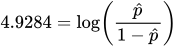
implies that
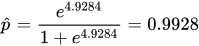
As another consideration, since soaking time is nonsignificant, you could fit another model that deleted the variable Soak.