The FREQ Procedure
Gail-Simon Test for Qualitative Interactions
The GAILSIMON option in the TABLES statement provides the Gail-Simon test for qualitative interaction for stratified  tables. For more information, see Gail and Simon (1985); Silvapulle (2001); Dmitrienko et al. (2005).
The Gail-Simon test is based on the risk differences in stratified tables, where the risk difference is defined as the row 1 risk (proportion in column 1) minus the row 2 risk. For more information, see the section Risks and Risk Differences. By default, PROC FREQ uses column 1 risks to compute the Gail-Simon test. If you specify the GAILSIMON(COLUMN=2) option, PROC FREQ uses column 2 risks.
PROC FREQ computes the Gail-Simon test statistics as described in Gail and Simon (1985),
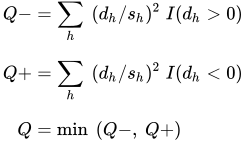
where  is the risk difference in table h,
  is the standard error of the risk difference, and
  equals 1 if
  and 0 otherwise. Similarly,
  equals 1 if
  and 0 otherwise. The q tables (strata) are indexed by
  .
.
The p-values for the Gail-Simon statistics are computed as
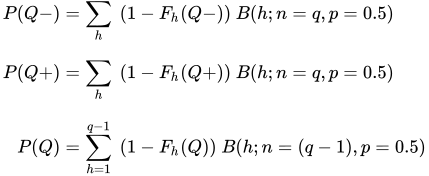
where  is the cumulative chi-square distribution function with h degrees of freedom and
  is the binomial probability function with parameters n and p. The statistic Q tests the null hypothesis of no qualitative interaction. The statistic
  tests the null hypothesis of positive risk differences. A small p-value for indicates negative differences; similarly, a small p-value for
  indicates positive risk differences.