The GENMOD Procedure
F Statistics
Suppose that  is the deviance resulting from fitting a generalized linear model and that
  is the deviance from fitting a submodel. Then, under appropriate regularity conditions, the asymptotic distribution of
 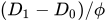 is chi-square with r degrees of freedom, where r is the difference in the number of parameters between the two models and
  is the dispersion parameter. If is unknown, and
  is an estimate of based on the deviance or Pearson’s chi-square divided by degrees of freedom, then, under regularity conditions,
  has an asymptotic chi-square distribution with
  degrees of freedom. Here, n is the number of observations and p is the number of parameters in the model that is used to estimate . Thus, the asymptotic distribution of
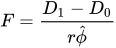
is the F distribution
with r and degrees of freedom, assuming that and are approximately independent.
This F statistic is computed for the Type 1 analysis, Type 3 analysis, and hypothesis tests specified in CONTRAST statements when the dispersion parameter is estimated by either the deviance or Pearson’s chi-square divided by degrees of freedom, as specified by the DSCALE or PSCALE option in the MODEL statement. In the case of a Type 1 analysis, model 0 is the higher-order model obtained by including one additional effect in model 1. For a Type 3 analysis and hypothesis tests, model 0 is the full specified model and model 1 is the submodel obtained from constraining the Type III contrast or the user-specified contrast to be 0.