The GLIMMIX Procedure

Quasi-likelihood for Independent Data

Quasi-likelihood estimation uses only the first and second moment of the response. In the case of independent data, this requires only a specification of the mean and variance of your data. The GLIMMIX procedure estimates parameters by quasi-likelihood, if the following conditions are met:

  • The response distribution is unknown, because of a user-specified variance function.

  • There are no G-side random effects.

  • There are no R-side covariance structures or at most an overdispersion parameter.

Under some mild regularity conditions, the function
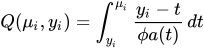
upper Q left-parenthesis mu Subscript i Baseline comma y Subscript i Baseline right-parenthesis equals integral Subscript y Subscript i Baseline Superscript mu Subscript i Baseline Baseline StartFraction y Subscript i Baseline minus t Over phi a left-parenthesis t right-parenthesis EndFraction d t

known as the log quasi-likelihood of the ith observation, has some properties of a log-likelihood function (McCullagh and Nelder 1989, p. 325). For example, the expected value of its derivative is zero, and the variance of its derivative equals the negative of the expected value of the second derivative. Consequently,
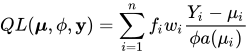
upper Q upper L left-parenthesis bold-italic mu comma phi comma bold y right-parenthesis equals sigma-summation Underscript i equals 1 Overscript n Endscripts f Subscript i Baseline w Subscript i Baseline StartFraction upper Y Subscript i Baseline minus mu Subscript i Baseline Over phi a left-parenthesis mu Subscript i Baseline right-parenthesis EndFraction

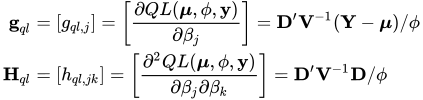
can serve as the score function for estimation. Quasi-likelihood estimation takes as the gradient and "Hessian" matrix—with respect to the fixed-effects parameters bold-italic beta—the quantities

StartLayout 1st Row 1st Column bold g Subscript q l 2nd Column equals left-bracket g Subscript q l comma j Baseline right-bracket equals left-bracket StartFraction partial-differential upper Q upper L left-parenthesis bold-italic mu comma phi comma bold y right-parenthesis Over partial-differential beta Subscript j Baseline EndFraction right-bracket equals bold upper D prime bold upper V Superscript negative 1 Baseline left-parenthesis bold upper Y minus bold-italic mu right-parenthesis slash phi 2nd Row 1st Column bold upper H Subscript q l 2nd Column equals left-bracket h Subscript q l comma j k Baseline right-bracket equals left-bracket StartFraction partial-differential squared upper Q upper L left-parenthesis bold-italic mu comma phi comma bold y right-parenthesis Over partial-differential beta Subscript j Baseline partial-differential beta Subscript k Baseline EndFraction right-bracket equals bold upper D prime bold upper V Superscript negative 1 Baseline bold upper D slash phi EndLayout

In this expression, bold upper D is a matrix of derivatives of bold-italic mu with respect to the elements in bold-italic beta, and bold upper V is a diagonal matrix containing variance functions, bold upper V equals left-bracket a left-parenthesis mu 1 right-parenthesis comma ellipsis comma a left-parenthesis mu Subscript n Baseline right-parenthesis right-bracket. Notice that bold upper H Subscript q l is not the second derivative matrix of upper Q left-parenthesis bold-italic mu comma bold y right-parenthesis. Rather, it is the negative of the expected value of partial-differential bold g Subscript q l slash partial-differential bold-italic beta. bold upper H Subscript q l thus has the form of a "scoring Hessian."

The GLIMMIX procedure fixes the scale parameter phi at 1.0 by default. To estimate the parameter, add the statement

random _residual_;

The resulting estimator (McCullagh and Nelder 1989, p. 328) is
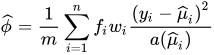
ModifyingAbove phi With caret equals StartFraction 1 Over m EndFraction sigma-summation Underscript i equals 1 Overscript n Endscripts f Subscript i Baseline w Subscript i Baseline StartFraction left-parenthesis y Subscript i Baseline minus ModifyingAbove mu With caret Subscript i Baseline right-parenthesis squared Over a left-parenthesis ModifyingAbove mu With caret Subscript i Baseline right-parenthesis EndFraction

where m equals f minus normal r normal a normal n normal k StartSet bold upper X EndSet if the NOREML option is in effect, m = f otherwise, and f is the sum of the frequencies.

See Example 52.4 for an application of quasi-likelihood estimation with PROC GLIMMIX.

Last updated: December 09, 2022