The GLIMMIX Procedure
Effects of Adding Overdispersion
You can add a multiplicative overdispersion parameter to a generalized linear model in the GLIMMIX procedure with the statement
random _residual_;
For models in which  , this effectively lifts the constraint of the parameter. In models that already contain a
  or k scale parameter—such as the normal, gamma, or negative binomial model—the statement adds a multiplicative scalar (the overdispersion parameter,
  ) to the variance function.
The overdispersion parameter is estimated from Pearson’s statistic after all other parameters have been determined by (restricted) maximum likelihood or quasi-likelihood. This estimate is
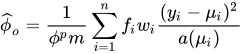
where  if the NOREML option is in effect, and
  otherwise, and f is the sum of the frequencies. The power p is –1 for the gamma distribution and 1 otherwise.
Adding an overdispersion parameter does not alter any of the other parameter estimates. It only changes the variance-covariance matrix of the estimates by a certain factor. If overdispersion arises from correlations among the observations, then you should investigate more complex random-effects structures.