The GLIMMIX Procedure

Pseudo-likelihood Estimation Based on Linearization

The Pseudo-model

Recall from the section Notation for the Generalized Linear Mixed Model that

normal upper E left-bracket bold upper Y vertical-bar bold-italic gamma right-bracket equals g Superscript negative 1 Baseline left-parenthesis bold upper X bold-italic beta plus bold upper Z bold-italic gamma right-parenthesis equals g Superscript negative 1 Baseline left-parenthesis bold-italic eta right-parenthesis equals bold-italic mu

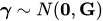
where bold-italic gamma tilde upper N left-parenthesis bold 0 comma bold upper G right-parenthesis and normal upper V normal a normal r left-bracket bold upper Y vertical-bar bold-italic gamma right-bracket equals bold upper A Superscript 1 slash 2 Baseline bold upper R bold upper A Superscript 1 slash 2. Following Wolfinger and O’Connell (1993), a first-order Taylor series of bold-italic mu about bold-italic beta overTilde and bold-italic gamma overTilde yields

g Superscript negative 1 Baseline left-parenthesis bold-italic eta right-parenthesis approaches-the-limit g Superscript negative 1 Baseline left-parenthesis bold-italic eta overTilde right-parenthesis plus bold upper Delta overTilde bold upper X left-parenthesis bold-italic beta minus bold-italic beta overTilde right-parenthesis plus bold upper Delta overTilde bold upper Z left-parenthesis bold-italic gamma minus bold-italic gamma overTilde right-parenthesis

where

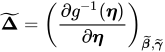
bold upper Delta overTilde equals left-parenthesis StartFraction partial-differential g Superscript negative 1 Baseline left-parenthesis bold-italic eta right-parenthesis Over partial-differential bold-italic eta EndFraction right-parenthesis Subscript bold-italic beta overTilde comma bold-italic gamma overTilde

is a diagonal matrix of derivatives of the conditional mean evaluated at the expansion locus. Rearranging terms yields the expression

bold upper Delta overTilde Superscript negative 1 Baseline left-parenthesis bold-italic mu minus g Superscript negative 1 Baseline left-parenthesis bold-italic eta overTilde right-parenthesis right-parenthesis plus bold upper X bold-italic beta overTilde plus bold upper Z bold-italic gamma overTilde approaches-the-limit bold upper X bold-italic beta plus bold upper Z bold-italic gamma

The left side is the expected value, conditional on bold-italic gamma, of

bold upper Delta overTilde Superscript negative 1 Baseline left-parenthesis bold upper Y minus g Superscript negative 1 Baseline left-parenthesis bold-italic eta overTilde right-parenthesis right-parenthesis plus bold upper X bold-italic beta overTilde plus bold upper Z bold-italic gamma overTilde identical-to bold upper P

and

normal upper V normal a normal r left-bracket bold upper P vertical-bar bold-italic gamma right-bracket equals bold upper Delta overTilde Superscript negative 1 Baseline bold upper A Superscript 1 slash 2 Baseline bold upper R bold upper A Superscript 1 slash 2 Baseline bold upper Delta overTilde Superscript negative 1

You can thus consider the model

bold upper P equals bold upper X bold-italic beta plus bold upper Z bold-italic gamma plus bold-italic epsilon

which is a linear mixed model with pseudo-response bold upper P, fixed effects bold-italic beta, random effects bold-italic gamma, and normal upper V normal a normal r left-bracket bold-italic epsilon right-bracket equals normal upper V normal a normal r left-bracket bold upper P vertical-bar bold-italic gamma right-bracket.

Objective Functions

Now define

bold upper V left-parenthesis bold-italic theta right-parenthesis equals bold upper Z bold upper G bold upper Z prime plus bold upper Delta overTilde Superscript negative 1 Baseline bold upper A Superscript 1 slash 2 Baseline bold upper R bold upper A Superscript 1 slash 2 Baseline bold upper Delta overTilde Superscript negative 1

as the marginal variance in the linear mixed pseudo-model, where bold-italic theta is the left-parenthesis q times 1 right-parenthesis parameter vector containing all unknowns in bold upper G and bold upper R. Based on this linearized model, an objective function can be defined, assuming that the distribution of bold upper P is known. The GLIMMIX procedure assumes that bold-italic epsilon has a normal distribution. The maximum log pseudo-likelihood (MxPL) and restricted log pseudo-likelihood (RxPL) for bold upper P are then

StartLayout 1st Row 1st Column l left-parenthesis bold-italic theta comma bold p right-parenthesis 2nd Column equals minus one-half log StartAbsoluteValue bold upper V left-parenthesis bold-italic theta right-parenthesis EndAbsoluteValue minus one-half bold r prime bold upper V left-parenthesis bold-italic theta right-parenthesis Superscript negative 1 Baseline bold r minus StartFraction f Over 2 EndFraction log left-brace 2 pi right-brace 2nd Row 1st Column l Subscript upper R Baseline left-parenthesis bold-italic theta comma bold p right-parenthesis 2nd Column equals minus one-half log StartAbsoluteValue bold upper V left-parenthesis bold-italic theta right-parenthesis EndAbsoluteValue minus one-half bold r prime bold upper V left-parenthesis bold-italic theta right-parenthesis Superscript negative 1 Baseline bold r minus one-half log StartAbsoluteValue bold upper X prime bold upper V left-parenthesis bold-italic theta right-parenthesis Superscript negative 1 Baseline bold upper X EndAbsoluteValue minus StartFraction f minus k Over 2 EndFraction log left-brace 2 pi right-brace EndLayout

with bold r equals bold p minus bold upper X left-parenthesis bold upper X prime bold upper V Superscript negative 1 Baseline bold upper X right-parenthesis Superscript minus Baseline bold upper X prime bold upper V Superscript negative 1 Baseline bold p. f denotes the sum of the frequencies used in the analysis, and k denotes the rank of bold upper X. The fixed-effects parameters bold-italic beta are profiled from these expressions. The parameters in bold-italic theta are estimated by the optimization techniques specified in the NLOPTIONS statement. The objective function for minimization is minus 2 l left-parenthesis bold-italic theta comma bold p right-parenthesis or minus 2 l Subscript upper R Baseline left-parenthesis bold-italic theta comma bold p right-parenthesis. At convergence, the profiled parameters are estimated and the random effects are predicted as

StartLayout 1st Row 1st Column ModifyingAbove bold-italic beta With caret 2nd Column equals left-parenthesis bold upper X prime bold upper V left-parenthesis ModifyingAbove bold-italic theta With caret right-parenthesis Superscript negative 1 Baseline bold upper X right-parenthesis Superscript minus Baseline bold upper X prime bold upper V left-parenthesis ModifyingAbove bold-italic theta With caret right-parenthesis Superscript negative 1 Baseline bold p 2nd Row 1st Column ModifyingAbove bold-italic gamma With caret 2nd Column equals ModifyingAbove bold upper G With caret bold upper Z prime bold upper V left-parenthesis ModifyingAbove bold-italic theta With caret right-parenthesis Superscript negative 1 Baseline ModifyingAbove bold r With caret EndLayout

With these statistics, the pseudo-response and error weights of the linearized model are recomputed and the objective function is minimized again. The predictors ModifyingAbove bold-italic gamma With caret are the estimated BLUPs in the approximated linear model. This process continues until the relative change between parameter estimates at two successive (outer) iterations is sufficiently small. See the PCONV= option in the PROC GLIMMIX statement for the computational details about how the GLIMMIX procedure compares parameter estimates across optimizations.

If the conditional distribution contains a scale parameter phi not-equals 1 (Table 22), the GLIMMIX procedure profiles this parameter in GLMMs from the log pseudo-likelihoods as well. To this end define

bold upper V left-parenthesis bold-italic theta Superscript asterisk Baseline right-parenthesis equals bold upper Delta overTilde Superscript negative 1 Baseline bold upper A Superscript 1 slash 2 Baseline bold upper R Superscript asterisk Baseline bold upper A Superscript 1 slash 2 Baseline bold upper Delta overTilde Superscript negative 1 Baseline plus bold upper Z bold upper G Superscript asterisk Baseline bold upper Z prime

where bold-italic theta Superscript asterisk is the covariance parameter vector with q – 1 elements. The matrices bold upper G Superscript asterisk and bold upper R Superscript asterisk are appropriately reparameterized versions of bold upper G and bold upper R. For example, if bold upper G has a variance component structure and bold upper R equals phi bold upper I, then bold-italic theta Superscript asterisk contains ratios of the variance components and phi, and bold upper R Superscript asterisk Baseline equals bold upper I. The solution for ModifyingAbove phi With caret is

ModifyingAbove phi With caret equals ModifyingAbove bold r With caret prime bold upper V left-parenthesis ModifyingAbove bold-italic theta With caret Superscript asterisk Baseline right-parenthesis Superscript negative 1 Baseline ModifyingAbove bold r With caret slash m

where m = f for MxPL and m = fk for RxPL. Substitution into the previous functions yields the profiled log pseudo-likelihoods,
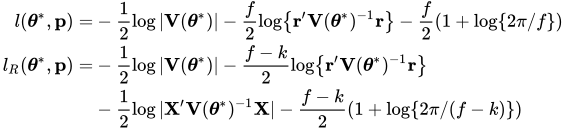
StartLayout 1st Row 1st Column l left-parenthesis bold-italic theta Superscript asterisk Baseline comma bold p right-parenthesis equals 2nd Column minus one-half log StartAbsoluteValue bold upper V left-parenthesis bold-italic theta Superscript asterisk Baseline right-parenthesis EndAbsoluteValue minus StartFraction f Over 2 EndFraction log left-brace bold r prime bold upper V left-parenthesis bold-italic theta Superscript asterisk Baseline right-parenthesis Superscript negative 1 Baseline bold r right-brace minus StartFraction f Over 2 EndFraction left-parenthesis 1 plus log left-brace 2 pi slash f right-brace right-parenthesis 2nd Row 1st Column l Subscript upper R Baseline left-parenthesis bold-italic theta Superscript asterisk Baseline comma bold p right-parenthesis equals 2nd Column minus one-half log StartAbsoluteValue bold upper V left-parenthesis bold-italic theta Superscript asterisk Baseline right-parenthesis EndAbsoluteValue minus StartFraction f minus k Over 2 EndFraction log left-brace bold r prime bold upper V left-parenthesis bold-italic theta Superscript asterisk Baseline right-parenthesis Superscript negative 1 Baseline bold r right-brace 3rd Row 1st Column Blank 2nd Column minus one-half log StartAbsoluteValue bold upper X prime bold upper V left-parenthesis bold-italic theta Superscript asterisk Baseline right-parenthesis Superscript negative 1 Baseline bold upper X EndAbsoluteValue minus StartFraction f minus k Over 2 EndFraction left-parenthesis 1 plus log left-brace 2 pi slash left-parenthesis f minus k right-parenthesis right-brace right-parenthesis EndLayout

Profiling of phi can be suppressed with the NOPROFILE option in the PROC GLIMMIX statement.

Where possible, the objective function, its gradient, and its Hessian employ the sweep-based W-transformation ( Hemmerle and Hartley 1973; Goodnight 1979; Goodnight and Hemmerle 1979). Further details about the minimization process in the general linear mixed model can be found in Wolfinger, Tobias, and Sall (1994).

Estimated Precision of Estimates

The GLIMMIX procedure produces estimates of the variability of ModifyingAbove bold-italic beta With caret, ModifyingAbove bold-italic theta With caret, and estimates of the prediction variability for ModifyingAbove bold-italic gamma With caret, normal upper V normal a normal r left-bracket ModifyingAbove bold-italic gamma With caret minus bold-italic gamma right-bracket. Denote as bold upper S the matrix

bold upper S identical-to ModifyingAbove normal upper V normal a normal r With caret left-bracket bold upper P vertical-bar bold-italic gamma right-bracket equals bold upper Delta overTilde Superscript negative 1 Baseline bold upper A Superscript 1 slash 2 Baseline bold upper R bold upper A Superscript 1 slash 2 Baseline bold upper Delta overTilde Superscript negative 1

where all components on the right side are evaluated at the converged estimates. The mixed model equations (Henderson 1984) in the linear mixed (pseudo-)model are then

Start 2 By 2 Matrix 1st Row 1st Column bold upper X prime bold upper S Superscript negative 1 Baseline bold upper X 2nd Column bold upper X prime bold upper S Superscript negative 1 Baseline bold upper Z 2nd Row 1st Column bold upper Z prime bold upper S Superscript negative 1 Baseline bold upper X 2nd Column bold upper Z prime bold upper S Superscript negative 1 Baseline bold upper Z plus bold upper G left-parenthesis ModifyingAbove bold-italic theta With caret right-parenthesis Superscript negative 1 Baseline EndMatrix StartBinomialOrMatrix ModifyingAbove bold-italic beta With caret Choose ModifyingAbove bold-italic gamma With caret EndBinomialOrMatrix equals StartBinomialOrMatrix bold upper X prime bold upper S Superscript negative 1 Baseline bold p Choose bold upper Z prime bold upper S Superscript negative 1 Baseline bold p EndBinomialOrMatrix

and

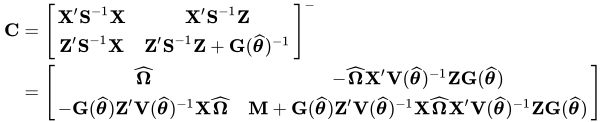
StartLayout 1st Row 1st Column bold upper C 2nd Column equals Start 2 By 2 Matrix 1st Row 1st Column bold upper X prime bold upper S Superscript negative 1 Baseline bold upper X 2nd Column bold upper X prime bold upper S Superscript negative 1 Baseline bold upper Z 2nd Row 1st Column bold upper Z prime bold upper S Superscript negative 1 Baseline bold upper X 2nd Column bold upper Z prime bold upper S Superscript negative 1 Baseline bold upper Z plus bold upper G left-parenthesis ModifyingAbove bold-italic theta With caret right-parenthesis Superscript negative 1 EndMatrix Superscript minus Baseline 2nd Row 1st Column Blank 2nd Column equals Start 2 By 2 Matrix 1st Row 1st Column ModifyingAbove bold upper Omega With caret 2nd Column minus ModifyingAbove bold upper Omega With caret bold upper X prime bold upper V left-parenthesis ModifyingAbove bold-italic theta With caret right-parenthesis Superscript negative 1 Baseline bold upper Z bold upper G left-parenthesis ModifyingAbove bold-italic theta With caret right-parenthesis 2nd Row 1st Column minus bold upper G left-parenthesis ModifyingAbove bold-italic theta With caret right-parenthesis bold upper Z prime bold upper V left-parenthesis ModifyingAbove bold-italic theta With caret right-parenthesis Superscript negative 1 Baseline bold upper X ModifyingAbove bold upper Omega With caret 2nd Column bold upper M plus bold upper G left-parenthesis ModifyingAbove bold-italic theta With caret right-parenthesis bold upper Z prime bold upper V left-parenthesis ModifyingAbove bold-italic theta With caret right-parenthesis Superscript negative 1 Baseline bold upper X ModifyingAbove bold upper Omega With caret bold upper X prime bold upper V left-parenthesis ModifyingAbove bold-italic theta With caret right-parenthesis Superscript negative 1 Baseline bold upper Z bold upper G left-parenthesis ModifyingAbove bold-italic theta With caret right-parenthesis EndMatrix EndLayout

is the approximate estimated variance-covariance matrix of left-bracket ModifyingAbove bold-italic beta With caret prime comma ModifyingAbove bold-italic gamma With caret prime minus bold-italic gamma Superscript prime Baseline right-bracket prime. Here, ModifyingAbove bold upper Omega With caret equals left-parenthesis bold upper X prime bold upper V left-parenthesis ModifyingAbove bold-italic theta With caret right-parenthesis Superscript negative 1 Baseline bold upper X right-parenthesis Superscript minus and bold upper M equals left-parenthesis bold upper Z prime bold upper S Superscript negative 1 Baseline bold upper Z plus bold upper G left-parenthesis ModifyingAbove bold-italic theta With caret right-parenthesis Superscript negative 1 Baseline right-parenthesis Superscript negative 1.

The square roots of the diagonal elements of ModifyingAbove bold upper Omega With caret are reported in the Standard Error column of the "Parameter Estimates" table. This table is produced with the SOLUTION option in the MODEL statement. The prediction standard errors of the random-effects solutions are reported in the Std Err Pred column of the "Solution for Random Effects" table. This table is produced with the SOLUTION option in the RANDOM statement.

As a cautionary note, bold upper C tends to underestimate the true sampling variability of [ModifyingAbove bold-italic beta With caret prime comma ModifyingAbove bold-italic gamma With caret prime right-bracket prime, because no account is made for the uncertainty in estimating bold upper G and bold upper R. Although inflation factors have been proposed (Kackar and Harville 1984; Kass and Steffey 1989; Prasad and Rao 1990), they tend to be small for data sets that are fairly well balanced. PROC GLIMMIX does not compute any inflation factors by default. The DDFM=KENWARDROGER option in the MODEL statement prompts PROC GLIMMIX to compute a specific inflation factor (Kenward and Roger 1997), along with Satterthwaite-based degrees of freedom.

If bold upper G left-parenthesis ModifyingAbove bold-italic theta With caret right-parenthesis is singular, or if you use the CHOL option of the PROC GLIMMIX statement, the mixed model equations are modified as follows. Let bold upper L denote the lower triangular matrix so that bold upper L bold upper L Superscript prime Baseline equals bold upper G left-parenthesis ModifyingAbove bold-italic theta With caret right-parenthesis. PROC GLIMMIX then solves the equations

Start 2 By 2 Matrix 1st Row 1st Column bold upper X prime bold upper S Superscript negative 1 Baseline bold upper X 2nd Column bold upper X prime bold upper S Superscript negative 1 Baseline bold upper Z bold upper L 2nd Row 1st Column bold upper L prime bold upper Z prime bold upper S Superscript negative 1 Baseline bold upper X 2nd Column bold upper L prime bold upper Z prime bold upper S Superscript negative 1 Baseline bold upper Z bold upper L plus bold upper I EndMatrix StartBinomialOrMatrix ModifyingAbove bold-italic beta With caret Choose ModifyingAbove bold-italic tau With caret EndBinomialOrMatrix equals StartBinomialOrMatrix bold upper X prime bold upper S Superscript negative 1 Baseline bold p Choose bold upper L prime bold upper Z prime bold upper S Superscript negative 1 Baseline bold p EndBinomialOrMatrix

and transforms ModifyingAbove bold-italic tau With caret and a generalized inverse of the left-side coefficient matrix by using bold upper L.

The asymptotic covariance matrix of the covariance parameter estimator ModifyingAbove bold-italic theta With caret is computed based on the observed or expected Hessian matrix of the optimization procedure. Consider first the case where the scale parameter phi is not present or not profiled. Because bold-italic beta is profiled from the pseudo-likelihood, the objective function for minimization is f left-parenthesis bold-italic theta right-parenthesis equals minus 2 l left-parenthesis bold-italic theta comma bold p right-parenthesis for METHOD=MSPL and METHOD=MMPL and f left-parenthesis bold-italic theta right-parenthesis equals minus 2 l Subscript upper R Baseline left-parenthesis bold-italic theta comma bold p right-parenthesis for METHOD=RSPL and METHOD=RMPL. Denote the observed Hessian (second derivative) matrix as
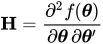
bold upper H equals StartFraction partial-differential squared f left-parenthesis bold-italic theta right-parenthesis Over partial-differential bold-italic theta partial-differential bold-italic theta prime EndFraction

The GLIMMIX procedure computes the variance of ModifyingAbove bold-italic theta With caret by default as 2 bold upper H Superscript negative 1. If the Hessian is not positive definite, a sweep-based generalized inverse is used instead. When the EXPHESSIAN option of the PROC GLIMMIX statement is used, or when the procedure is in scoring mode at convergence (see the SCORING option in the PROC GLIMMIX statement), the observed Hessian is replaced with an approximated expected Hessian matrix in these calculations.

Following Wolfinger, Tobias, and Sall (1994), define the following components of the gradient and Hessian in the optimization:
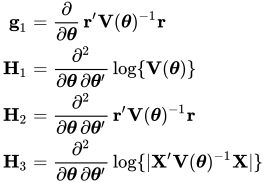
StartLayout 1st Row 1st Column bold g 1 2nd Column equals StartFraction partial-differential Over partial-differential bold-italic theta EndFraction bold r prime bold upper V left-parenthesis bold-italic theta right-parenthesis Superscript negative 1 Baseline bold r 2nd Row 1st Column bold upper H 1 2nd Column equals StartFraction partial-differential squared Over partial-differential bold-italic theta partial-differential bold-italic theta prime EndFraction log left-brace bold upper V left-parenthesis bold-italic theta right-parenthesis right-brace 3rd Row 1st Column bold upper H 2 2nd Column equals StartFraction partial-differential squared Over partial-differential bold-italic theta partial-differential bold-italic theta prime EndFraction bold r prime bold upper V left-parenthesis bold-italic theta right-parenthesis Superscript negative 1 Baseline bold r 4th Row 1st Column bold upper H 3 2nd Column equals StartFraction partial-differential squared Over partial-differential bold-italic theta partial-differential bold-italic theta prime EndFraction log left-brace StartAbsoluteValue bold upper X prime bold upper V left-parenthesis bold-italic theta right-parenthesis Superscript negative 1 Baseline bold upper X EndAbsoluteValue right-brace EndLayout

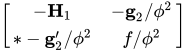
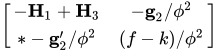
Table 25 gives expressions for the Hessian matrix bold upper H depending on estimation method, profiling, and scoring.

Table 25: Hessian Computation in PROC GLIMMIX

Profiling Scoring MxPL RxPL
No No bold upper H 1 plus bold upper H 2 bold upper H 1 plus bold upper H 2 plus bold upper H 3
No Yes minus bold upper H 1 minus bold upper H 1 plus bold upper H 3
No Modified    minus bold upper H 1 minus bold upper H 1 minus bold upper H 3
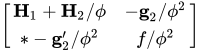
Yes No Start 2 By 2 Matrix 1st Row 1st Column bold upper H 1 plus bold upper H 2 slash phi 2nd Column minus bold g 2 slash phi squared 2nd Row 1st Column asterisk minus bold g prime 2 slash phi squared 2nd Column f slash phi squared EndMatrix   Start 2 By 2 Matrix 1st Row 1st Column bold upper H 1 plus bold upper H 2 slash phi plus bold upper H 3 2nd Column minus bold g 2 slash phi squared 2nd Row 1st Column asterisk minus bold g prime 2 slash phi squared 2nd Column left-parenthesis f minus k right-parenthesis slash phi squared EndMatrix
Yes Yes Start 2 By 2 Matrix 1st Row 1st Column minus bold upper H 1 2nd Column minus bold g 2 slash phi squared 2nd Row 1st Column asterisk minus bold g prime 2 slash phi squared 2nd Column f slash phi squared EndMatrix Start 2 By 2 Matrix 1st Row 1st Column minus bold upper H 1 plus bold upper H 3 2nd Column minus bold g 2 slash phi squared 2nd Row 1st Column asterisk minus bold g prime 2 slash phi squared 2nd Column left-parenthesis f minus k right-parenthesis slash phi squared EndMatrix
Yes Modified Start 2 By 2 Matrix 1st Row 1st Column minus bold upper H 1 2nd Column minus bold g 2 slash phi squared 2nd Row 1st Column asterisk minus bold g prime 2 slash phi squared 2nd Column f slash phi squared EndMatrix Start 2 By 2 Matrix 1st Row 1st Column minus bold upper H 1 minus bold upper H 3 2nd Column minus bold g 2 slash phi squared 2nd Row 1st Column asterisk minus bold g prime 2 slash phi squared 2nd Column left-parenthesis f minus k right-parenthesis slash phi squared EndMatrix


The "Modified" expressions for the Hessian under scoring in RxPL estimation refer to a modified scoring method. In some cases, the modification leads to faster convergence than the standard scoring algorithm. The modification is requested with the SCOREMOD option in the PROC GLIMMIX statement.

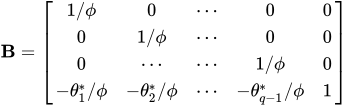
Finally, in the case of a profiled scale parameter phi, the Hessian for the left-parenthesis bold-italic theta Superscript asterisk Baseline comma phi right-parenthesis parameterization is converted into that for the bold-italic theta parameterization as

bold upper H left-parenthesis bold-italic theta right-parenthesis equals bold upper B bold upper H left-parenthesis bold-italic theta Superscript asterisk Baseline comma phi right-parenthesis bold upper B prime

where

bold upper B equals Start 4 By 5 Matrix 1st Row 1st Column 1 slash phi 2nd Column 0 3rd Column midline-horizontal-ellipsis 4th Column 0 5th Column 0 2nd Row 1st Column 0 2nd Column 1 slash phi 3rd Column midline-horizontal-ellipsis 4th Column 0 5th Column 0 3rd Row 1st Column 0 2nd Column midline-horizontal-ellipsis 3rd Column midline-horizontal-ellipsis 4th Column 1 slash phi 5th Column 0 4th Row 1st Column minus theta 1 Superscript asterisk Baseline slash phi 2nd Column minus theta 2 Superscript asterisk Baseline slash phi 3rd Column midline-horizontal-ellipsis 4th Column minus theta Subscript q minus 1 Superscript asterisk Baseline slash phi 5th Column 1 EndMatrix
Subject-Specific and Population-Averaged (Marginal) Expansions

There are two basic choices for the expansion locus of the linearization. A subject-specific (SS) expansion uses
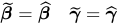
bold-italic beta overTilde equals ModifyingAbove bold-italic beta With caret bold-italic gamma overTilde equals ModifyingAbove bold-italic gamma With caret

which are the current estimates of the fixed effects and estimated BLUPs. The population-averaged (PA) expansion expands about the same fixed effects and the expected value of the random effects
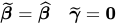
bold-italic beta overTilde equals ModifyingAbove bold-italic beta With caret bold-italic gamma overTilde equals bold 0

To recompute the pseudo-response and weights in the SS expansion, the BLUPs must be computed every time the objective function in the linear mixed model is maximized. The PA expansion does not require any BLUPs. The four pseudo-likelihood methods implemented in the GLIMMIX procedure are the 2 times 2 factorial combination between two expansion loci and residual versus maximum pseudo-likelihood estimation. The following table shows the combination and the corresponding values of the METHOD= option (PROC GLIMMIX statement); METHOD=RSPL is the default.

Type of Expansion Locus
PL ModifyingAbove bold-italic gamma With caret Eleft-bracket bold-italic gamma right-bracket
Residual RSPL RMPL
Maximum MSPL MMPL

Last updated: December 09, 2022