The GLIMMIX Procedure
Design-Adjusted MBN Estimator
Morel (1989) and Morel, Bokossa, and Neerchal (2003) suggested a bias correction of the classical sandwich estimator that rests on an additive correction of the residual crossproducts and a sample size correction. This estimator is available with the EMPIRICAL=MBN option in the PROC GLIMMIX statement. In the notation of the previous section, the residual-based MBN estimator can be written as

where
 or c = 1 when you specify the EMPIRICAL=MBN(NODF) option
 f is the sum of the frequencies
k equals the rank of

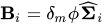


 if
if  , otherwise
  equals the number of nonzero singular values of
 if
if  and
and  otherwise
  and
and  are parameters supplied with the mbn-options of the EMPIRICAL=MBN(mbn-options) option. The default values are d = 2 and r = 1. When the NODF option is in effect, the factor c is set to 1.
Rearranging terms, the MBN estimator can also be written as an additive adjustment to a sample-size corrected classical sandwich estimator

Because  is of order
  , the additive adjustment to the classical estimator vanishes as the number of independent sampling units (subjects) increases. The parameter
  is a measure of the design effect (Morel, Bokossa, and Neerchal 2003). Besides good statistical properties in terms of Type I error rates in small-m situations, the MBN estimator also has the desirable property of recovering rank when the number of sampling units is small. If
  , the "meat" piece of the classical sandwich estimator is essentially a sum of rank one matrices. A small number of subjects relative to the rank of
  can result in a loss of rank and subsequent loss of numerator degrees of freedom in tests. The additive MBN adjustment counters the rank exhaustion. You can examine the rank of an adjusted covariance matrix with the COVB(DETAILS) option in the MODEL statement.
When the principle of the MBN estimator is applied to the likelihood-based empirical estimator, you obtain

where  , and
, and  is the second derivative of the log likelihood for the ith sampling unit (subject) evaluated at the vector of parameter estimates,
  . Also,
  is the first derivative of the log likelihood for the ith sampling unit. This estimator is computed if you request EMPIRICAL=MBN with METHOD=LAPLACE or METHOD=QUAD.
In terms of adjusting the classical likelihood-based estimator (White 1982), the likelihood MBN estimator can be written as

The parameter is determined as


- if , otherwise equals the number of nonzero singular values of
