The GLIMMIX Procedure

Odds Ratios in Multinomial Models

The GLIMMIX procedure fits two kinds of models to multinomial data. Models with cumulative link functions apply to ordinal data, and generalized logit models are fit to nominal data. If you model a multinomial response with LINK=CUMLOGIT or LINK=GLOGIT, odds ratio results are available for these models.

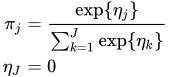
In the generalized logit model, you model baseline category logits. By default, the GLIMMIX procedure chooses the last category as the reference category. If your nominal response has J categories, the baseline logit for category j is

log left-brace pi Subscript j Baseline slash pi Subscript upper J Baseline right-brace equals eta Subscript j Baseline equals bold x prime bold-italic beta Subscript j Baseline plus bold z prime bold u Subscript j

and

StartLayout 1st Row 1st Column pi Subscript j 2nd Column equals StartFraction exp left-brace eta Subscript j Baseline right-brace Over sigma-summation Underscript k equals 1 Overscript upper J Endscripts exp left-brace eta Subscript k Baseline right-brace EndFraction 2nd Row 1st Column eta Subscript upper J 2nd Column equals 0 EndLayout

As before, suppose that the two conditions to be compared are identified with subscripts 1 and 0. The log odds ratio of outcome j versus J for the two conditions is then

StartLayout 1st Row 1st Column log left-brace psi left-parenthesis eta Subscript j Baseline 1 Baseline comma eta Subscript j Baseline 0 Baseline right-parenthesis right-brace 2nd Column equals log left-brace StartFraction pi Subscript j Baseline 1 Baseline slash pi Subscript upper J Baseline 1 Baseline Over pi Subscript j Baseline 0 Baseline slash pi Subscript upper J Baseline 0 Baseline EndFraction right-brace equals log left-brace StartFraction exp left-brace eta Subscript j Baseline 1 Baseline right-brace Over exp left-brace eta Subscript j Baseline 0 Baseline right-brace EndFraction right-brace 2nd Row 1st Column Blank 2nd Column equals eta Subscript j Baseline 1 Baseline minus eta Subscript j Baseline 0 EndLayout

Note that the log odds ratios are again differences on the scale of the linear predictor, but they depend on the response category. The GLIMMIX procedure determines the estimable functions whose differences represent log odds ratios as discussed previously but produces separate estimates for each nonreference response category.

In models for ordinal data, PROC GLIMMIX models the logits of cumulative probabilities. Thus, the estimates on the linear scale represent log cumulative odds. The cumulative logits are formed as

log left-brace StartFraction normal upper P normal r left-parenthesis upper Y less-than-or-equal-to j right-parenthesis Over normal upper P normal r left-parenthesis upper Y greater-than j right-parenthesis EndFraction right-brace equals eta Subscript j Baseline equals alpha Subscript j Baseline plus bold x prime bold-italic beta plus bold z prime bold-italic gamma equals alpha Subscript j Baseline plus eta overTilde

so that the linear predictor depends on the response category only through the intercepts (cutoffs) alpha 1 comma ellipsis comma alpha Subscript upper J minus 1 Baseline. The odds ratio comparing two conditions represented by linear predictors eta Subscript j Baseline 1 and eta Subscript j Baseline 0 is then

StartLayout 1st Row 1st Column psi left-parenthesis eta Subscript j Baseline 1 Baseline comma eta Subscript j Baseline 0 Baseline right-parenthesis 2nd Column equals exp left-brace eta Subscript j Baseline 1 Baseline minus eta Subscript j Baseline 0 Baseline right-brace 2nd Row 1st Column Blank 2nd Column equals exp left-brace eta overTilde Subscript 1 Baseline minus eta overTilde Subscript 0 Baseline right-brace EndLayout

and is independent of category.

Last updated: December 09, 2022