The GLIMMIX Procedure
Type III Tests of Fixed Effects
The "Type III Tests of Fixed Effects" table contains hypothesis tests for the significance of each of the fixed effects specified in the MODEL statement. By default, PROC GLIMMIX computes these tests by first constructing a Type III  matrix for each effect; see Chapter 16, The Four Types of Estimable Functions.
The matrix is then used to construct the test statistic
matrix for each effect; see Chapter 16, The Four Types of Estimable Functions.
The matrix is then used to construct the test statistic
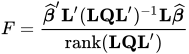
where the matrix  depends on the estimation method and options. For example, in a GLMM, the default is
  , where
  is the marginal variance of the pseudo-response. If you specify the DDFM=KENWARDROGER option, is the estimated variance matrix of the fixed effects, adjusted by the method of Kenward and Roger (1997). If the EMPIRICAL= option is in effect, corresponds to the selected sandwich estimator.
You can use the HTYPE= option in the MODEL statement to obtain tables of Type I (sequential) tests and Type II (adjusted) tests in addition to or instead of the table of Type III (partial) tests.
The ODS names of the "Type I Tests of Fixed Effects" through the "Type III Tests of Fixed Effects" tables are Tests1 through Tests3, respectively.