The GLMPOWER Procedure

Contrasts in Fixed-Effect Multivariate Models

The multivariate model has the form

bold upper Y equals bold upper X bold-italic beta plus bold-italic epsilon

where bold upper Y is the N times p vector of responses, for p > 1; bold upper X is the N times k design matrix; bold-italic beta is the k times p matrix of model parameters that correspond to the columns of bold upper X and bold upper Y; and bold-italic epsilon is an N times p vector of errors, where

epsilon 1 comma ellipsis comma epsilon Subscript upper N Baseline tilde normal upper N left-parenthesis 0 comma bold upper Sigma right-parenthesis left-parenthesis normal i normal i normal d right-parenthesis

In PROC GLMPOWER, the model parameters bold-italic beta are not specified directly, but rather indirectly as bold upper Y Superscript star, which represents either conjectured response means or typical response values for each design profile. The bold upper Y Superscript star values are manifested as the collection of dependent variables in the MODEL statement. The matrix bold-italic beta is obtained from bold upper Y Superscript star according to the least squares equation,

bold-italic beta equals left-parenthesis bold upper X prime bold upper X right-parenthesis Superscript minus Baseline bold upper X prime bold upper Y Superscript star

Note that, in general, there is not a one-to-one mapping between bold upper Y Superscript star and bold-italic beta. Many different scenarios for bold upper Y Superscript star might lead to the same bold-italic beta. If you specify bold upper Y Superscript star with the intention of representing cell means, keep in mind that PROC GLMPOWER allows scenarios that are not valid cell means according to the model that is specified in the MODEL statement. For example, if bold upper Y Superscript star exhibits an interaction effect but the corresponding interaction term is left out of the model, then the cell means (bold upper X bold-italic beta) that are derived from bold-italic beta differ from bold upper Y Superscript star. In particular, the cell means that are derived in this way are the projection of bold upper Y Superscript star onto the model space.

It is convenient in power analysis to parameterize the design matrix bold upper X in three parts, StartSet ModifyingAbove bold upper X With two-dots comma bold upper W comma upper N EndSet, defined as follows:

  1. The q times k essence design matrix ModifyingAbove bold upper X With two-dots is the collection of unique rows of bold upper X. Its rows are sometimes referred to as "design profiles." Here, q less-than-or-equal-to N is defined simply as the number of unique rows of bold upper X.

  2. The q times 1 weight vector bold w reveals the relative proportions of design profiles, and bold upper W equals normal d normal i normal a normal g left-parenthesis bold w right-parenthesis. Row i of ModifyingAbove bold upper X With two-dots is to be included in the design w Subscript i times for every w Subscript j times that row j is included. The weights are assumed to be standardized (that is, they sum up to 1).

  3. The total sample size is N. This is the number of rows in bold upper X. If you gather upper N w Subscript i Baseline equals n Subscript i copies of the ith row of ModifyingAbove bold upper X With two-dots, for i equals 1 comma ellipsis comma q, then you end up with bold upper X.

The preceding quantities are derived from PROC GLMPOWER syntax as follows:

  • Values for ModifyingAbove bold upper X With two-dots, bold upper Y Superscript star, and bold w are specified in the exemplary data set (from using the DATA= option in the PROC GLMPOWER statement), and the corresponding variables are identified in the CLASS, MODEL, and WEIGHT statements.

  • N is specified in the NTOTAL= option in the POWER statement.

It is useful to express the crossproduct matrix bold upper X prime bold upper X in terms of these three parts,

bold upper X prime bold upper X equals upper N ModifyingAbove bold upper X With two-dots prime bold upper W ModifyingAbove bold upper X With two-dots

because this expression factors out the portion (N) that depends on sample size and the portion (ModifyingAbove bold upper X With two-dots prime bold upper W ModifyingAbove bold upper X With two-dots) that depends only on the design structure.

A general linear hypothesis for the univariate model has the form
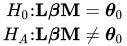
StartLayout 1st Row 1st Column upper H 0 colon 2nd Column bold upper L bold-italic beta bold upper M equals bold-italic theta 0 2nd Row 1st Column upper H Subscript upper A Baseline colon 2nd Column bold upper L bold-italic beta bold upper M not-equals bold-italic theta 0 EndLayout

where bold upper L is an l times k between-subject contrast matrix with rank r Subscript upper L, bold upper M is a p times m within-subject contrast matrix with rank r Subscript upper M, and bold-italic theta 0 is an l times m null contrast matrix (usually just a matrix of zeros).

Note that model effect tests are just between-subject contrasts that use special forms of bold upper L, combined with an bold upper M that is the p times 1 mean transformation vector of the dependent variables (a vector of values all equal to 1 slash p). Thus, this scheme covers both effect tests (which are specified in the MODEL statement and the EFFECTS= option in the POWER statement) and custom between-subject contrasts (which are specified in the CONTRAST statement).

The bold upper M matrix is often referred to as the dependent variable transformation and is specified in the MANOVA or REPEATED statement.

The model degrees of freedom normal upper D normal upper F Subscript normal upper M are equal to the rank of bold upper X, denoted r Subscript upper X. The error degrees of freedom normal upper D normal upper F Subscript normal upper E are equal to Nr Subscript upper X.

The hypothesis sum of squares normal upper S normal upper S Subscript normal upper H in the univariate model generalizes to the hypothesis SSCP matrix in the multivariate model,

bold upper H equals left-parenthesis bold upper L ModifyingAbove bold-italic beta With caret bold upper M minus bold-italic theta 0 right-parenthesis prime left-parenthesis bold upper L left-parenthesis bold upper X prime bold upper X right-parenthesis Superscript negative 1 Baseline bold upper L prime right-parenthesis Superscript negative 1 Baseline left-parenthesis bold upper L ModifyingAbove bold-italic beta With caret bold upper M minus bold-italic theta 0 right-parenthesis

The error sum of squares ModifyingAbove sigma With caret squared left-parenthesis upper N minus r Subscript upper X Baseline right-parenthesis in the univariate model generalizes to the error SSCP matrix in the multivariate model,

bold upper E equals left-parenthesis upper N minus r Subscript upper X Baseline right-parenthesis bold upper M prime ModifyingAbove bold upper Sigma With caret bold upper M

where

ModifyingAbove bold upper Sigma With caret equals left-parenthesis bold upper Y minus bold upper X ModifyingAbove bold-italic beta With caret right-parenthesis prime left-parenthesis bold upper Y minus bold upper X ModifyingAbove bold-italic beta With caret right-parenthesis slash left-parenthesis upper N minus r Subscript upper X Baseline right-parenthesis

and

ModifyingAbove bold-italic beta With caret equals left-parenthesis bold upper X prime bold upper X right-parenthesis Superscript minus Baseline bold upper X prime bold upper Y

The population counterpart of bold upper H slash upper N is

bold upper H Superscript star Baseline equals left-parenthesis bold upper L bold-italic beta bold upper M minus bold-italic theta 0 right-parenthesis prime left-parenthesis bold upper L left-parenthesis ModifyingAbove bold upper X With two-dots prime bold upper W ModifyingAbove bold upper X With two-dots right-parenthesis Superscript minus Baseline bold upper L prime right-parenthesis Superscript negative 1 Baseline left-parenthesis bold upper L bold-italic beta bold upper M minus bold-italic theta 0 right-parenthesis

and the population counterpart of bold upper E slash upper N is

bold upper E Superscript star Baseline equals bold upper M prime bold upper Sigma bold upper M

The elements of bold upper Sigma are specified in the MATRIX= and STDDEV= options and identified in the CORRMAT=, CORRS=, COVMAT=, and SQRTVAR= options in the POWER statement.

The power and sample size computations for all the tests that are supported in the MTEST= option in the POWER statement are based on bold upper H Superscript star and bold upper E Superscript star. The following two subsections cover the computational methods and formulas for the multivariate and univariate tests that are supported in the MTEST= and UEPSDEF= options in the POWER statement.

Multivariate Tests

Power computations for multivariate tests are based on O’Brien and Shieh (1992) (for METHOD=OBRIENSHIEH) and Muller and Peterson (1984) (for METHOD=MULLERPETERSON).

Let s = min left-parenthesis r Subscript upper L Baseline comma r Subscript upper M Baseline right-parenthesis, the smaller of the between-subject and within-subject contrast degrees of freedom. Critical value computations assume that under upper H 0, the test statistic F is distributed as upper F left-parenthesis r Subscript upper L Baseline r Subscript upper M Baseline comma nu 2 right-parenthesis, where nu 2 equals left-parenthesis upper N minus r Subscript upper X Baseline right-parenthesis minus r Subscript upper M Baseline plus 1 if s = 1 but depends on the choice of test if s > 1. Power computations assume that under upper H Subscript upper A, F is distributed as upper F left-parenthesis r Subscript upper L Baseline r Subscript upper M Baseline comma nu 2 comma lamda right-parenthesis, where the noncentrality lamda depends on r Subscript upper L, r Subscript upper M, the choice of test, and the power computation method.

Formulas for the test statistic F, denominator degrees of freedom nu 2, and noncentrality lamda for all combinations of dimensions, tests, and methods are given in the following subsections.

The power in each case is computed as

normal p normal o normal w normal e normal r equals upper P left-parenthesis upper F left-parenthesis r Subscript upper L Baseline r Subscript upper M Baseline comma nu 2 comma lamda right-parenthesis greater-than-or-equal-to upper F Subscript 1 minus alpha Baseline left-parenthesis r Subscript upper L Baseline r Subscript upper M Baseline comma nu 2 right-parenthesis right-parenthesis

Computed power is exact for some cases and approximate for others. Sample size is computed by inverting the power equation.

Let bold upper Delta equals bold upper E Superscript negative 1 Baseline bold upper H, and define bold-italic phi as the s times 1 vector of ordered positive eigenvalues of bold upper Delta, bold-italic phi equals StartSet phi 1 comma ellipsis comma phi Subscript s Baseline EndSet, where phi 1 greater-than-or-equal-to midline-horizontal-ellipsis greater-than-or-equal-to phi Subscript s Baseline greater-than 0. The population equivalent is

StartLayout 1st Row 1st Column bold upper Delta Superscript star 2nd Column equals bold upper E Superscript star Baseline Superscript negative 1 Baseline bold upper H Superscript star Baseline 2nd Row 1st Column Blank 2nd Column equals left-parenthesis bold upper M prime bold upper Sigma bold upper M right-parenthesis Superscript negative 1 Baseline left-parenthesis bold upper L bold-italic beta bold upper M minus bold-italic theta 0 right-parenthesis prime left-parenthesis bold upper L left-parenthesis ModifyingAbove bold upper X With two-dots prime bold upper W ModifyingAbove bold upper X With two-dots right-parenthesis Superscript negative 1 Baseline bold upper L prime right-parenthesis Superscript negative 1 Baseline left-parenthesis bold upper L bold-italic beta bold upper M minus bold-italic theta 0 right-parenthesis EndLayout

where bold-italic phi Superscript star is the s times 1 vector of ordered positive eigenvalues of bold upper Delta Superscript star, bold-italic phi Superscript star Baseline equals StartSet phi 1 Superscript star Baseline comma ellipsis comma phi Subscript s Superscript star Baseline EndSet for phi 1 Superscript star Baseline greater-than-or-equal-to midline-horizontal-ellipsis greater-than-or-equal-to phi Subscript s Superscript star Baseline greater-than 0.

Case 1: s = 1

When s = 1, all three multivariate tests (MTEST=HLT, MTEST=PT, and MTEST=WILKS) are equivalent. The test statistic is F = phi 1 nu 2 slash left-parenthesis r Subscript upper L Baseline r Subscript upper M Baseline right-parenthesis, where nu 2 equals left-parenthesis upper N minus r Subscript upper X Baseline right-parenthesis minus r Subscript upper M Baseline plus 1.

When the dependent variable transformation has a single degree of freedom (r Subscript upper M Baseline equals 1), METHOD=OBRIENSHIEH and METHOD=MULLERPETERSON are the same, computing exact power by using noncentrality lamda equals upper N bold upper Delta Superscript star. The sample size must satisfy upper N greater-than-or-equal-to r Subscript upper X Baseline plus 1.

When the dependent variable transformation has more than one degree of freedom but the between-subject contrast has a single degree of freedom (r Subscript upper M Baseline greater-than 1 comma r Subscript upper L Baseline equals 1), METHOD=OBRIENSHIEH computes exact power by using noncentrality lamda equals upper N phi 1 Superscript star, and METHOD=MULLERPETERSON computes approximate power by using

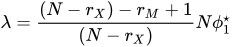
lamda equals StartFraction left-parenthesis upper N minus r Subscript upper X Baseline right-parenthesis minus r Subscript upper M Baseline plus 1 Over left-parenthesis upper N minus r Subscript upper X Baseline right-parenthesis EndFraction upper N phi 1 Superscript star

The sample size must satisfy upper N greater-than-or-equal-to r Subscript upper X Baseline plus r Subscript upper M.

Case 2: s > 1

When both the dependent variable transformation and the between-subject contrast have more than one degree of freedom (s > 1), METHOD=OBRIENSHIEH computes the noncentrality as lamda equals upper N lamda Superscript star, where lamda Superscript star is the primary noncentrality. The form of lamda Superscript star depends on the choice of test statistic.

METHOD=MULLERPETERSON computes the noncentrality as lamda equals nu 2 lamda Superscript left-parenthesis normal upper M normal upper P right-parenthesis Baseline Superscript star, where lamda Superscript left-parenthesis normal upper M normal upper P right-parenthesis Baseline Superscript star has the same form as lamda Superscript star except that bold-italic phi Superscript star is replaced by
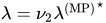
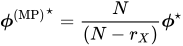
bold-italic phi Superscript left-parenthesis normal upper M normal upper P right-parenthesis Baseline Superscript star Baseline equals StartFraction upper N Over left-parenthesis upper N minus r Subscript upper X Baseline right-parenthesis EndFraction bold-italic phi Superscript star

Computed power is approximate for both methods when s > 1.

Hotelling-Lawley Trace (MTEST=HLT) When s > 1

If upper N greater-than r Subscript upper X Baseline plus r Subscript upper M Baseline plus 1, then the denominator degrees of freedom for the Hotelling-Lawley trace are nu 2 equals nu Subscript 2 a,

nu Subscript 2 a Baseline equals 4 plus left-parenthesis r Subscript upper L Baseline r Subscript upper M Baseline plus 2 right-parenthesis g

where

g equals StartFraction left-parenthesis upper N minus r Subscript upper X Baseline right-parenthesis squared minus left-parenthesis upper N minus r Subscript upper X Baseline right-parenthesis left-parenthesis 2 r Subscript upper M Baseline plus 3 right-parenthesis plus r Subscript upper M Baseline left-parenthesis r Subscript upper M Baseline plus 3 right-parenthesis Over left-parenthesis upper N minus r Subscript upper X Baseline right-parenthesis left-parenthesis r Subscript upper L Baseline plus r Subscript upper M Baseline plus 1 right-parenthesis minus left-parenthesis r Subscript upper L Baseline plus 2 r Subscript upper M Baseline plus r Subscript upper M Superscript 2 Baseline minus 1 right-parenthesis EndFraction

which is the same as nu 2 Superscript left-parenthesis upper T 2 right-parenthesis in O’Brien and Shieh (1992) and is due to McKeon (1974).

If upper N less-than-or-equal-to r Subscript upper X Baseline plus r Subscript upper M Baseline plus 1, then nu 2 equals nu Subscript 2 b,

nu Subscript 2 b Baseline equals s left-parenthesis left-parenthesis upper N minus r Subscript upper X Baseline right-parenthesis minus r Subscript upper M Baseline minus 1 right-parenthesis plus 2

which is the same as both nu 2 Superscript left-parenthesis upper T 1 right-parenthesis in O’Brien and Shieh (1992) and nu 2 in Muller and Peterson (1984) and is due to Pillai and Samson (1959).

The primary noncentrality is

lamda Superscript star Baseline equals sigma-summation Underscript i equals 1 Overscript s Endscripts phi Subscript i Superscript star

The sample size must satisfy

upper N greater-than-or-equal-to r Subscript upper X Baseline plus r Subscript upper M Baseline plus 1 minus 1 slash s

If upper N greater-than r Subscript upper X Baseline plus r Subscript upper M Baseline plus 1, then the test statistic is

upper F equals StartFraction upper U slash nu 1 Over c slash nu Subscript 2 a Baseline EndFraction

where

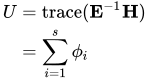
StartLayout 1st Row 1st Column upper U 2nd Column equals normal t normal r normal a normal c normal e left-parenthesis bold upper E Superscript negative 1 Baseline bold upper H right-parenthesis 2nd Row 1st Column Blank 2nd Column equals sigma-summation Underscript i equals 1 Overscript s Endscripts phi Subscript i EndLayout

and

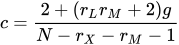
c equals StartFraction 2 plus left-parenthesis r Subscript upper L Baseline r Subscript upper M Baseline plus 2 right-parenthesis g Over upper N minus r Subscript upper X Baseline minus r Subscript upper M Baseline minus 1 EndFraction

If upper N less-than-or-equal-to r Subscript upper X Baseline plus r Subscript upper M Baseline plus 1, then the test statistic is

upper F equals StartFraction upper U slash nu 1 Over s slash nu Subscript 2 b Baseline EndFraction

Pillai’s Trace (MTEST=PT) When s > 1

The denominator degrees of freedom for Pillai’s trace are

nu 2 equals s left-parenthesis left-parenthesis upper N minus r Subscript upper X Baseline right-parenthesis plus s minus r Subscript upper M Baseline right-parenthesis

The primary noncentrality is

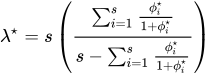
lamda Superscript star Baseline equals s left-parenthesis StartStartFraction sigma-summation Underscript i equals 1 Overscript s Endscripts StartFraction phi Subscript i Superscript star Baseline Over 1 plus phi Subscript i Superscript star Baseline EndFraction OverOver s minus sigma-summation Underscript i equals 1 Overscript s Endscripts StartFraction phi Subscript i Superscript star Baseline Over 1 plus phi Subscript i Superscript star Baseline EndFraction EndEndFraction right-parenthesis

The sample size must satisfy

upper N greater-than-or-equal-to r Subscript upper X Baseline plus r Subscript upper M Baseline plus 1 slash s minus s

The test statistic is

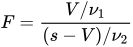
upper F equals StartFraction upper V slash nu 1 Over left-parenthesis s minus upper V right-parenthesis slash nu 2 EndFraction

where

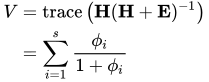
StartLayout 1st Row 1st Column upper V 2nd Column equals normal t normal r normal a normal c normal e left-parenthesis bold upper H left-parenthesis bold upper H plus bold upper E right-parenthesis Superscript negative 1 Baseline right-parenthesis 2nd Row 1st Column Blank 2nd Column equals sigma-summation Underscript i equals 1 Overscript s Endscripts StartFraction phi Subscript i Baseline Over 1 plus phi Subscript i Baseline EndFraction EndLayout

Wilks’ Lambda (MTEST=WILKS) When s > 1

The denominator degrees of freedom for Wilks’ lambda are

nu 2 equals t left-bracket left-parenthesis upper N minus r Subscript upper X Baseline right-parenthesis minus 0.5 left-parenthesis r Subscript upper M Baseline minus r Subscript upper L Baseline plus 1 right-parenthesis right-bracket minus 0.5 left-parenthesis r Subscript upper L Baseline r Subscript upper M Baseline minus 2 right-parenthesis

where

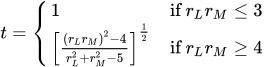
t equals StartLayout Enlarged left-brace 1st Row 1st Column 1 2nd Column if r Subscript upper L Baseline r Subscript upper M Baseline less-than-or-equal-to 3 2nd Row 1st Column left-bracket StartFraction left-parenthesis r Subscript upper L Baseline r Subscript upper M Baseline right-parenthesis squared minus 4 Over r Subscript upper L Superscript 2 Baseline plus r Subscript upper M Superscript 2 Baseline minus 5 EndFraction right-bracket Superscript one-half Baseline 2nd Column if r Subscript upper L Baseline r Subscript upper M Baseline greater-than-or-equal-to 4 EndLayout

The primary noncentrality is

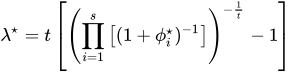
lamda Superscript star Baseline equals t left-bracket left-parenthesis product Underscript i equals 1 Overscript s Endscripts left-bracket left-parenthesis 1 plus phi Subscript i Superscript star Baseline right-parenthesis Superscript negative 1 Baseline right-bracket right-parenthesis Superscript minus StartFraction 1 Over t EndFraction Baseline minus 1 right-bracket

The sample size must satisfy

upper N greater-than-or-equal-to left-parenthesis 1 plus 0.5 left-parenthesis r Subscript upper L Baseline r Subscript upper M Baseline minus 2 right-parenthesis right-parenthesis slash t plus r Subscript upper X Baseline plus left-parenthesis r Subscript upper M Baseline minus r Subscript upper L Baseline plus 1 right-parenthesis slash 2

The test statistic is

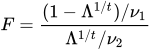
upper F equals StartFraction left-parenthesis 1 minus normal upper Lamda Superscript 1 slash t Baseline right-parenthesis slash nu 1 Over normal upper Lamda Superscript 1 slash t Baseline slash nu 2 EndFraction

where

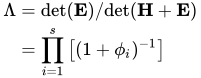
StartLayout 1st Row 1st Column normal upper Lamda 2nd Column equals normal d normal e normal t left-parenthesis bold upper E right-parenthesis slash normal d normal e normal t left-parenthesis bold upper H plus bold upper E right-parenthesis 2nd Row 1st Column Blank 2nd Column equals product Underscript i equals 1 Overscript s Endscripts left-bracket left-parenthesis 1 plus phi Subscript i Baseline right-parenthesis Superscript negative 1 Baseline right-bracket EndLayout
Univariate Tests

Power computations for univariate tests are based on Muller et al. (2007) and Muller and Barton (1989).

The test statistic is
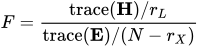
upper F equals StartFraction normal t normal r normal a normal c normal e left-parenthesis bold upper H right-parenthesis slash r Subscript upper L Baseline Over normal t normal r normal a normal c normal e left-parenthesis bold upper E right-parenthesis slash left-parenthesis upper N minus r Subscript upper X Baseline right-parenthesis EndFraction

Critical value computations assume that under upper H 0, F is distributed as upper F left-parenthesis nu 1 comma nu 2 right-parenthesis, where nu 1 and nu 2 depend on the choice of test.

The four tests for the univariate approach to repeated measures differ in their assumptions about the sphericity epsilon of bold upper E Superscript star,

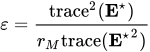
epsilon equals StartFraction normal t normal r normal a normal c normal e squared left-parenthesis bold upper E Superscript star Baseline right-parenthesis Over r Subscript upper M Baseline normal t normal r normal a normal c normal e left-parenthesis bold upper E Superscript star Baseline squared right-parenthesis EndFraction

Power computations assume that under upper H Subscript upper A, F is distributed as upper F left-parenthesis nu 1 Superscript star Baseline comma nu 2 Superscript star Baseline comma lamda right-parenthesis.

Formulas for nu 1 and nu 2 for each test and formulas for nu 1 Superscript star, nu 2 Superscript star, and lamda are given in the following subsections.

The power in each case is approximated as

normal p normal o normal w normal e normal r equals upper P left-parenthesis upper F left-parenthesis nu 1 Superscript star Baseline comma nu 2 Superscript star Baseline comma lamda right-parenthesis greater-than-or-equal-to upper F Subscript 1 minus alpha Baseline left-parenthesis nu 1 comma nu 2 right-parenthesis right-parenthesis

Sample size is computed by inverting the power equation.

The sample size must be large enough to yield nu 1 greater-than 0, nu 1 Superscript star Baseline greater-than 0, nu 2 greater-than-or-equal-to 1, and nu 2 Superscript star Baseline greater-than-or-equal-to 1.

Because these univariate tests are biased, the achieved significance level might differ from the nominal significance level. The actual alpha is computed in the same way as the power, except that the noncentrality parameter lamda is set to 0.

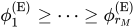
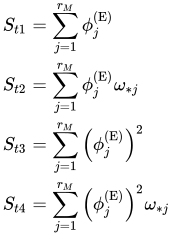
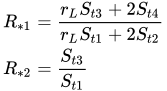
Define bold-italic phi Superscript left-parenthesis normal upper E right-parenthesis as the vector of ordered eigenvalues of bold upper E Superscript star, bold-italic phi Superscript left-parenthesis normal upper E right-parenthesis Baseline equals StartSet phi 1 Superscript left-parenthesis normal upper E right-parenthesis Baseline comma ellipsis comma phi Subscript r Sub Subscript upper M Subscript Superscript left-parenthesis normal upper E right-parenthesis Baseline EndSet, where phi 1 Superscript left-parenthesis normal upper E right-parenthesis Baseline greater-than-or-equal-to midline-horizontal-ellipsis greater-than-or-equal-to phi Subscript r Sub Subscript upper M Superscript left-parenthesis normal upper E right-parenthesis, and define bold-italic gamma Subscript j Superscript left-parenthesis normal upper E right-parenthesis as the jth eigenvector of bold upper E Superscript star. Critical values and power computations are based on the following intermediate parameters:

omega Subscript asterisk j Baseline equals upper N left-parenthesis bold-italic gamma Subscript j Superscript left-parenthesis normal upper E right-parenthesis Baseline right-parenthesis prime bold upper H Superscript star Baseline bold-italic gamma Subscript j Superscript left-parenthesis normal upper E right-parenthesis Baseline slash phi Subscript j Superscript left-parenthesis normal upper E right-parenthesis
StartLayout 1st Row 1st Column upper S Subscript t Baseline 1 2nd Column equals sigma-summation Underscript j equals 1 Overscript r Subscript upper M Baseline Endscripts phi Subscript j Superscript left-parenthesis normal upper E right-parenthesis Baseline 2nd Row 1st Column upper S Subscript t Baseline 2 2nd Column equals sigma-summation Underscript j equals 1 Overscript r Subscript upper M Baseline Endscripts phi Subscript j Superscript left-parenthesis normal upper E right-parenthesis Baseline omega Subscript asterisk j Baseline 3rd Row 1st Column upper S Subscript t Baseline 3 2nd Column equals sigma-summation Underscript j equals 1 Overscript r Subscript upper M Baseline Endscripts left-parenthesis phi Subscript j Superscript left-parenthesis normal upper E right-parenthesis Baseline right-parenthesis squared 4th Row 1st Column upper S Subscript t Baseline 4 2nd Column equals sigma-summation Underscript j equals 1 Overscript r Subscript upper M Baseline Endscripts left-parenthesis phi Subscript j Superscript left-parenthesis normal upper E right-parenthesis Baseline right-parenthesis squared omega Subscript asterisk j EndLayout
StartLayout 1st Row 1st Column upper R Subscript asterisk 1 2nd Column equals StartFraction r Subscript upper L Baseline upper S Subscript t Baseline 3 Baseline plus 2 upper S Subscript t Baseline 4 Baseline Over r Subscript upper L Baseline upper S Subscript t Baseline 1 Baseline plus 2 upper S Subscript t Baseline 2 Baseline EndFraction 2nd Row 1st Column upper R Subscript asterisk 2 2nd Column equals StartFraction upper S Subscript t Baseline 3 Baseline Over upper S Subscript t Baseline 1 Baseline EndFraction EndLayout
StartLayout 1st Row 1st Column normal upper E left-parenthesis t 1 right-parenthesis 2nd Column equals 2 left-parenthesis upper N minus r Subscript upper X Baseline right-parenthesis upper S Subscript t Baseline 3 Baseline plus left-parenthesis upper N minus r Subscript upper X Baseline right-parenthesis squared upper S Subscript t Baseline 1 Superscript 2 Baseline 2nd Row 1st Column normal upper E left-parenthesis t 2 right-parenthesis 2nd Column equals left-parenthesis upper N minus r Subscript upper X Baseline right-parenthesis left-parenthesis left-parenthesis upper N minus r Subscript upper X Baseline right-parenthesis plus 2 right-parenthesis upper S Subscript t Baseline 3 Baseline plus 2 left-parenthesis upper N minus r Subscript upper X Baseline right-parenthesis sigma-summation Underscript j 1 equals 2 Overscript r Subscript upper M Baseline Endscripts sigma-summation Underscript j 2 equals 1 Overscript j 1 minus 1 Endscripts phi Subscript j 1 Superscript left-parenthesis normal upper E right-parenthesis Baseline phi Subscript j 2 Superscript left-parenthesis normal upper E right-parenthesis EndLayout

The degrees of freedom and noncentrality in the noncentral F approximation of the test statistic are computed as follows:

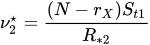
nu 1 Superscript star Baseline equals StartFraction r Subscript upper L Baseline upper S Subscript t Baseline 1 Baseline Over upper R Subscript asterisk 1 Baseline EndFraction
nu 2 Superscript star Baseline equals StartFraction left-parenthesis upper N minus r Subscript upper X Baseline right-parenthesis upper S Subscript t Baseline 1 Baseline Over upper R Subscript asterisk 2 Baseline EndFraction
lamda equals StartFraction upper S Subscript t Baseline 2 Baseline Over upper R Subscript asterisk 1 Baseline EndFraction

Uncorrected Test

The uncorrected test assumes sphericity epsilon equals 1, in which case the null F distribution is exact, with the following degrees of freedom:
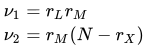
StartLayout 1st Row 1st Column nu 1 2nd Column equals r Subscript upper L Baseline r Subscript upper M Baseline 2nd Row 1st Column nu 2 2nd Column equals r Subscript upper M Baseline left-parenthesis upper N minus r Subscript upper X Baseline right-parenthesis EndLayout

Greenhouse-Geisser Adjustment (MTEST=UNCORR)

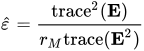
The Greenhouse-Geisser adjustment to the uncorrected test reduces degrees of freedom by the MLE ModifyingAbove epsilon With caret of the sphericity,

ModifyingAbove epsilon With caret equals StartFraction normal t normal r normal a normal c normal e squared left-parenthesis bold upper E right-parenthesis Over r Subscript upper M Baseline normal t normal r normal a normal c normal e left-parenthesis bold upper E squared right-parenthesis EndFraction

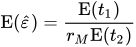
An approximation for the expected value of ModifyingAbove epsilon With caret is used to compute the degrees of freedom for the null F distribution,
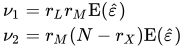
StartLayout 1st Row 1st Column nu 1 2nd Column equals r Subscript upper L Baseline r Subscript upper M Baseline normal upper E left-parenthesis ModifyingAbove epsilon With caret right-parenthesis 2nd Row 1st Column nu 2 2nd Column equals r Subscript upper M Baseline left-parenthesis upper N minus r Subscript upper X Baseline right-parenthesis normal upper E left-parenthesis ModifyingAbove epsilon With caret right-parenthesis EndLayout

where

normal upper E left-parenthesis ModifyingAbove epsilon With caret right-parenthesis equals StartFraction normal upper E left-parenthesis t 1 right-parenthesis Over r Subscript upper M Baseline normal upper E left-parenthesis t 2 right-parenthesis EndFraction

Huynh-Feldt Adjustments (MTEST=HF)

The Huynh-Feldt adjustment reduces degrees of freedom by a nearly unbiased estimate epsilon overTilde of the sphericity,

epsilon overTilde equals StartLayout Enlarged left-brace 1st Row 1st Column StartFraction upper N r Subscript upper M Baseline ModifyingAbove epsilon With caret minus 2 Over r Subscript upper M Baseline left-bracket left-parenthesis upper N minus r Subscript upper X Baseline right-parenthesis minus r Subscript upper M Baseline ModifyingAbove epsilon With caret right-bracket EndFraction 2nd Column if UEPSDEF equals HF 2nd Row 1st Column StartFraction left-parenthesis upper N minus r Subscript upper X Baseline plus 1 right-parenthesis r Subscript upper M Baseline ModifyingAbove epsilon With caret minus 2 Over r Subscript upper M Baseline left-bracket left-parenthesis upper N minus r Subscript upper X Baseline right-parenthesis minus r Subscript upper M Baseline ModifyingAbove epsilon With caret right-bracket EndFraction 2nd Column if UEPSDEF equals HFL 3rd Row 1st Column left-parenthesis StartFraction left-parenthesis nu Subscript a Baseline minus 2 right-parenthesis left-parenthesis nu Subscript a Baseline minus 4 right-parenthesis Over nu Subscript a Superscript 2 Baseline EndFraction right-parenthesis left-parenthesis StartFraction left-parenthesis upper N minus r Subscript upper X Baseline plus 1 right-parenthesis r Subscript upper M Baseline ModifyingAbove epsilon With caret minus 2 Over r Subscript upper M Baseline left-bracket left-parenthesis upper N minus r Subscript upper X Baseline right-parenthesis minus r Subscript upper M Baseline ModifyingAbove epsilon With caret right-bracket EndFraction right-parenthesis 2nd Column if UEPSDEF equals CM EndLayout

where

nu Subscript a Baseline equals left-parenthesis upper N minus r Subscript upper X Baseline minus 1 right-parenthesis plus left-parenthesis upper N minus r Subscript upper X Baseline right-parenthesis left-parenthesis upper N minus r Subscript upper X Baseline minus 1 right-parenthesis slash 2

The value of epsilon overTilde is truncated if necessary to be at least 1 slash r Subscript upper M and at most 1.

An approximation for the expected value of epsilon overTilde is used to compute the degrees of freedom for the null F distribution,
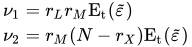
StartLayout 1st Row 1st Column nu 1 2nd Column equals r Subscript upper L Baseline r Subscript upper M Baseline normal upper E Subscript normal t Baseline left-parenthesis epsilon overTilde right-parenthesis 2nd Row 1st Column nu 2 2nd Column equals r Subscript upper M Baseline left-parenthesis upper N minus r Subscript upper X Baseline right-parenthesis normal upper E Subscript normal t Baseline left-parenthesis epsilon overTilde right-parenthesis EndLayout

where

normal upper E Subscript normal t Baseline left-parenthesis epsilon overTilde right-parenthesis equals min left-parenthesis max left-parenthesis normal upper E left-parenthesis epsilon overTilde right-parenthesis comma 1 slash r Subscript upper M Baseline right-parenthesis comma 1 right-parenthesis

and

normal upper E left-parenthesis epsilon overTilde right-parenthesis equals StartLayout Enlarged left-brace 1st Row 1st Column StartFraction upper N normal upper E left-parenthesis t 1 right-parenthesis minus 2 normal upper E left-parenthesis t 2 right-parenthesis Over r Subscript upper M Baseline left-bracket left-parenthesis upper N minus r Subscript upper X Baseline right-parenthesis normal upper E left-parenthesis t 2 right-parenthesis minus normal upper E left-parenthesis t 1 right-parenthesis right-bracket EndFraction 2nd Column if UEPSDEF equals HF 2nd Row 1st Column StartFraction left-parenthesis upper N minus r Subscript upper X Baseline plus 1 right-parenthesis normal upper E left-parenthesis t 1 right-parenthesis minus 2 normal upper E left-parenthesis t 2 right-parenthesis Over r Subscript upper M Baseline left-bracket left-parenthesis upper N minus r Subscript upper X Baseline right-parenthesis normal upper E left-parenthesis t 2 right-parenthesis minus normal upper E left-parenthesis t 1 right-parenthesis right-bracket EndFraction 2nd Column if UEPSDEF equals HFL 3rd Row 1st Column left-parenthesis StartFraction left-parenthesis nu Subscript a Baseline minus 2 right-parenthesis left-parenthesis nu Subscript a Baseline minus 4 right-parenthesis Over nu Subscript a Superscript 2 Baseline EndFraction right-parenthesis left-parenthesis StartFraction left-parenthesis upper N minus r Subscript upper X Baseline plus 1 right-parenthesis normal upper E left-parenthesis t 1 right-parenthesis minus 2 normal upper E left-parenthesis t 2 right-parenthesis Over r Subscript upper M Baseline left-bracket left-parenthesis upper N minus r Subscript upper X Baseline right-parenthesis normal upper E left-parenthesis t 2 right-parenthesis minus normal upper E left-parenthesis t 1 right-parenthesis right-bracket EndFraction right-parenthesis 2nd Column if UEPSDEF equals CM EndLayout

Box Conservative Test (MTEST=BOX)

The Box conservative test assumes the worst case for sphericity, epsilon equals 1 slash r Subscript upper M, leading to the following degrees of freedom for the null F distribution:
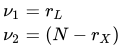
StartLayout 1st Row 1st Column nu 1 2nd Column equals r Subscript upper L Baseline 2nd Row 1st Column nu 2 2nd Column equals left-parenthesis upper N minus r Subscript upper X Baseline right-parenthesis EndLayout
Last updated: December 09, 2022