The HPCANDISC Procedure
PROC HPCANDISC Statement
PROC HPCANDISC <options>;
The PROC HPCANDISC statement invokes the HPCANDISC procedure. Optionally, it also identifies input and output data sets, specifies the analyses performed, and controls displayed output. Table 1 summarizes the options available in the PROC HPCANDISC statement.
Table 1: PROC HPCANDISC Statement Options
| Option | Description |
|---|---|
| Specify Data Sets | |
| DATA= | Specifies the input data set |
| OUT= | Specifies the output data set that contains canonical scores |
| OUTSTAT= | Specifies the output statistics data set |
| Specify Details of Analysis | |
| NCAN= | Specifies the number of canonical variables |
| PREFIX= | Specifies a prefix for naming the canonical variables |
| SINGULAR= | Specifies the singularity criterion |
| Control Displayed Output | |
| ALL | Displays all output |
| ANOVA | Displays univariate statistics |
| BCORR | Displays between correlations |
| BCOV | Displays between covariances |
| BSSCP | Displays between SSCPs |
| DISTANCE | Displays squared Mahalanobis distances |
| NOPRINT | Suppresses all displayed output |
| PCORR | Displays pooled correlations |
| PCOV | Displays pooled covariances |
| PSSCP | Displays pooled SSCPs |
| SHORT | Suppresses some displayed output |
| SIMPLE | Displays simple descriptive statistics |
| STDMEAN | Displays standardized class means |
| TCORR | Displays total correlations |
| TCOV | Displays total covariances |
| TSSCP | Displays total SSCPs |
| WCORR | Displays within correlations |
| WCOV | Displays within covariances |
| WSSCP | Displays within SSCPs |
The following list provides details about these options.
- ALL
- ANOVA
displays univariate statistics for testing the hypothesis that the class means are equal in the population for each variable.
- BCORR
- BCOV
displays between-class covariances. The between-class covariance matrix equals the between-class SSCP matrix divided by
 , where n is the number of observations and c is the number of classes. The between-class covariances should be interpreted in comparison with the total-sample and within-class covariances, not as formal estimates of population parameters.
 - BSSCP
- DATA=SAS-data-set
specifies the data set to be analyzed. The data set can only be an ordinary SAS data set (raw data). If you omit the DATA= option, PROC HPCANDISC uses the most recently created SAS data set.
-
DISTANCE
MAHALANOBIS displays squared Mahalanobis distances between the group means, the F statistics, and the corresponding probabilities of greater squared Mahalanobis distances between the group means.
- NCAN=n
specifies the number of canonical variables to be computed. The value of n must be less than or equal to the number of variables. If you specify NCAN=0, PROC HPCANDISC displays the canonical correlations but not the canonical coefficients, structures, or means. A negative value suppresses the canonical analysis entirely. Let v be the number of variables in the VAR statement, and let c be the number of classes. If you omit the NCAN= option, only
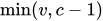 canonical variables are generated; if you also specify an OUT= output data set, v canonical variables are generated, and the last
  canonical variables have missing values.
 - NOPRINT
suppresses the normal display of results. This option temporarily disables the Output Delivery System (ODS). For more information about ODS, see Chapter 23, Using the Output Delivery System.
- OUT=SAS-data-set
-
creates an output SAS data set to contain observationwise canonical variable scores. The variables in the input data set are not included in the output data set to avoid data duplication for large data sets; however, variables that are specified in the ID statement are included.
If you want to create a SAS data set in a permanent library, you must specify a two-level name. For more information about permanent libraries and SAS data sets, see SAS Programmers Guide: Essentials. For more information about OUT= data sets, see the section Output Data Sets.
- OUTSTAT=SAS-data-set
-
creates a TYPE=CORR output SAS data set to contain various statistics, including class means, standard deviations, correlations, canonical correlations, canonical structures, canonical coefficients, and means of canonical variables for each class level.
If you want to create a SAS data set in a permanent library, you must specify a two-level name. For more information about permanent libraries and SAS data sets, see SAS Programmers Guide: Essentials.
- PCORR
displays pooled within-class correlations (partial correlations based on the pooled within-class covariances).
- PCOV
- PREFIX=name
specifies a prefix for naming the canonical variables. By default, the names are
Can1,Can2,Can3, and so on. If you specify PREFIX=Abc, the components are namedAbc1,Abc2, and so on. The number of characters in the prefix plus the number of digits required to designate the canonical variables should not exceed 32. The prefix is truncated if the combined length exceeds 32.- PSSCP
- SHORT
suppresses the display of canonical structures, canonical coefficients, and class means on canonical variables; only tables of canonical correlations and multivariate test statistics are displayed.
- SIMPLE
displays simple descriptive statistics for the total sample and within each class.
- SINGULAR=p
-
specifies the criterion for determining the singularity of the total-sample correlation matrix and the pooled within-class covariance matrix, where 0 < p < 1. The default is SINGULAR=1E–8.
Let
 be the total-sample correlation matrix. If the R square for predicting a quantitative variable in the VAR statement from the variables that precede it exceeds 1 – p, then is considered singular. If is singular, the probability levels for the multivariate test statistics and canonical correlations are adjusted for the number of variables whose R square exceeds 1 – p.
 If
is considered singular and the inverse of (squared Mahalanobis distances) is required, a quasi inverse is used instead. For more information, see the section Quasi-inverse. - STDMEAN
displays total-sample and pooled within-class standardized class means.
- TCORR
- TCOV
- TSSCP
- WCORR
- WCOV
- WSSCP
displays the within-class corrected SSCP matrix for each class level.