The HPGENSELECT Procedure
PROC HPGENSELECT Statement
PROC HPGENSELECT <options>;
The PROC HPGENSELECT statement invokes the procedure. Table 1 summarizes the available options in the PROC HPGENSELECT statement by function. The options are then described fully in alphabetical order.
Table 1: PROC HPGENSELECT Statement Options
| Option | Description |
|---|---|
| Basic Options | |
| ALPHA= | Specifies a global significance level |
| DATA= | Specifies the input data set |
| NAMELEN= | Limits the length of effect names |
| Output Options | |
| CORR | Displays the "Parameter Estimates Correlation Matrix" table |
| COV | Displays the "Parameter Estimates Covariance Matrix" table |
| ITDETAILS | Displays the "Iteration History" table when no model selection is performed |
| ITSELECT | Displays the summarized "Iteration History" table when model selection is performed |
| ITSUMMARY | Displays the summarized "Iteration History" table when no model selection is performed |
| NOPRINT | Suppresses ODS output |
| NOCLPRINT | Limits or suppresses the display of classification variable levels |
| NOSTDERR | Suppresses computation of the covariance matrix and standard errors |
| Optimization Options | |
| ABSCONV= | Tunes the absolute function convergence criterion |
| ABSFCONV= | Tunes the absolute function difference convergence criterion |
| ABSGCONV= | Tunes the absolute gradient convergence criterion |
| FCONV= | Tunes the relative function difference convergence criterion |
| GCONV= | Tunes the relative gradient convergence criterion |
| INEST= | Specifies the SAS data set that contains starting values, bounds, |
| and constraints for single parameters | |
| LASSORHO= | Specifies the base scaling factor for the LASSO method |
| LASSOSTEPS= | Specifies the maximum number of steps for the LASSO method |
| MAXITER= | Chooses the maximum number of iterations in any optimization |
| MAXFUNC= | Specifies the maximum number of function evaluations in any optimization |
| MAXTIME= | Specifies the upper limit of CPU time (in seconds) for any optimization |
| MINITER= | Specifies the minimum number of iterations in any optimization |
| NORMALIZE= | Specifies whether the objective function is normalized during optimization |
| OUTEST | Adds parameter names to the "Parameter Estimates" table |
| TECHNIQUE= | Selects the optimization technique |
| XCONV= | Tunes the relative parameter difference convergence criterion |
| Tolerance Options | |
| LASSOTOL= | Specifies the convergence criterion for the LASSO method |
| SINGCHOL= | Tunes the singularity criterion for Cholesky decompositions |
| SINGSWEEP= | Tunes the singularity criterion for the sweep operator |
| SINGULAR= | Tunes the general singularity criterion |
| User-Defined Format Options | |
| FMTLIBXML= | Specifies the file reference for a format stream |
You can specify the following options in the PROC HPGENSELECT statement.
-
ABSCONV=r
ABSTOL=r specifies an absolute function convergence criterion. For minimization, termination requires
 r, where
  is the vector of parameters in the optimization and
  is the objective function. The default value of r is the negative square root of the largest double-precision value, which serves only as a protection against overflow.
 -
ABSFCONV=r <n>
ABSFTOL=r<n> -
specifies an absolute function difference convergence criterion. For all techniques except NMSIMP, termination requires a small change of the function value in successive iterations:

Here,
denotes the vector of parameters that participate in the optimization, and is the objective function. The same formula is used for the NMSIMP technique, but  is defined as the vertex that has the lowest function value and
  is defined as the vertex that has the highest function value in the simplex. The optional integer value n specifies the number of successive iterations for which the criterion must be satisfied before the process can be terminated. The default value is r = 0.
 -
ABSGCONV=r <n>
ABSGTOL=r<n> -
specifies an absolute gradient convergence criterion. Termination requires the maximum absolute gradient element to be small:
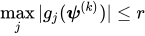
Here,
denotes the vector of parameters that participate in the optimization, and  is the gradient of the objective function with respect to the jth parameter. This criterion is not used by the NMSIMP technique. The optional integer value n specifies the number of successive iterations for which the criterion must be satisfied before the process can be terminated. The default value is r = 1E–8.
 - ALPHA=number
specifies a global significance level for the construction of confidence intervals. The confidence level is 1 – number. The value of number must be between 0 and 1; the default is 0.05. You can override this global significance level by specifying the ALPHA= option in the MODEL statement or the ALPHA= option in the OUTPUT statement.
- CORR
creates the "Parameter Estimates Correlation Matrix" table. The correlation matrix is computed by normalizing the covariance matrix
 . That is, if
  is an element of , then the corresponding element of the correlation matrix is
  , where
  .
. - COV
creates the "Parameter Estimates Covariance Matrix" table. The covariance matrix is computed as the inverse of the negative of the matrix of second derivatives of the log-likelihood function with respect to the model parameters (the Hessian matrix).
- DATA=SAS-data-set
names the input SAS data set for PROC HPGENSELECT to use. The default is the most recently created data set.
-
FCONV=r<n>
FTOL=r<n> -
specifies a relative function difference convergence criterion. For all techniques except NMSIMP, termination requires a small relative change of the function value in successive iterations:
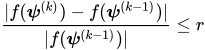
Here,
denotes the vector of parameters that participate in the optimization, and is the objective function. The same formula is used for the NMSIMP technique, but  is defined as the vertex that has the lowest function value, and is defined as the vertex that has the highest function value in the simplex.
 The optional integer value n specifies the number of successive iterations for which the criterion must be satisfied before the process can be terminated. The default value is r =
 , where
  is the machine precision.
 - FMTLIBXML=file-ref
specifies the file reference for the XML stream that contains the user-defined format definitions. For information about how to generate an XML stream for your formats, see the section Working with Formats.
-
GCONV=r<n>
GTOL=r<n> -
specifies a relative gradient convergence criterion. For all techniques except CONGRA and NMSIMP, termination requires that the normalized predicted function reduction be small:
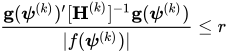
Here,
denotes the vector of parameters that participate in the optimization, is the objective function, and  is the gradient. For the CONGRA technique (where a reliable Hessian estimate
  is not available), the following criterion is used:
This criterion is not used by the NMSIMP technique. The optional integer value n specifies the number of successive iterations for which the criterion must be satisfied before the process can be terminated. The default value is r=1E–8.
- INEST=SAS-data-set
names the SAS data set that contains starting values for the parameters. Your data set must include the
_TYPE_variable, a character variable in which the value 'PARMS' indicates the observation that contains your starting values. The data set also includes a numeric variable for each parameter for which you are specifying a starting value; the name of this numeric variable is the parameter name. You can obtain parameter names by specifying the OUTEST option and by using the ODS OUTPUT statement to output the "Parameter Estimates" table into a data set; the parameter name is contained in theParmNamevariable in this data set. If you do not specify a starting value for a parameter, it is set to 0. PROC HPGENSELECT uses only the first observation for which_TYPE_=PARMS, and it ignores BY variables. You can also specify single-parameter equality constraints by using a value of 'EQ' for the variable_TYPE_to indicate the observation that contains your equality constraints, and similarly by using values for_TYPE_of 'UB' for upper bounds and 'LB' for lower bounds on parameters.- ITDETAILS
adds to the "Iteration History" table the current values of the parameter estimates and their gradients. These quantities are reported only for parameters that participate in the optimization. This option is not available when you perform model selection.
- ITSELECT
generates the "Iteration History" table when you perform a model selection.
- ITSUMMARY
generates the "Iteration History" table. This option is not available when you perform model selection.
- LASSORHO=r
specifies the base scaling factor that is applied to the maximum regularization parameter for the LASSO model selection method. The regularization parameter for step i is
 , where m is the maximum regularization parameter.
 - LASSOSTEPS=n
specifies the maximum number of steps for LASSO model selection.
- LASSOTOL=r
specifies the convergence tolerance for the optimization algorithm that solves for the LASSO parameter estimates at each step of LASSO model selection.
-
MAXFUNC=n
MAXFU=n -
specifies the maximum number of function calls in the optimization process. The default values are as follows, depending on the optimization technique:
TRUREG, NRRIDG, NEWRAP: n = 125
QUANEW, DBLDOG: n = 500
CONGRA: n = 1,000
NMSIMP: n = 3,000
The optimization can terminate only after completing a full iteration. Therefore, the number of function calls that are actually performed can exceed n. You can choose the optimization technique by specifying the TECHNIQUE= option.
-
MAXITER=n
MAXIT=n -
specifies the maximum number of iterations in the optimization process. The default values are as follows, depending on the optimization technique:
TRUREG, NRRIDG, NEWRAP: n = 50
QUANEW, DBLDOG: n = 200
CONGRA: n = 400
NMSIMP: n = 1,000
These default values also apply when n is specified as a missing value. You can choose the optimization technique by specifying the TECHNIQUE= option.
- MAXTIME=r
specifies an upper limit of r seconds of CPU time for the optimization process. The default value is the largest floating-point double representation of your computer. The time specified by this option is checked only once at the end of each iteration. Therefore, the actual running time can be longer than r.
-
MINITER=n
MINIT=n specifies the minimum number of iterations. The default value is 0. If you request more iterations than are actually needed for convergence to a stationary point, the optimization algorithms might behave strangely. For example, the effect of rounding errors can prevent the algorithm from continuing for the required number of iterations.
- NAMELEN=number
specifies the length to which long effect names are shortened. The default and minimum value is 20.
- NOCLPRINT<=number>
suppresses the display of the "Class Level Information" table if you do not specify number. If you specify number, the values of the classification variables are displayed for only those variables whose number of levels is less than number. Specifying a number helps to reduce the size of the "Class Level Information" table if some classification variables have a large number of levels.
- NOPRINT
- NORMALIZE=YES | NO
specifies whether to normalize the objective function during optimization by the reciprocal of the frequency count of observations that are used in the analysis. This option affects the values that are reported in the "Iteration History" table. The results that are reported in the "Fit Statistics" are always displayed for the nonnormalized log-likelihood function. By default, NORMALIZE = NO.
- NOSTDERR
suppresses the computation of the covariance matrix and the standard errors of the regression coefficients. When the model contains many variables (thousands), the inversion of the Hessian matrix to derive the covariance matrix and the standard errors of the regression coefficients can be time-consuming.
- OUTEST
-
adds a column for the ParmName variable to the "Parameter Estimates" table. This column is not displayed, but you can use it to create a data set that you can specify in an INEST= option by first using the ODS OUTPUT statement to output the "Parameter Estimates" table and then submitting the following statements:
proc transpose data=parameterestimates out=inest label=_TYPE_; label Estimate=PARMS; var Estimate; id ParmName; run; - SINGCHOL=number
tunes the singularity criterion in Cholesky decompositions. The default is 1E4 times the machine epsilon; this product is approximately 1E–12 on most computers.
- SINGSWEEP=number
tunes the singularity criterion for sweep operations. The default is 1E4 times the machine epsilon; this product is approximately 1E–12 on most computers.
- SINGULAR=number
tunes the general singularity criterion that is applied in sweeps and inversions. The default is 1E4 times the machine epsilon; this product is approximately 1E–12 on most computers.
-
TECHNIQUE=keyword
TECH=keyword -
specifies the optimization technique for obtaining maximum likelihood estimates. You can choose from the following techniques by specifying the appropriate keyword:
- CONGRA
performs a conjugate-gradient optimization.
- DBLDOG
performs a version of double-dogleg optimization.
- NEWRAP
performs a Newton-Raphson optimization with line search.
- NMSIMP
performs a Nelder-Mead simplex optimization.
- NONE
performs no optimization.
- NRRIDG
performs a Newton-Raphson optimization with ridging.
- QUANEW
performs a dual quasi-Newton optimization.
- TRUREG
performs a trust-region optimization
The default value is TECHNIQUE=NRRIDG, except for the Tweedie distribution, for which the default value is TECHNIQUE=QUANEW.
For more information, see the section Choosing an Optimization Algorithm.
-
XCONV=r<n>
XTOL=r<n> -
specifies the relative parameter convergence criterion. The termination criterion and the default value depend on the technique, as follows:
-
For all techniques except NMSIMP, termination requires a small relative parameter change in subsequent iterations:
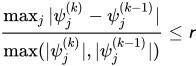
By default, XCONV = 0.
For the NMSIMP technique, the same formula is used, but
 is defined as the vertex with the lowest function value and
  is defined as the vertex with the highest function value in the simplex. The default value is r = 1E–8.
The optional integer value n specifies the number of successive iterations for which the criterion must be satisfied before the process can be terminated.
-