The HPLMIXED Procedure
Matrix Notation
Suppose that you observe n data points  and that you want to explain them by using n values for each of p explanatory variables
  ,
,  ,
,  . The
. The  values can be either regression-type continuous variables or dummy variables that indicate class membership. The standard linear model for this setup is
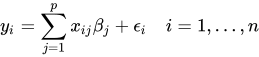
where  are unknown fixed-effects parameters to be estimated and
  are unknown independent and identically distributed normal (Gaussian) random variables with mean 0 and variance
  .
.
The preceding equations can be written simultaneously by using vectors and a matrix, as follows:
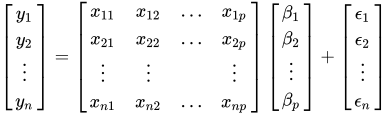
For convenience, simplicity, and extendability, this entire system is written as

where  denotes the vector of observed
  ’s,
’s,  is the known matrix of ’s,
  is the unknown fixed-effects parameter vector, and
  is the unobserved vector of independent and identically distributed Gaussian random errors.
In addition to denoting data, random variables, and explanatory variables in the preceding fashion, the subsequent development makes use of basic matrix operators such as transpose ( ), inverse (
 ), generalized inverse (
 ), determinant (
 ), and matrix multiplication. See Searle (1982) for details about these and other matrix techniques.