The HPLMIXED Procedure

Estimating Fixed and Random Effects in the Mixed Model

ML and REML methods provide estimates of bold upper G and bold upper R, which are denoted ModifyingAbove bold upper G With caret and ModifyingAbove bold upper R With caret, respectively. To obtain estimates of bold-italic beta and predicted values of bold-italic gamma, the standard method is to solve the mixed model equations (Henderson 1984):

Start 2 By 2 Matrix 1st Row 1st Column bold upper X prime ModifyingAbove bold upper R With caret Superscript negative 1 Baseline bold upper X 2nd Column bold upper X prime ModifyingAbove bold upper R With caret Superscript negative 1 Baseline bold upper Z 2nd Row 1st Column bold upper Z prime ModifyingAbove bold upper R With caret Superscript negative 1 Baseline bold upper X 2nd Column bold upper Z prime ModifyingAbove bold upper R With caret Superscript negative 1 Baseline bold upper Z plus ModifyingAbove bold upper G With caret Superscript negative 1 Baseline EndMatrix StartBinomialOrMatrix ModifyingAbove bold-italic beta With caret Choose ModifyingAbove bold-italic gamma With caret EndBinomialOrMatrix equals StartBinomialOrMatrix bold upper X prime ModifyingAbove bold upper R With caret Superscript negative 1 Baseline bold y Choose bold upper Z prime ModifyingAbove bold upper R With caret Superscript negative 1 Baseline bold y EndBinomialOrMatrix

The solutions can also be written as

StartLayout 1st Row 1st Column ModifyingAbove bold-italic beta With caret 2nd Column equals left-parenthesis bold upper X prime ModifyingAbove bold upper V With caret Superscript negative 1 Baseline bold upper X right-parenthesis Superscript minus Baseline bold upper X prime ModifyingAbove bold upper V With caret Superscript negative 1 Baseline bold y 2nd Row 1st Column ModifyingAbove bold-italic gamma With caret 2nd Column equals ModifyingAbove bold upper G With caret bold upper Z prime ModifyingAbove bold upper V With caret Superscript negative 1 Baseline left-parenthesis bold y minus bold upper X ModifyingAbove bold-italic beta With caret right-parenthesis EndLayout

and have connections with empirical Bayes estimators (Laird and Ware 1982; Carlin and Louis 1996). Note that the bold-italic gamma are random variables and not parameters (unknown constants) in the model. Technically, determining values for bold-italic gamma from the data is thus a prediction task, whereas determining values for bold-italic beta is an estimation task.

The mixed model equations are extended normal equations. The preceding expression assumes that ModifyingAbove bold upper G With caret is nonsingular. For the extreme case where the eigenvalues of ModifyingAbove bold upper G With caret are very large, ModifyingAbove bold upper G With caret Superscript negative 1 contributes very little to the equations and ModifyingAbove bold-italic gamma With caret is close to what it would be if bold-italic gamma actually contained fixed-effects parameters. On the other hand, when the eigenvalues of ModifyingAbove bold upper G With caret are very small, ModifyingAbove bold upper G With caret Superscript negative 1 dominates the equations and ModifyingAbove bold-italic gamma With caret is close to 0. For intermediate cases, ModifyingAbove bold upper G With caret Superscript negative 1 can be viewed as shrinking the fixed-effects estimates of bold-italic gamma toward 0 (Robinson 1991).

If ModifyingAbove bold upper G With caret is singular, then the mixed model equations are modified (Henderson 1984) as follows:

Start 2 By 2 Matrix 1st Row 1st Column bold upper X prime ModifyingAbove bold upper R With caret Superscript negative 1 Baseline bold upper X 2nd Column bold upper X prime ModifyingAbove bold upper R With caret Superscript negative 1 Baseline bold upper Z ModifyingAbove bold upper G With caret 2nd Row 1st Column ModifyingAbove bold upper G With caret prime bold upper Z prime ModifyingAbove bold upper R With caret Superscript negative 1 Baseline bold upper X 2nd Column ModifyingAbove bold upper G With caret prime bold upper Z prime ModifyingAbove bold upper R With caret Superscript negative 1 Baseline bold upper Z ModifyingAbove bold upper G With caret plus bold upper G EndMatrix StartBinomialOrMatrix ModifyingAbove bold-italic beta With caret Choose ModifyingAbove bold-italic tau With caret EndBinomialOrMatrix equals StartBinomialOrMatrix bold upper X prime ModifyingAbove bold upper R With caret Superscript negative 1 Baseline bold y Choose ModifyingAbove bold upper G With caret prime bold upper Z prime ModifyingAbove bold upper R With caret Superscript negative 1 Baseline bold y EndBinomialOrMatrix

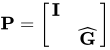
Denote the generalized inverses of the nonsingular ModifyingAbove bold upper G With caret and singular ModifyingAbove bold upper G With caret forms of the mixed model equations by bold upper C and bold upper M, respectively. In the nonsingular case, the solution ModifyingAbove bold-italic gamma With caret estimates the random effects directly. But in the singular case, the estimates of random effects are achieved through a back-transformation ModifyingAbove bold-italic gamma With caret equals ModifyingAbove bold upper G With caret ModifyingAbove bold-italic tau With caret where ModifyingAbove bold-italic tau With caret is the solution to the modified mixed model equations. Similarly, while in the nonsingular case bold upper C itself is the estimated covariance matrix for left-parenthesis ModifyingAbove bold-italic beta With caret comma ModifyingAbove bold-italic gamma With caret right-parenthesis, in the singular case the covariance estimate for left-parenthesis ModifyingAbove bold-italic beta With caret comma ModifyingAbove bold upper G With caret ModifyingAbove bold-italic tau With caret right-parenthesis is given by bold upper P bold upper M bold upper P where

bold upper P equals Start 2 By 2 Matrix 1st Row 1st Column bold upper I 2nd Column Blank 2nd Row 1st Column Blank 2nd Column ModifyingAbove bold upper G With caret EndMatrix

An example of when the singular form of the equations is necessary is when a variance component estimate falls on the boundary constraint of 0.

Last updated: December 09, 2022