The HPMIXED Procedure
OUTPUT Statement
OUTPUT <OUT=SAS-data-set><keyword<(keyword-options)> <=name>> …<keyword<(keyword-options)> <=name>> </ options>;
The OUTPUT statement creates a data set that contains predicted values and residual diagnostics, computed after fitting the model. By default, all variables in the original data set are included in the output data set.
You can use the ID statement to select a subset of the variables from the input data set to be added to the output data set.
For example, suppose that the data set Scores contains the variables score, machine, and person. The following statements fit a model with fixed machine and random person effects and save the predicted and residual values to the data set igausout:
proc hpmixed data = Scores;
   class machine person score;
   model score = machine;
   random person;
   output out=igausout pred=p resid=r;
run;
You can specify the following options in the OUTPUT statement before the slash (/).
- OUT=SAS data set
specifies the name of the output data set. If the OUT= option is omitted, the procedure uses the
DATAnconvention to name the output data set.- keyword <(keyword-options)><=name>
-
specifies a statistic to include in the output data set and optionally assigns the variable the name
name. You can use the keyword-options to control which type of a particular statistic to compute. The keyword-options can take on the following values:- BLUP
uses the predictors of the random effects in computing the statistic.
- NOBLUP
does not use the predictors of the random effects in computing the statistic.
The default is to compute statistics by using BLUPs. For example, the following two OUTPUT statements are equivalent:
output out=out1  pred=predicted lcl=lower;
output out=out1  pred(blup)=predicted lcl(blup)=lower;
If a particular combination of keyword and keyword-options is not supported, the statistic is not computed and a message is produced in the SAS log.
A keyword can appear multiple times in the OUTPUT statement. Table 6 lists the keywords and the default names assigned by the HPMIXED procedure if you do not specify a name. In this table, y denotes the response variable.
Table 6: Keywords for Output Statistics
Keyword Options Description Expression Name PREDICTED BLUP Linear predictor 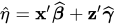
Pred NOBLUP Marginal linear predictor 
PredPA STDERR BLUP Standard deviation of linear predictor 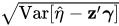
StdErr NOBLUP Standard deviation of marginal linear predictor 
StdErrPA RESIDUAL BLUP Residual 
Resid NOBLUP Marginal residual 
ResidPA PEARSON BLUP Pearson-type residual 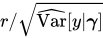
Pearson NOBLUP Marginal Pearson-type residual 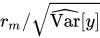
PearsonPA STUDENT BLUP Studentized residual 
Student NOBLUP Studentized marginal residual 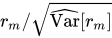
StudentPA LCL BLUP Lower prediction limit for linear predictor LCL NOBLUP Lower confidence limit for marginal linear predictor LCLPA UCL BLUP Upper prediction limit for linear predictor UCL NOBLUP Upper confidence limit for marginal linear predictor UCLPA VARIANCE BLUP Conditional variance of response variable 
Variance NOBLUP Marginal variance of response variable 
VariancePA
You can use the following shortcuts to request statistics: PRED for PREDICTED, STD for STDERR, RESID for RESIDUAL, VAR for VARIANCE.
You can specify the following options of the OUTPUT statement after the slash (/).
- ALLSTATS
requests that all statistics are computed. If you do not use a keyword to assign a name, the HPMIXED procedure uses the default name.
- ALPHA=number
determines the coverage probability for two-sided confidence and prediction intervals. The coverage probability is computed as
 . The value of number must be between 0 and 1 inclusively; the default is 0.05.
 - NOMISS
requests that records from the input data set be written to the output data only for those observations that were used in the analysis. By default, the HPMIXED procedure produces output statistics for all observations in the input data set.
- NOUNIQUE
requests that names not be made unique in the case of naming conflicts. By default, the HPMIXED procedure avoids naming conflicts by assigning a unique name to each output variable. If you specify the NOUNIQUE option, variables with conflicting names are not renamed. In that case, the first variable added to the output data set takes precedence.
- NOVAR
requests that variables from the input data set not be added to the output data set. This option ignores ID statement but does not apply to variables listed in a BY statement.