The HPPLS Procedure
SIMPLS
Note that each extracted PLS factor is defined in terms of different X-variables  . This leads to difficulties in comparing different scores, weights, and so on. The SIMPLS method of De Jong (1993) overcomes these difficulties by computing each score
  in terms of the original (centered and scaled) predictors
  . The SIMPLS X-weight vectors
  are similar to the eigenvectors of
  , but they satisfy a different orthogonality condition. The
  vector is just the first eigenvector
  (so that the first SIMPLS score is the same as the first PLS score). However, the second eigenvector maximizes

whereas the second SIMPLS weight  maximizes

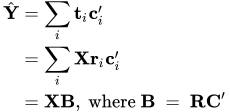
The SIMPLS scores are identical to the PLS scores for one response but slightly different for more than one response; see De Jong (1993) for details. The X- and Y-loadings are defined as in PLS, but because the scores are all defined in terms of , it is easy to compute the overall model coefficients  :
: