The HPREG Procedure
OUTPUT Statement
OUTPUT <OUT=SAS-data-set><COPYVARS=(variables)><keyword <=name>>…<keyword <=name>> ;
The OUTPUT statement creates a data set that contains observationwise statistics, which are computed after fitting the model. The variables in the input data set are not included in the output data set to avoid data duplication for large data sets; however, variables specified in the ID statement or COPYVARS= option are included.
The output statistics are computed based on the parameter estimates for the selected model.
You can specify the following syntax elements in the OUTPUT statement:
In addition to the preceding statistics, you can also use the keywords listed in Table 4 in the OUTPUT statement to obtain additional statistics. These statistics are not available if you use METHOD=LAR or METHOD=LASSO in the SELECTION statement, unless you also specify the LSCOEFFS option. See the section Diagnostic Statistics for computational formulas. All the statistics available in the OUTPUT statement are conditional on the selected model and do not take into account the variability introduced by doing model selection.
Table 4: Keywords for OUTPUT Statement
| Keyword | Description |
|---|---|
| COOKD | Cook’s D influence statistic |
| COVRATIO | Standard influence of observation on covariance of betas |
| DFFIT | Standard influence of observation on predicted value |
| H | Leverage, 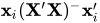 |
| LCL | Lower bound of a  % confidence interval for an % confidence interval for an individual prediction. This includes the variance of the error, as well as the variance of the parameter estimates. |
| LCLM | Lower bound of a % confidence interval for the expected value (mean) of the dependent variable |
| PRESS | ith residual divided by  , where h is the leverage, , where h is the leverage, and where the model has been refit without the ith observation |
| RSTUDENT | A studentized residual with the current observation deleted |
| STDI | Standard error of the individual predicted value |
| STDP | Standard error of the mean predicted value |
| STDR | Standard error of the residual |
| STUDENT | Studentized residuals, which are the residuals divided by their standard errors |
| UCL | Upper bound of a % confidence interval for an individual prediction |
| UCLM | Upper bound of a % confidence interval for the expected value (mean) of the dependent variable |