The ICLIFETEST Procedure
PROC ICLIFETEST Statement
PROC ICLIFETEST <options>;
The PROC ICLIFETEST statement invokes the ICLIFETEST procedure. Table 1 summarizes the options available in the PROC ICLIFETEST statement.
Table 1: Options Available in the PROC ICLIFETEST Statement
| Option | Description |
|---|---|
| Input and Output Data Sets | |
| DATA= | Specifies the input SAS data set |
| OUTSURV= | Names an output data set to contain survival estimates and confidence limits |
| Nonparametric Estimation | |
| BOOTSTRAP | Requests that the simple bootstrap method be used for computing standard errors of the survival estimates |
| IMPUTE | Specifies details for multiple imputations used for computing standard errors and estimating covariance matrix of the generalized log-rank statistic |
| ITHISTORY | Displays the iteration history of nonparametric estimation |
| MAXITER= | Set the maximum number of iterations allowed for the estimation method |
| METHOD= | Specifies the method to estimate the survival function |
| TOLLIKE= | Sets the log-likelihood convergence criterion |
| Confidence Limits for Survival Function | |
| ALPHA= | Sets the level for confidence interval estimation |
| CONFTYPE= | Specifies the transformation applied to the survival function for computing confidence limits |
| ODS Graphics | |
| MAXTIME= | Specifies the maximum time value for plotting |
| PLOTS= | Specifies plots to display |
| Control Output | |
| NOPRINT | Suppresses the display of printed output |
| NOSUMMARY | Suppresses the display of summary of censored and uncensored values |
| SHOWTI | Displays the Turnbull intervals |
| Miscellaneous | |
| ALPHAQT= | Sets the level for confidence intervals for survival time quartiles |
| MISSING | Treats missing values as a valid stratum or group for the variables specified in the STRATA and TEST statements |
| SINGULAR= | Sets the tolerance for testing singularity of the covariance matrix of test statistics |
If no options are specified, PROC ICLIFETEST computes and displays a nonparametric estimate of the survival function. If ODS Graphics is enabled, a plot of the estimated survival function is also displayed.
You can specify the following options.
-
ALPHA=

specifies the level
for the  % confidence intervals for the survival functions. For example, ALPHA=0.05 requests 95% confidence limits. By default, ALPHA=0.05.
 -
ALPHAQT=
specifies the level
for the % confidence intervals for the quartiles of the survival time. For example, ALPHAQT=0.05 requests a 95% confidence interval. By default, ALPHAQT=0.05. -
BOOTSTRAP <(options)>
BOOT <(options)> -
performs simple bootstrap sampling and computes bootstrap standard errors of nonparametric survival estimates. You can specify the following suboptions to control how the bootstrap samples are generated:
- CONFTYPE=ASINSQRT | LINEAR | LOG | LOGLOG
-
specifies the transformation to be applied to
 to obtain pointwise confidence intervals for the survival function in addition to the confidence intervals for the quartiles of the survival times. You can specify the following keywords:
 - ASINSQRT
-
specifies the arcsine–square root transformation,

- LOGLOG
-
specifies the log–log transformation,

This is also referred to as the log cumulative hazard transformation, because it applies the log transformation to the cumulative hazard function. Collett (1994) and Lachin (2000) call it the complementary log-log transformation.
- LINEAR
-
specifies the identity transformation,

- LOG
-
specifies the log transformation,

- LOGIT
-
specifies the logit transformation,
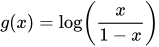
By default, CONFTYPE=LOGLOG.
- DATA=SAS-data-set
names the SAS data set that PROC ICLIFETEST reads. By default, the most recently created SAS data set is used.
-
IMPUTE <(options)>
IM <(options)> -
specifies details for multiple imputations. You can specify the following two suboptions to control how the samples are generated:
- ITHISTORY
prints the iteration history of the nonparametric estimation, including the log likelihood, the probability estimate that is associated with each Turnbull interval, and whether the EM or ICM method is used for each iteration.
-
MAXITER=n
MAXIT=n -
specifies the maximum number of iterations for estimating the survival function. The default value depends on the estimation method as follows:
EMICM method: 200
ICM method: 200
Turnbull method: 500
Note that you specify the method with the METHOD= option.
- MAXTIME=value
specifies the maximum value of the time variable that is allowed in plots so that outlying points do not determine the scale of the time axis of the plots. This option affects only the way in which plots are displayed and has no effect on any calculations.
- METHOD=TURNBULL | ICM | EMICM
-
specifies the method to be used for computing survival function estimates. You can specify the following:
By default, METHOD=EMICM.
- MISSING
allows missing values to be a stratum level or a valid group for the variables that are specified in the STRATA and TEST statements.
- NOPRINT
suppresses the display of output. This option is useful when only an output data set is needed. It temporarily disables the Output Delivery System (ODS); for more information about ODS, see Chapter 23, Using the Output Delivery System.
- NOSUMMARY
suppresses the summary table of the number of censored and uncensored values.
-
OUTSURV=SAS-data-set
OUTS=SAS-data-set creates an output SAS data set to contain the estimates of the survival function and corresponding confidence limits for all the strata. For more information about the contents of the OUTSURV= data set, see the section OUTSURV= Data Set.
-
PLOTS<(global-plot-options)>=plot-request <(options)>
PLOTS<(global-plot-options)>=(plot-request <(options)> <…plot-request <(options)>>) -
controls the plots that are produced by using ODS Graphics. When you specify only one plot-request, you can omit the parentheses around it. Here are some examples:
plots=none
plots=(survival(cl) logsurv)
plots(only)=hazard
ODS Graphics must be enabled before plots can be requested. For example:
ods graphics on;

proc iclifetest plots=survival;
   time (Left,Right);
run;

ods graphics off;
For more information about enabling and disabling ODS Graphics, see the section Enabling and Disabling ODS Graphics in Chapter 24, Statistical Graphics Using ODS.
If ODS Graphics is enabled but you do not specify the PLOTS= option, then by default PROC ICLIFETEST produces a plot of the estimated survival functions.
You can specify the following global-plot-option:
You can specify the following plot-requests and their options:
- ALL
produces all appropriate plots. Specifying PLOTS=ALL is equivalent to specifying PLOTS=(SURVIVAL LOGSURV LOGLOGS HAZARD).
-
HAZARD <(hazard-options)>
H <hazard-options> -
plots the kernel-smoothed hazard functions. You can specify the following hazard-options.
-
BANDWIDTH=value | numeric-list | RANGE(lower,upper)
BW= -
specifies the bandwidth for kernel-smoothed estimation of the hazard function. You can specify one of the following:
For more information about the cross validation pseudo-likelihood function, see the section Kernel-Smoothed Estimation. By default, BANDWIDTH= RANGE(0.1b,0.25b), where
 ;
;  is the left boundary of the first Turnbull interval; and
  is the right boundary of the last Turnbull interval if it is finite or the left boundary of that interval multiplied by 1.1 otherwise.
 - SAMPLING=LEAVEONE | RANDOM
-
specifies how to partition the data set to form cross validation groups. You can specify the following values:
By default, SAMPLING=RANDOM.
- GRIDL=number
specifies the lower grid limit for the kernel-smoothed estimate. The default value is the time origin.
- GRIDU=number
specifies the upper grid limit for the kernel-smoothed estimate. The default value is the maximum input boundary value.
- KERNEL=kernel-option
-
specifies the kernel to be used. You can specify the following values:
-
BIWEIGHT
BW uses the following kernel:

-
EPANECHNIKOV
E uses the following kernel:

-
UNIFORM
U uses the following kernel:

By default, KERNEL=EPANECHNIKOV.
-
BIWEIGHT
- CVFOLD=number
specifies the number of cross validation groups. This option is applicable only when SAMPLING=RANDOM. The default number is either 5 or the sample size, whichever value is less.
- CVGRID=number
specifies the number of grid points to use in determining the cross validation pseudo-likelihood. By default, CVGRID=51.
- HGRID=number
specifies the number of grid points for discretizing the smoothed hazard function. By default, HGRID=101.
-
BANDWIDTH=value | numeric-list | RANGE(lower,upper)
-
LOGLOGS
LLS plots the log of the negative log of the estimated survival function versus the log of time.
-
LOGSURV
LS plots the negative log of the estimated survival function versus time.
- NONE
suppresses all plots.
-
SURVIVAL <(CL | FAILURE | NODASH | STRATA | TEST)>
S <(CL | FAILURE | STRATA | TEST)> -
plots the estimated survival function. You can customize the display by specifying the following values:
- SHOWTI
presents the survival estimates in terms of Turnbull intervals.
- SINGULAR=value
sets the tolerance for testing the singularity of the covariance matrix of test statistics.
- TOLLIKE=value
-
sets the log-likelihood convergence criterion for the estimation algorithm. The default value depends on the estimation method as follows:
EMICM method:

ICM method:
Turnbull method:
