Shared Concepts and Topics
Predictive Margins Compared with LS-Means
The MARGINS statement computes predictive margins of fixed effects. The LSMEANS statement computes least squares means (LS-means) of fixed effects. Both predictive margins and LS-means are covariate-adjusted marginal means. They differ in the following ways:
LS-means estimate the marginal means over a balanced population—that is, a population in which there are an equal number of observations for all possible effect level combinations. In contrast, predictive margins are computed over the observed distribution of the covariates. You can use the OM option in the LSMEANS statement to change the LS-means coefficients to be proportional to those found in the input data set. For linear models, this adjustment leads to LS-means that are equal to predictive margins if the margin effect is not part of any interaction effect.
LS-means are constructed on the linear predictor scale—that is, the scale of
 . In contrast, predictive margins are computed on the mean scale—that is, the scale of
 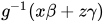 . You can use the ILINK option in the LSMEANS statement to apply the inverse link transform to the LS-means. Note that in general the transformed LS-means are not equal to predictive margins for nonlinear models. They are equal only when the values of all covariates and classification variables are either specified or fixed in the computation.