The Four Types of Estimable Functions
Examples
A One-Way Classification Model
For the model

the general form of estimable functions  is (from the previous example)

Thus,

Tests involving only the parameters  ,
,  , and
, and  must have an
  of the form

Since this for the A parameters involves only two symbols, hypotheses with at most two degrees of freedom can be constructed. For example, letting  be
be  and
and  , respectively, yields
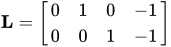
The preceding can be used to test the hypothesis that  . For this example, any with two linearly independent rows with column 1 equal to zero produces the same sum of squares. For example, a joint test for linear and quadratic effects of A
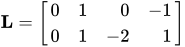
gives the same SS. In fact, for any of full row rank and any nonsingular matrix  of conformable dimensions,

A Three-Factor Main-Effects Model
Consider a three-factor main-effects model involving the CLASS variables A, B, and C, as shown in Table 1.
Table 1: Three-Factor Main-Effects Model
| Obs | A | B | C | |||
|---|---|---|---|---|---|---|
| 1 | 1 | 2 | 1 | |||
| 2 | 1 | 1 | 2 | |||
| 3 | 2 | 1 | 3 | |||
| 4 | 2 | 2 | 2 | |||
| 5 | 2 | 2 | 2 |
The general form of an estimable function is shown in Table 2.
Table 2: General Form of an Estimable Function for Three-Factor Main-Effects Model
| Parameter | Coefficient | |
|---|---|---|
 (Intercept) (Intercept) |
L1 | |
| A1 | L2 | |
| A2 | L1 – L2 | |
| B1 | L4 | |
| B2 | L1 – L4 | |
| C1 | L6 | |
| C2 | L1 + L2 – L4 – 2  L6 L6 |
|
| C3 | –L2 + L4 + L6 |
Since only four symbols (L1, L2, L4, and L6) are involved, any testable hypothesis will have at most four degrees of freedom. If you form an matrix with four linearly independent rows according to the preceding rules, then testing  is equivalent to testing that
  is uniformly 0. Symbolically,

In a main-effects model, the usual hypothesis of interest for a main effect is the equality of all the parameters. In this example, it is not possible to unambiguously test such a hypothesis because of confounding: any test for the equality of the parameters for any one of A, B, or C will necessarily involve the parameters for the other two effects. One way to proceed is to construct a maximum rank hypothesis (MRH) involving only the parameters of the main effect in question. This can be done using the general form of estimable functions. Note the following:
To get an MRH involving only the parameters of A, the coefficients of
associated with , B1, B2, C1, C2, and C3 must be equated to zero. Starting at the top of the general form, let L1 = 0, then L4 = 0, then L6 = 0. If C2 and C3 are not to be involved, then L2 must also be zero. Thus, A1 – A2 is not estimable; that is, the MRH involving only the A parameters has zero rank and  .
. To obtain the MRH involving only the B parameters, let L1 = L2 = L6 = 0. But then to remove C2 and C3 from the comparison, L4 must also be set to 0. Thus, B1 – B2 is not estimable and
 .
. -
To obtain the MRH involving only the C parameters, let L1 = L2 = L4 =0. Thus, the MRH involving only C parameters is

or any multiple of the left-hand side equal to K. Furthermore,

A Multiple Regression Model
Suppose

where the  matrix has full rank. The general form of estimable functions is as shown in Table 3.
Table 3: General Form of Estimable Functions for a Multiple Regression Model When Matrix Is of Full Rank
| Parameter | Coefficient | |
|---|---|---|
 |
L1 | |
 |
L2 | |
 |
L3 | |
 |
L4 |
For example, to test the hypothesis that  , let L1 = L2 = L4 = 0 and let L3 = 1. Then SS
 . In this full-rank case, all parameters, as well as any linear combination of parameters, are estimable.
Suppose, however, that  . The general form of estimable functions is shown in Table 4.
Table 4: General Form of Estimable Functions for a Multiple Regression Model When Matrix Is Not of Full Rank
| Parameter | Coefficient | |
|---|---|---|
|
|
L1 | |
|
|
L2 | |
|
|
L3 | |
|
|
 |
For this example, it is possible to test  . However, , , and are not jointly estimable; that is,
