Introduction to Statistical Modeling with SAS/STAT Software
Finding the Least Squares Estimators
Finding the least squares estimator of  can be motivated as a calculus problem or by considering the geometry of least squares. The former approach simply states that the OLS estimator is the vector
  that minimizes the objective function

Applying the differentiation rules from the section Matrix Differentiation leads to
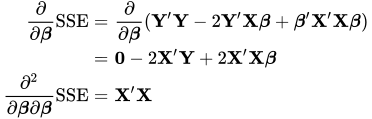
Consequently, the solution to the normal equations,  , solves
  , and the fact that the second derivative is nonnegative definite guarantees that this solution minimizes
  . The geometric argument to motivate ordinary least squares estimation is as follows. Assume that
  is of rank k. For any value of , such as
  , the following identity holds:

The vector  is a point in a k-dimensional subspace of
  , and the residual
  is a point in an
  -dimensional subspace. The OLS estimator is the value that minimizes the distance of from
  , implying that
  and
and  are orthogonal to each other; that is,
 . This in turn implies that satisfies the normal equations, since

Full-Rank Case
If is of full column rank, the OLS estimator is unique and given by

The OLS estimator is an unbiased estimator of —that is,

Note that this result holds if  ; in other words, the condition that the model errors have mean zero is sufficient for the OLS estimator to be unbiased. If the errors are homoscedastic and uncorrelated, the OLS estimator is indeed the best linear unbiased estimator (BLUE) of —that is, no other estimator that is a linear function of has a smaller mean squared error. The fact that the estimator is unbiased implies that no other linear estimator has a smaller variance. If, furthermore, the model errors are normally distributed, then the OLS estimator has minimum variance among all unbiased estimators of , whether they are linear or not. Such an estimator is called a uniformly minimum variance unbiased estimator, or UMVUE.
Rank-Deficient Case
In the case of a rank-deficient matrix, a generalized inverse is used to solve the normal equations:

Although a  -inverse is sufficient to solve a linear system, computational expedience and interpretation of the results often dictate the use of a generalized inverse with reflexive properties (that is, a
  -inverse; see the section Generalized Inverse Matrices for details). Suppose, for example, that the matrix is partitioned as
  , where
  is of full column rank and each column in
  is a linear combination of the columns of . The matrix

is a -inverse of  and
and
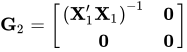
is a -inverse. If the least squares solution is computed with the -inverse, then computing the variance of the estimator requires additional matrix operations and storage. On the other hand, the variance of the solution that uses a -inverse is proportional to  .
.

If a generalized inverse  of is used to solve the normal equations, then the resulting solution is a biased estimator of (unless is of full rank, in which case the generalized inverse is "the" inverse), since
 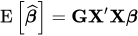 , which is not in general equal to .
If you think of estimation as "estimation without bias," then is the estimator of something, namely  . Since this is not a quantity of interest and since it is not unique—it depends on your choice of —Searle (1971, p. 169) cautions that in the less-than-full-rank case, is a solution to the normal equations and "nothing more."