Introduction to Statistical Modeling with SAS/STAT Software
Test of Hypotheses
Consider a general linear hypothesis of the form  , where
  is a
is a  matrix. It is assumed that
  is such that this hypothesis is
linearly consistent—that is, that there exists some
is such that this hypothesis is
linearly consistent—that is, that there exists some  for which
  . This is always the case if is in the
column space of , if has full row rank, or if
. This is always the case if is in the
column space of , if has full row rank, or if  ; the latter is the most common case. Since many linear models have a rank-deficient
  matrix, the question arises whether the hypothesis is
testable. The idea of testability of a hypothesis is—not surprisingly—connected to the concept of estimability as introduced previously. The hypothesis is testable if it consists of estimable functions.
matrix, the question arises whether the hypothesis is
testable. The idea of testability of a hypothesis is—not surprisingly—connected to the concept of estimability as introduced previously. The hypothesis is testable if it consists of estimable functions.
There are two important approaches to testing hypotheses in statistical applications—the reduction principle and the linear inference approach.
The reduction principle states that the validity of the hypothesis can be inferred by comparing a suitably chosen summary statistic between the model at hand and a reduced model in which the constraint is imposed. The
linear inference approach relies on the fact that  is an estimator of and its stochastic properties are known, at least approximately. A test statistic can then be formed using , and its behavior under the restriction can be ascertained.
The two principles lead to identical results in certain—for example, least squares estimation in the classical linear model. In more complex situations the two approaches lead to similar but not identical results. This is the case, for example, when weights or unequal variances are involved, or when is a nonlinear estimator.
Reduction Tests
The two main reduction principles are the sum of squares reduction test and the likelihood ratio test. The test statistic in the former is proportional to the difference of the residual sum of squares between the reduced model and the full model. The test statistic in the likelihood ratio test is proportional to the difference of the log likelihoods between the full and reduced models. To fix these ideas, suppose that you are fitting the model  , where
  . Suppose that
  denotes the residual sum of squares in this model and that
  is the residual sum of squares in the model for which holds. Then under the hypothesis the ratio

follows a chi-square distribution with degrees of freedom equal to the rank of . Maybe surprisingly, the residual sum of squares in the full model is distributed independently of this quantity, so that under the hypothesis,

follows an F distribution with  numerator and
 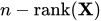 denominator degrees of freedom. Note that the quantity in the denominator of the F statistic is a particular estimator of
  —namely, the unbiased moment-based estimator that is customarily associated with least squares estimation. It is also the restricted maximum likelihood estimator of if
  is normally distributed.
In the case of the likelihood ratio test, suppose that  denotes the log likelihood evaluated at the ML estimators. Also suppose that
  denotes the log likelihood in the model for which holds. Then under the hypothesis the statistic

follows approximately a chi-square distribution with degrees of freedom equal to the rank of . In the case of a normally distributed response, the log-likelihood function can be profiled with respect to . The resulting profile log likelihood is

and the likelihood ratio test statistic becomes

The preceding expressions show that, in the case of normally distributed data, both reduction principles lead to simple functions of the residual sums of squares in two models. As Pawitan (2001, p. 151) puts it, there is, however, an important difference not in the computations but in the statistical content. The least squares principle, where sum of squares reduction tests are widely used, does not require a distributional specification. Assumptions about the distribution of the data are added to provide a framework for confirmatory inferences, such as the testing of hypotheses. This framework stems directly from the assumption about the data’s distribution, or from the sampling distribution of the least squares estimators. The likelihood principle, on the other hand, requires a distributional specification at the outset. Inference about the parameters is implicit in the model; it is the result of further computations following the estimation of the parameters. In the least squares framework, inference about the parameters is the result of further assumptions.
Linear Inference
The principle of linear inference is to formulate a test statistic for that builds on the linearity of the hypothesis about . For many models that have linear components, the estimator  is also linear in . It is then simple to establish the distributional properties of based on the distributional assumptions about or based on large-sample arguments. For example, might be a nonlinear estimator, but it is known to asymptotically follow a normal distribution; this is the case in many
nonlinear and generalized linear models.
is also linear in . It is then simple to establish the distributional properties of based on the distributional assumptions about or based on large-sample arguments. For example, might be a nonlinear estimator, but it is known to asymptotically follow a normal distribution; this is the case in many
nonlinear and generalized linear models.
If the sampling distribution or the asymptotic distribution of is normal, then one can easily derive quadratic forms with known distributional properties. For example, if the random vector  is distributed as
  , then
  follows a chi-square distribution with
  degrees of freedom and noncentrality parameter
  , provided that
  .
.
In the classical linear model, suppose that is deficient in rank and that  is a solution to the normal equations. Then, if the errors are normally distributed,

Because is testable,  is estimable, and thus
  , as established in the previous section. Hence,

The conditions for a chi-square distribution of the quadratic form

are thus met, provided that

This condition is obviously met if  is of full rank. The condition is also met if
 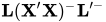 is a
reflexive inverse (a
is a
reflexive inverse (a  -inverse) of
  .
.
The test statistic to test the linear hypothesis is thus

and it follows an F distribution with numerator and 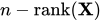 denominator degrees of freedom under the hypothesis.
This test statistic looks very similar to the F statistic for the
sum of squares reduction test. This is no accident. If the model is linear and parameters are estimated by ordinary least squares, then you can show that the quadratic form  equals the differences in the residual sum of squares,
  , where is obtained as the residual sum of squares from OLS estimation in a model that satisfies . However, this correspondence between the two test formulations does not apply when a different estimation principle is used. For example, assume that
 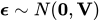 and that is estimated by
generalized least squares:
and that is estimated by
generalized least squares:

The construction of matrices associated with hypotheses in SAS/STAT software is frequently based on the properties of the matrix, not of  . In other words, the construction of the matrix is governed only by the design. A sum of squares reduction test for
  that uses the generalized residual sum of squares
  is not identical to a linear hypothesis test with the statistic
Furthermore,  is usually unknown and must be estimated as well. The estimate for depends on the model, and imposing a constraint on the model would change the estimate. The asymptotic distribution of the statistic
  is a chi-square distribution. However, in practical applications the F distribution with numerator and
  denominator degrees of freedom is often used because it provides a better approximation to the sampling distribution of in finite samples. The computation of the denominator degrees of freedom , however, is a matter of considerable discussion. A number of methods have been proposed and are implemented in various forms in SAS/STAT (see, for example, the degrees-of-freedom methods in the MIXED and GLIMMIX procedures).
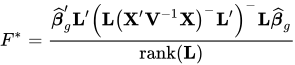
The general form of an F statistic for testing a linear hypotheses is

where  . The preceding development assumes that the estimated variance of
  ,
,  , is of the form
  for some estimate of the variance of . In this case, estimability ensures that this F statistic has a unique value no matter which kind of generalized inverse is used to compute it. However, when a residual-based sandwich estimator is used to estimate , estimability does not ensure uniqueness. In this case, the F value is invariant to the choice of the generalized inverse if and only if is estimable and
  .
.
Although it is extremely rare, it is possible in practice that the preceding uniqueness condition is not satisfied. For example, if the number of subjects (clusters) is less than the number of nonsingular parameters in the model and a residual-based sandwich variance estimator,  , is used to estimate
  , then the matrix of coefficients for testing the overall null does not satisfy the uniqueness condition. If this condition is not satisfied, then the F statistic for testing is not invariant to the choice of the -inverse of
 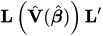 . In practical applications, F is compared with an F distribution with
  numerator and denominator degrees of freedom, where depends on how the variance of is estimated. But the F value and therefore the inference might be different when a different -inverse is used. This F test is not recommended when the uniqueness condition is not satisfied. An alternative approach would be to increase the number of subjects (clusters) or to find a parsimonious model so that the number of parameters is less than the number of subjects (clusters).