Introduction to Power and Sample Size Analysis
Equivalence and Noninferiority
Whereas the standard two-sided hypothesis test for a parameter  (such as a mean difference) aims to demonstrate that it is significantly different than a null value
  :
:

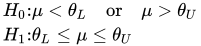
an equivalence test instead aims to demonstrate that it is significantly similar to some value, expressed in terms of a range  around that value:
Whereas the standard one-sided hypothesis test for (say, the upper one-sided test) aims to demonstrate that it is significantly greater than :

a corresponding noninferiority test aims to demonstrate that it is not significantly less than , expressed in terms of a margin  :
:
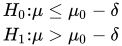
Corresponding forms of these hypotheses with the inequalities reversed apply to lower one-sided noninferiority tests (sometimes called nonsuperiority tests).
The POWER procedure performs power analyses for equivalence tests for one-sample, paired, and two-sample tests of normal and lognormal mean differences and ratios. It also supports noninferiority tests for a variety of analyses of means, proportions, and correlation, both directly (with a MARGIN= option representing  ) and indirectly (with an option for a custom null value representing the sum or difference of and ).