The IRT Procedure

Maximizing the Marginal Likelihood

You can obtain parameter estimates by maximizing the marginal likelihood by using either the expectation maximization (EM) algorithm or a Newton-type algorithm. Both algorithms are available in PROC IRT.

The most widely used estimation method for IRT models is the Gauss-Hermite quadrature–based EM algorithm, proposed by Bock and Aitkin (1981). However, this method has several important shortcomings, the most serious of which is the lack of reliable convergence criteria. Without reliable convergence criteria, estimates can be seriously biased because of spurious convergence. In comparison, gradient-based convergence criteria is readily available for Newton-type algorithms. As a result, PROC IRT uses the quasi-Newton algorithm instead of EM as the default optimization method.

Newton-Type Algorithms

Newton-type algorithms maximize the marginal likelihood directly, based on the first and second derivatives. Two of the most widely used estimation algorithms are the Newton-Raphson and Fisher scoring algorithms, which rely on the gradient and Hessian of the log likelihood. However, for latent variable models that contain categorical responses, the Hessian matrix is often expensive to compute. As a result, several quasi-Newton algorithms that require only gradients have been proposed. In the field of IRT, Bock and Lieberman (1970) propose replacing the Hessian with the following information matrix:

upper I left-parenthesis bold-italic theta right-parenthesis equals upper E left-bracket StartFraction partial-differential log ModifyingAbove upper L With tilde left-parenthesis theta vertical-bar upper U right-parenthesis Over partial-differential theta EndFraction left-parenthesis StartFraction partial-differential log ModifyingAbove upper L With tilde left-parenthesis theta vertical-bar upper U right-parenthesis Over partial-differential theta EndFraction right-parenthesis Superscript upper T Baseline right-bracket equals sigma-summation Underscript h equals 1 Overscript 2 Superscript upper J Baseline Endscripts left-bracket StartFraction partial-differential log upper L overTilde Subscript i Baseline Over partial-differential theta EndFraction left-parenthesis StartFraction partial-differential log upper L overTilde Subscript i Baseline Over partial-differential theta EndFraction right-parenthesis Superscript upper T Baseline right-bracket

To calculate the preceding expectation, you need to sum over not just the observed but all 2 Superscript upper J possible response patterns; this becomes computationally very expensive when the number of items is large. Fortunately, other quasi-Newton algorithms that do not have these computational difficulties have been proposed. The Broyden-Fletcher-Goldfarb-Shanno (BFGS) method is one of the most popular quasi-Newton algorithms that approximate the Hessian matrix with gradient.

For the objective function, log ModifyingAbove upper L With tilde left-parenthesis theta right-parenthesis, the first derivatives with respect to theta Subscript j are

StartFraction partial-differential log ModifyingAbove upper L With tilde left-parenthesis bold-italic theta vertical-bar bold upper U right-parenthesis Over partial-differential theta Subscript j Baseline EndFraction equals sigma-summation Underscript i equals 1 Overscript upper N Endscripts left-bracket left-parenthesis upper L overTilde Subscript i Baseline right-parenthesis Superscript negative 1 Baseline StartFraction partial-differential upper L overTilde Subscript i Baseline Over partial-differential theta Subscript j Baseline EndFraction right-bracket equals sigma-summation Underscript i equals 1 Overscript upper N Endscripts left-bracket left-parenthesis upper L overTilde Subscript i Baseline right-parenthesis Superscript negative 1 Baseline sigma-summation Underscript g equals 1 Overscript upper G Superscript d Baseline Endscripts left-bracket StartFraction partial-differential f Subscript i Baseline left-parenthesis bold x Subscript g Baseline right-parenthesis Over partial-differential theta Subscript j Baseline EndFraction w Subscript g Superscript asterisk Baseline right-bracket right-bracket

where

upper L overTilde Subscript i Baseline equals sigma-summation Underscript g equals 1 Overscript upper G Superscript d Baseline Endscripts left-bracket product Underscript j equals 1 Overscript upper J Endscripts product Underscript k equals 1 Overscript upper K Endscripts left-parenthesis upper P Subscript i j k Baseline left-parenthesis bold x Subscript g Baseline right-parenthesis right-parenthesis Superscript v Super Subscript i j k Superscript Baseline StartFraction phi left-parenthesis bold x Subscript g Baseline semicolon bold-italic mu comma bold upper Sigma right-parenthesis Over d left-parenthesis bold x Subscript g Baseline semicolon 0 comma upper I right-parenthesis EndFraction right-bracket w Subscript g Baseline equals sigma-summation Underscript g equals 1 Overscript upper G Superscript d Baseline Endscripts f Subscript i Baseline left-parenthesis x Subscript g Baseline right-parenthesis w Subscript g
f Subscript i Baseline left-parenthesis x Subscript g Baseline right-parenthesis equals product Underscript j equals 1 Overscript upper J Endscripts product Underscript k equals 1 Overscript upper K Endscripts left-parenthesis upper P Subscript i j k Baseline left-parenthesis bold x Subscript g Baseline right-parenthesis right-parenthesis Superscript v Super Subscript i j k Baseline StartFraction phi left-parenthesis bold x Subscript g Baseline semicolon bold-italic mu comma bold upper Sigma right-parenthesis Over d left-parenthesis bold x Subscript g Baseline semicolon 0 comma upper I right-parenthesis EndFraction

and

StartFraction partial-differential f Subscript i Baseline left-parenthesis bold x Subscript g Baseline right-parenthesis Over partial-differential theta Subscript upper I j Baseline EndFraction equals StartFraction partial-differential left-bracket left-parenthesis upper P Subscript i j k Baseline left-parenthesis bold x Subscript g Baseline right-parenthesis right-parenthesis right-bracket Over partial-differential theta Subscript j Baseline EndFraction StartFraction f Subscript i Baseline left-parenthesis bold x Subscript g Baseline right-parenthesis Over left-parenthesis upper P Subscript i j k Baseline left-parenthesis bold x Subscript g Baseline right-parenthesis right-parenthesis EndFraction
StartFraction partial-differential f Subscript i Baseline left-parenthesis bold x Subscript g Baseline right-parenthesis Over partial-differential theta Subscript f Baseline EndFraction equals product Underscript j equals 1 Overscript upper J Endscripts product Underscript k equals 1 Overscript upper K Endscripts left-parenthesis upper P Subscript i j k Baseline left-parenthesis bold x Subscript g Baseline right-parenthesis right-parenthesis Superscript v Super Subscript i j k Baseline StartFraction partial-differential phi left-parenthesis bold x Subscript g Baseline semicolon bold-italic mu comma bold upper Sigma right-parenthesis Over partial-differential theta Subscript f Baseline EndFraction

where, in the preceding two equations, theta Subscript upper I j indicate parameters that are associated with item j and theta Subscript f represents parameters that are related to latent factors.

Expectation-Maximization (EM) Algorithm

The expectation-maximization (EM) algorithm starts from the complete data log likelihood that can be expressed as follows:
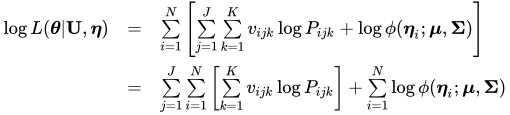
StartLayout 1st Row 1st Column log upper L left-parenthesis bold-italic theta vertical-bar bold upper U comma bold-italic eta right-parenthesis 2nd Column equals 3rd Column sigma-summation Underscript i equals 1 Overscript upper N Endscripts left-bracket sigma-summation Underscript j equals 1 Overscript upper J Endscripts sigma-summation Underscript k equals 1 Overscript upper K Endscripts v Subscript i j k Baseline log upper P Subscript i j k Baseline plus log phi left-parenthesis bold-italic eta Subscript i Baseline semicolon bold-italic mu comma bold upper Sigma right-parenthesis right-bracket 2nd Row 1st Column Blank 2nd Column equals 3rd Column sigma-summation Underscript j equals 1 Overscript upper J Endscripts sigma-summation Underscript i equals 1 Overscript upper N Endscripts left-bracket sigma-summation Underscript k equals 1 Overscript upper K Endscripts v Subscript i j k Baseline log upper P Subscript i j k Baseline right-bracket plus sigma-summation Underscript i equals 1 Overscript upper N Endscripts log phi left-parenthesis bold-italic eta Subscript i Baseline semicolon bold-italic mu comma bold upper Sigma right-parenthesis EndLayout

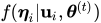
The expectation (E) step calculates the expectation of the complete data log likelihood with respect to the conditional distribution of bold-italic eta Subscript i, f left-parenthesis bold-italic eta Subscript i Baseline vertical-bar bold u Subscript i Baseline comma bold-italic theta Superscript left-parenthesis t right-parenthesis Baseline right-parenthesis as follows:

upper Q left-parenthesis bold-italic theta vertical-bar bold-italic theta Superscript left-parenthesis t right-parenthesis Baseline right-parenthesis equals sigma-summation Underscript j equals 1 Overscript upper J Endscripts sigma-summation Underscript i equals 1 Overscript upper N Endscripts left-bracket sigma-summation Underscript k equals 1 Overscript upper K Endscripts v Subscript i j k Baseline upper E left-bracket log upper P Subscript i j k Baseline vertical-bar bold u Subscript i Baseline comma bold-italic theta Superscript left-parenthesis t right-parenthesis Baseline right-bracket right-bracket plus sigma-summation Underscript i equals 1 Overscript upper N Endscripts upper E left-bracket log phi left-parenthesis bold-italic eta Subscript i Baseline semicolon bold-italic mu comma bold upper Sigma right-parenthesis vertical-bar bold u Subscript i Baseline comma bold-italic theta Superscript left-parenthesis t right-parenthesis Baseline right-bracket

The conditional distribution f left-parenthesis bold-italic eta vertical-bar u Subscript i Baseline comma theta Superscript left-parenthesis t right-parenthesis Baseline right-parenthesis is

f left-parenthesis bold-italic eta vertical-bar bold u Subscript i Baseline comma bold-italic theta Superscript left-parenthesis t right-parenthesis Baseline right-parenthesis equals StartFraction f left-parenthesis bold u Subscript i Baseline vertical-bar bold-italic eta comma bold-italic theta Superscript left-parenthesis t right-parenthesis Baseline right-parenthesis phi left-parenthesis bold-italic eta semicolon bold-italic mu Superscript left-parenthesis t right-parenthesis Baseline comma bold upper Sigma Superscript left-parenthesis t right-parenthesis Baseline right-parenthesis Over integral f left-parenthesis bold u Subscript i Baseline vertical-bar bold-italic eta comma bold-italic theta Superscript left-parenthesis t right-parenthesis Baseline right-parenthesis phi left-parenthesis bold-italic eta semicolon bold-italic mu Superscript left-parenthesis t right-parenthesis Baseline comma bold upper Sigma Superscript left-parenthesis t right-parenthesis Baseline right-parenthesis d bold-italic eta EndFraction equals StartFraction f left-parenthesis bold u Subscript i Baseline vertical-bar bold-italic eta comma bold-italic theta Superscript left-parenthesis t right-parenthesis Baseline right-parenthesis phi left-parenthesis bold-italic eta semicolon bold-italic mu Superscript left-parenthesis t right-parenthesis Baseline comma bold upper Sigma Superscript left-parenthesis t right-parenthesis Baseline right-parenthesis Over f left-parenthesis bold u Subscript i Baseline right-parenthesis EndFraction

These conditional expectations that are involved in the Q function can be expressed as follows:

upper E left-bracket log upper P Subscript i j k Baseline vertical-bar bold u Subscript i Baseline comma bold-italic theta Superscript left-parenthesis t right-parenthesis Baseline right-bracket equals integral log upper P Subscript i j k Baseline f left-parenthesis bold-italic eta vertical-bar bold u Subscript i Baseline comma bold-italic theta Superscript left-parenthesis t right-parenthesis Baseline right-parenthesis d bold-italic eta
upper E left-bracket log phi left-parenthesis bold-italic eta semicolon bold-italic mu comma bold upper Sigma right-parenthesis vertical-bar bold u Subscript i Baseline comma bold-italic theta Superscript left-parenthesis t right-parenthesis Baseline right-bracket equals integral log phi left-parenthesis bold-italic eta semicolon bold-italic mu comma bold upper Sigma right-parenthesis f left-parenthesis bold-italic eta vertical-bar bold u Subscript i Baseline comma bold-italic theta Superscript left-parenthesis t right-parenthesis Baseline right-parenthesis d bold-italic eta

Then

upper Q left-parenthesis bold-italic theta vertical-bar bold-italic theta Superscript left-parenthesis t right-parenthesis Baseline right-parenthesis equals sigma-summation Underscript j equals 1 Overscript upper J Endscripts integral left-bracket log upper P Subscript i j k Baseline r Subscript j k Baseline left-parenthesis bold-italic theta Superscript left-parenthesis t right-parenthesis Baseline right-parenthesis right-bracket phi left-parenthesis bold-italic eta semicolon bold-italic mu Superscript left-parenthesis t right-parenthesis Baseline comma bold upper Sigma Superscript left-parenthesis t right-parenthesis Baseline right-parenthesis d bold-italic eta plus integral log phi left-parenthesis bold-italic eta vertical-bar bold-italic theta right-parenthesis upper N left-parenthesis bold-italic theta Superscript left-parenthesis t right-parenthesis Baseline right-parenthesis phi left-parenthesis bold-italic eta semicolon bold-italic mu Superscript left-parenthesis t right-parenthesis Baseline comma bold upper Sigma Superscript left-parenthesis t right-parenthesis Baseline right-parenthesis d bold-italic eta

where

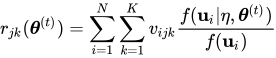
r Subscript j k Baseline left-parenthesis bold-italic theta Superscript left-parenthesis t right-parenthesis Baseline right-parenthesis equals sigma-summation Underscript i equals 1 Overscript upper N Endscripts sigma-summation Underscript k equals 1 Overscript upper K Endscripts v Subscript i j k Baseline StartFraction f left-parenthesis bold u Subscript i Baseline vertical-bar eta comma bold-italic theta Superscript left-parenthesis t right-parenthesis Baseline right-parenthesis Over f left-parenthesis bold u Subscript i Baseline right-parenthesis EndFraction

and

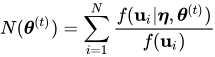
upper N left-parenthesis bold-italic theta Superscript left-parenthesis t right-parenthesis Baseline right-parenthesis equals sigma-summation Underscript i equals 1 Overscript upper N Endscripts StartFraction f left-parenthesis bold u Subscript i Baseline vertical-bar bold-italic eta comma bold-italic theta Superscript left-parenthesis t right-parenthesis Baseline right-parenthesis Over f left-parenthesis bold u Subscript i Baseline right-parenthesis EndFraction

Integrations in the preceding equations can be approximated as follows by using G-H quadrature:

ModifyingAbove upper Q With tilde left-parenthesis bold-italic theta vertical-bar bold-italic theta Superscript left-parenthesis t right-parenthesis Baseline right-parenthesis equals sigma-summation Underscript g equals 1 Overscript upper G Endscripts left-bracket log upper P Subscript i j k Baseline left-parenthesis bold x Subscript g Baseline right-parenthesis r Subscript j k Baseline left-parenthesis bold x Subscript g Baseline comma bold-italic theta Superscript left-parenthesis t right-parenthesis Baseline right-parenthesis plus log phi left-parenthesis bold x Subscript g Baseline vertical-bar bold-italic theta right-parenthesis upper N left-parenthesis bold x Subscript g Baseline comma bold-italic theta Superscript left-parenthesis t right-parenthesis Baseline right-parenthesis right-bracket StartFraction phi left-parenthesis bold x Subscript g Baseline semicolon bold-italic mu Superscript left-parenthesis t right-parenthesis Baseline comma bold upper Sigma Superscript left-parenthesis t right-parenthesis Baseline right-parenthesis Over d left-parenthesis bold x Subscript g Baseline semicolon 0 comma upper I right-parenthesis EndFraction w Subscript g

In the maximization (M) step of the EM algorithm, parameters are updated by maximizing ModifyingAbove upper Q With tilde left-parenthesis theta vertical-bar theta Superscript left-parenthesis t right-parenthesis Baseline right-parenthesis. To summarize, the EM algorithm consists of the following two steps:

E step: Approximate upper Q left-parenthesis bold-italic theta vertical-bar bold-italic theta Superscript left-parenthesis t right-parenthesis Baseline right-parenthesis by using numerical integration.

M step: Update parameter estimates by maximizing ModifyingAbove upper Q With tilde left-parenthesis bold-italic theta vertical-bar bold-italic theta Superscript left-parenthesis t right-parenthesis Baseline right-parenthesis with the one-step Newton-Raphson algorithm.

Last updated: December 09, 2022