The KRIGE2D Procedure
The Nugget Effect
For all the semivariogram models considered previously, the following property holds:

However, a plot of the experimental semivariogram might indicate a
discontinuity at h = 0; that is,  as
as  , while
  . The quantity
  is called the nugget effect; this term is from mining geostatistics where nuggets literally exist, and it represents variations at a much smaller scale than any of the measured pairwise distances—that is, at distances
  , where

Nonzero nugget effects have been associated with conceptual and theoretical difficulties;
see Cressie (1993, section 2.3.1) and Christakos (1992, section 7.4.3) for details. There is no practical difficulty, however; you simply visually extrapolate the experimental semivariogram as . The importance of availability of data at small lag distances is again illustrated.
As an example, an exponential semivariogram with a nugget effect has the form

and

where the factor  is called the partial sill and the sill
  .
.
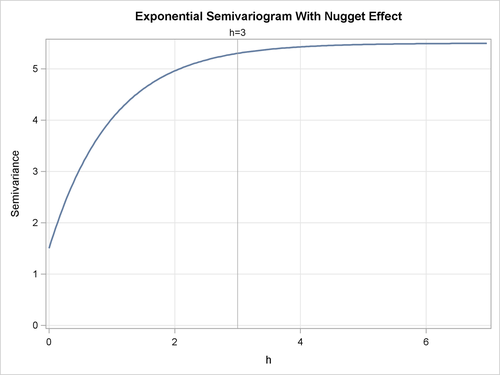
This is illustrated in Figure 11 for the parameters  ,
,  , and nugget effect
  .
.
You can specify the nugget effect in PROC KRIGE2D with the NUGGET= option in the MODEL statement. It is a separate, additive term independent of direction; that is, it is isotropic. The way to approximate an anisotropic nugget effect is described in the following section.
Figure 11: Exponential Semivariogram Model with a Nugget Effect