The KRIGE2D Procedure

Ordinary Kriging

Denote the SRF by upper Z left-parenthesis bold-italic s right-parenthesis comma bold-italic s element-of upper D subset-of script upper R squared. Following the notation in Cressie (1993), the following model for upper Z left-parenthesis bold-italic s right-parenthesis is assumed:

upper Z left-parenthesis bold-italic s right-parenthesis equals mu plus epsilon left-parenthesis bold-italic s right-parenthesis

Here, mu is the fixed, unknown mean of the process, and epsilon left-parenthesis bold-italic s right-parenthesis is a zero mean SRF, which represents the variation around the mean.

In most practical applications, an additional assumption is required in order to estimate the covariance upper C Subscript z of the upper Z left-parenthesis bold-italic s right-parenthesis process. This assumption is second-order stationarity:

upper C Subscript z Baseline left-parenthesis bold-italic s 1 comma bold-italic s 2 right-parenthesis equals normal upper E left-bracket epsilon left-parenthesis bold-italic s 1 right-parenthesis epsilon left-parenthesis bold-italic s 2 right-parenthesis right-bracket equals upper C Subscript z Baseline left-parenthesis bold-italic s 1 minus bold-italic s 2 right-parenthesis equals upper C Subscript z Baseline left-parenthesis bold-italic h right-parenthesis

This requirement can be relaxed slightly when you are using the semivariogram instead of the covariance. In this case, second-order stationarity is required of the differences epsilon left-parenthesis bold-italic s 1 right-parenthesis minus epsilon left-parenthesis bold-italic s 2 right-parenthesis rather than epsilon left-parenthesis bold-italic s right-parenthesis:

gamma Subscript z Baseline left-parenthesis bold-italic s 1 comma bold-italic s 2 right-parenthesis equals one-half normal upper E left-bracket left-parenthesis epsilon left-parenthesis bold-italic s 1 right-parenthesis minus epsilon left-parenthesis bold-italic s 2 right-parenthesis right-parenthesis squared right-bracket equals gamma Subscript z Baseline left-parenthesis bold-italic s 1 minus bold-italic s 2 right-parenthesis equals gamma Subscript z Baseline left-parenthesis bold-italic h right-parenthesis

By performing local kriging, the spatial processes represented by the previous equation for upper Z left-parenthesis bold-italic s right-parenthesis are more general than they appear. In local kriging, at an unsampled location bold-italic s 0, a separate model is fit using only data in a neighborhood of bold-italic s 0. This has the effect of fitting a separate mean mu at each point, and it is similar to the kriging with trend (KT) method discussed in Journel and Rossi (1989).

Given the N measurements upper Z left-parenthesis bold-italic s 1 right-parenthesis comma ellipsis comma upper Z left-parenthesis bold-italic s Subscript upper N Baseline right-parenthesis at known locations bold-italic s 1 comma ellipsis comma bold-italic s Subscript upper N Baseline, you want to obtain a prediction of Z at an unsampled location bold-italic s 0. When the following three requirements are imposed on the predictor ModifyingAbove upper Z With caret, the OK predictor is obtained:

  1. ModifyingAbove upper Z With caret is linear in upper Z left-parenthesis bold-italic s 1 right-parenthesis comma ellipsis comma upper Z left-parenthesis bold-italic s Subscript upper N Baseline right-parenthesis

  2. ModifyingAbove upper Z With caret is unbiased

  3. ModifyingAbove upper Z With caret minimizes the mean square prediction error normal upper E left-bracket left-parenthesis upper Z left-parenthesis bold-italic s 0 right-parenthesis minus ModifyingAbove upper Z With caret left-parenthesis bold-italic s 0 right-parenthesis right-parenthesis squared right-bracket

Linearity requires the following form for ModifyingAbove upper Z With caret left-parenthesis bold-italic s 0 right-parenthesis:

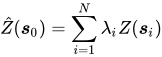
ModifyingAbove upper Z With caret left-parenthesis bold-italic s 0 right-parenthesis equals sigma-summation Underscript i equals 1 Overscript upper N Endscripts lamda Subscript i Baseline upper Z left-parenthesis bold-italic s Subscript i Baseline right-parenthesis

Applying the unbiasedness condition to the preceding equation yields

StartLayout 1st Row  normal upper E left-bracket ModifyingAbove upper Z With caret left-parenthesis bold-italic s 0 right-parenthesis right-bracket equals mu right double arrow sigma-summation Underscript i equals 1 Overscript upper N Endscripts lamda Subscript i Baseline normal upper E left-bracket upper Z left-parenthesis bold-italic s Subscript i Baseline right-parenthesis right-bracket equals mu right double arrow sigma-summation Underscript i equals 1 Overscript upper N Endscripts lamda Subscript i Baseline mu equals mu right double arrow sigma-summation Underscript i equals 1 Overscript upper N Endscripts lamda Subscript i Baseline equals 1 EndLayout

Finally, the third condition requires a constrained linear optimization that involves lamda 1 comma ellipsis comma lamda Subscript upper N Baseline and a Lagrange parameter 2 m. This constrained linear optimization can be expressed in terms of the function upper L left-parenthesis lamda 1 comma ellipsis comma lamda Subscript upper N Baseline comma m right-parenthesis given by

upper L equals normal upper E left-bracket left-parenthesis upper Z left-parenthesis bold-italic s 0 right-parenthesis minus sigma-summation Underscript i equals 1 Overscript upper N Endscripts lamda Subscript i Baseline upper Z left-parenthesis bold-italic s Subscript i Baseline right-parenthesis right-parenthesis squared right-bracket minus 2 m left-parenthesis sigma-summation Underscript i equals 1 Overscript upper N Endscripts lamda Subscript i Baseline minus 1 right-parenthesis

Define the upper N times 1 column vector bold-italic lamda by

bold-italic lamda equals left-parenthesis lamda 1 comma ellipsis comma lamda Subscript upper N Baseline right-parenthesis prime

and the left-parenthesis upper N plus 1 right-parenthesis times 1 column vector bold-italic lamda bold 0 by

bold-italic lamda bold 0 equals left-parenthesis lamda 1 comma ellipsis comma lamda Subscript upper N Baseline comma m right-parenthesis prime equals StartBinomialOrMatrix bold-italic lamda Choose m EndBinomialOrMatrix

The optimization is performed by solving

StartFraction partial-differential upper L Over partial-differential bold-italic lamda bold 0 EndFraction equals bold 0

in terms of lamda 1 comma ellipsis comma lamda Subscript upper N Baseline and m.

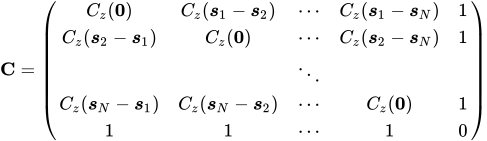
The resulting matrix equation can be expressed in terms of either the covariance upper C Subscript z Baseline left-parenthesis bold-italic h right-parenthesis or semivariogram gamma Subscript z Baseline left-parenthesis bold-italic h right-parenthesis. In terms of the covariance, the preceding equation results in the matrix equation

bold upper C bold-italic lamda bold 0 equals bold upper C bold 0

where

bold upper C equals Start 5 By 5 Matrix 1st Row 1st Column upper C Subscript z Baseline left-parenthesis bold 0 right-parenthesis 2nd Column upper C Subscript z Baseline left-parenthesis bold-italic s 1 minus bold-italic s 2 right-parenthesis 3rd Column midline-horizontal-ellipsis 4th Column upper C Subscript z Baseline left-parenthesis bold-italic s 1 minus bold-italic s Subscript upper N Baseline right-parenthesis 5th Column 1 2nd Row 1st Column upper C Subscript z Baseline left-parenthesis bold-italic s 2 minus bold-italic s 1 right-parenthesis 2nd Column upper C Subscript z Baseline left-parenthesis bold 0 right-parenthesis 3rd Column midline-horizontal-ellipsis 4th Column upper C Subscript z Baseline left-parenthesis bold-italic s 2 minus bold-italic s Subscript upper N Baseline right-parenthesis 5th Column 1 3rd Row 1st Column Blank 2nd Column Blank 3rd Column down-right-diagonal-ellipsis 4th Column Blank 5th Column Blank 4th Row 1st Column upper C Subscript z Baseline left-parenthesis bold-italic s Subscript upper N Baseline minus bold-italic s 1 right-parenthesis 2nd Column upper C Subscript z Baseline left-parenthesis bold-italic s Subscript upper N Baseline minus bold-italic s 2 right-parenthesis 3rd Column midline-horizontal-ellipsis 4th Column upper C Subscript z Baseline left-parenthesis bold 0 right-parenthesis 5th Column 1 5th Row 1st Column 1 2nd Column 1 3rd Column midline-horizontal-ellipsis 4th Column 1 5th Column 0 EndMatrix

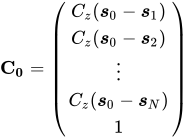
and

bold upper C bold 0 equals Start 5 By 1 Matrix 1st Row  upper C Subscript z Baseline left-parenthesis bold-italic s 0 minus bold-italic s 1 right-parenthesis 2nd Row  upper C Subscript z Baseline left-parenthesis bold-italic s 0 minus bold-italic s 2 right-parenthesis 3rd Row  vertical-ellipsis 4th Row  upper C Subscript z Baseline left-parenthesis bold-italic s 0 minus bold-italic s Subscript upper N Baseline right-parenthesis 5th Row  1 EndMatrix

The solution to the previous matrix equation is

ModifyingAbove bold-italic lamda With caret Subscript bold 0 Baseline equals bold upper C Superscript negative bold 1 Baseline bold upper C bold 0

Using this solution for bold-italic lamda and m, the ordinary kriging prediction at r 0 is

ModifyingAbove upper Z With caret left-parenthesis bold-italic s 0 right-parenthesis equals lamda 1 upper Z left-parenthesis bold-italic s 1 right-parenthesis plus midline-horizontal-ellipsis plus lamda Subscript upper N Baseline upper Z left-parenthesis bold-italic s Subscript upper N Baseline right-parenthesis

with associated prediction error the square root of the variance

sigma Subscript z Baseline Superscript 2 Baseline left-parenthesis bold-italic s 0 right-parenthesis equals upper C Subscript z Baseline left-parenthesis bold 0 right-parenthesis minus bold-italic lamda prime bold c bold 0 plus m

where bold c bold 0 is bold upper C bold 0 with the 1 in the last row removed, making it an upper N times 1 vector.

These formulas are used in the best linear unbiased prediction (BLUP) of random variables (Robinson 1991). Further details are provided in Cressie (1993, pp. 119–123).

Because of possible numeric problems when solving the previous matrix equation, Deutsch and Journel (1992) suggest replacing the last row and column of 1s in the preceding matrix bold upper C by upper C Subscript z Baseline left-parenthesis 0 right-parenthesis, keeping the 0 in the left-parenthesis upper N plus 1 comma upper N plus 1 right-parenthesis position and similarly replacing the last element in the preceding right-hand vector bold upper C bold 0 with upper C Subscript z Baseline left-parenthesis 0 right-parenthesis. This results in an equivalent system but avoids numeric problems when upper C Subscript z Baseline left-parenthesis 0 right-parenthesis is large or small relative to 1.

Last updated: December 09, 2022