The LIFEREG Procedure
Predicted Values
For a given set of covariates,  (including the intercept term), the pth quantile of the log response,
  , is given by

if no offset variable has been specified, or

for a given value o of an offset variable, where  is the pth quantile of the baseline distribution. The estimated quantile is computed by replacing the unknown parameters with their estimates, including any shape parameters on which the baseline distribution might depend. The estimated quantile of the original response is obtained by taking the exponential of the estimated log quantile unless the NOLOG option is specified in the preceding MODEL statement.
The following table shows how is computed from the baseline distribution  :
:
| Distribution | |
|
|---|---|---|
| Exponential |  |

|
| Generalized gamma | 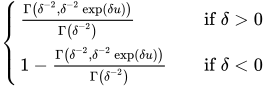 |
 |
| Logistic |  |

|
| Log-logistic | |
|
| Lognormal |  |
 |
| Normal | |
|
| Weibull | |
 |
For the generalized gamma distribution, is computed numerically.
The standard errors of the quantile estimates are computed using the estimated covariance matrix of the parameter estimates and a Taylor series expansion of the quantile estimate. The standard error is computed as
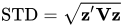
where  is the estimated covariance matrix of the parameter vector
  , and
, and  is the vector
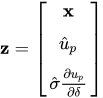
where  is the vector of the shape parameters. Unless the NOLOG option is specified, this standard error estimate is converted into a standard error estimate for
  as
as  STD. It might be more desirable to compute confidence limits for the log response and convert them back to the original response variable than to use the standard error estimates for directly. See Example 76.1 for a 90% confidence interval of the response constructed by exponentiating a confidence interval for the log response.
The variable CDF is computed as

where the residual is defined by
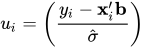
and F is the baseline cumulative distribution function. If the data are interval-censored, then the cumulative distribution function,  , is evaluated at the lower interval endpoint.