The LIFETEST Procedure

Comparison of Two or More Groups of Survival Data

Let K be the number of groups. Let upper S Subscript k Baseline left-parenthesis t right-parenthesis be the underlying survivor function of the kth group, k equals 1 comma ellipsis comma upper K. The null and alternative hypotheses to be tested are


upper H 0 colon upper S 1 left-parenthesis t right-parenthesis equals upper S 2 left-parenthesis t right-parenthesis equals midline-horizontal-ellipsis equals upper S Subscript upper K Baseline left-parenthesis t right-parenthesis for all t less-than-or-equal-to tau

versus

upper H 1 colon at least one of the upper S Subscript k Baseline left-parenthesis t right-parenthesis’s is different for some t less-than-or-equal-to tau

respectively, where tau is the largest observed time.

Likelihood Ratio Test

The likelihood ratio test statistic (Lawless 1982) for test upper H 0 versus upper H 1 assumes that the data in the various samples are exponentially distributed and tests that the scale parameters are equal. The test statistic is computed as

chi squared equals 2 upper N log left-parenthesis StartFraction upper T Over upper N EndFraction right-parenthesis minus 2 sigma-summation Underscript k equals 1 Overscript upper K Endscripts upper N Subscript k Baseline log left-parenthesis StartFraction upper T Subscript k Baseline Over upper N Subscript k Baseline EndFraction right-parenthesis

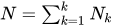
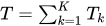
where upper N Subscript k is the total number of events in the kth group, upper N equals sigma-summation Underscript k equals 1 Overscript k Endscripts upper N Subscript k, upper T Subscript k is the total time on test in the kth stratum, and upper T equals sigma-summation Underscript k equals 1 Overscript upper K Endscripts upper T Subscript k. The approximate probability value is computed by treating chi squared as having a chi-square distribution with K – 1 degrees of freedom.
Nonparametric Tests

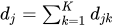
Let (upper T Subscript i Baseline comma delta Subscript i Baseline comma upper X Subscript i Baseline right-parenthesis comma i equals 1 comma ellipsis comma n comma denote an independent sample of right-censored survival data, where upper T Subscript i is the possibly right-censored time, delta Subscript i is the censoring indicator (delta Subscript i=0 if upper T Subscript i is censored and delta Subscript i=1 if upper T Subscript i is an event time), and upper X Subscript i Baseline equals 1 comma ellipsis comma upper K for K different groups. Let t 1 less-than t 2 less-than midline-horizontal-ellipsis less-than t Subscript upper D be the distinct event times in the sample. At time t Subscript j Baseline comma j equals 1 comma ellipsis comma upper D comma let upper W left-parenthesis t Subscript j Baseline right-parenthesis be a positive weight function, and let upper Y Subscript j k Baseline equals sigma-summation Underscript i colon upper T Subscript i Baseline greater-than-or-equal-to t Subscript j Baseline Endscripts upper I left-parenthesis upper X i equals k right-parenthesis and d Subscript j k Baseline equals sigma-summation Underscript i colon upper T Subscript i Baseline equals t Subscript j Baseline Endscripts delta Subscript i Baseline upper I left-parenthesis upper X Subscript i Baseline equals k right-parenthesis be the size of the risk set and the number of events in the kth group, respectively. Let upper Y Subscript j Baseline equals sigma-summation Underscript k equals 1 Overscript upper K Endscripts upper Y Subscript j k, d Subscript j Baseline equals sigma-summation Underscript k equals 1 Overscript upper K Endscripts d Subscript j k.



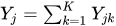
The choices of the weight function upper W left-parenthesis t Subscript j Baseline right-parenthesis are given in Table 3.

Table 3: Weight Functions for Various Tests

Test upper W left-parenthesis t Subscript i Baseline right-parenthesis
Log-rank 1.0
Wilcoxon upper Y Subscript j
Tarone-Ware StartRoot upper Y Subscript j Baseline EndRoot
Peto-Peto ModifyingAbove upper S With tilde left-parenthesis t Subscript j Baseline right-parenthesis
Modified Peto-Peto ModifyingAbove upper S With tilde left-parenthesis t Subscript j Baseline right-parenthesis StartFraction upper Y Subscript j Baseline Over upper Y Subscript j Baseline plus 1 EndFraction
Harrington-Fleming (p,q) left-bracket ModifyingAbove upper S With caret left-parenthesis t Subscript j minus 1 Baseline right-parenthesis right-bracket Superscript p Baseline left-bracket 1 minus ModifyingAbove upper S With caret left-parenthesis t Subscript j minus 1 Baseline right-parenthesis right-bracket Superscript q Baseline comma p greater-than-or-equal-to 0 comma q greater-than-or-equal-to 0


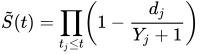
In Table 3, ModifyingAbove upper S With caret left-parenthesis t right-parenthesis is the product-limit estimate at t for the pooled sample, and ModifyingAbove upper S With tilde left-parenthesis t right-parenthesis is a survivor function estimate close to ModifyingAbove upper S With caret left-parenthesis t right-parenthesis given by

ModifyingAbove upper S With tilde left-parenthesis t right-parenthesis equals product Underscript t Subscript j Baseline less-than-or-equal-to t Endscripts left-parenthesis 1 minus StartFraction d Subscript j Baseline Over upper Y Subscript j Baseline plus 1 EndFraction right-parenthesis
Unstratified Tests

The rank statistics (Klein and Moeschberger 1997, Section 7.3) for testing upper H 0 versus upper H 1 have the form of a K-vector bold v equals left-parenthesis v 1 comma v 2 comma ellipsis comma v Subscript upper K Baseline right-parenthesis prime with

v Subscript k Baseline equals sigma-summation Underscript j equals 1 Overscript upper D Endscripts left-bracket upper W left-parenthesis t Subscript j Baseline right-parenthesis left-parenthesis d Subscript j k Baseline minus upper Y Subscript j k Baseline StartFraction d Subscript j Baseline Over upper Y Subscript j Baseline EndFraction right-parenthesis right-bracket

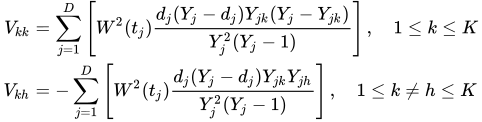
and the variance of v Subscript k and the covariance of v Subscript k and v Subscript h are, respectively,

StartLayout 1st Row 1st Column upper V Subscript k k 2nd Column equals 3rd Column sigma-summation Underscript j equals 1 Overscript upper D Endscripts left-bracket upper W squared left-parenthesis t Subscript j Baseline right-parenthesis StartFraction d Subscript j Baseline left-parenthesis upper Y Subscript j Baseline minus d Subscript j Baseline right-parenthesis upper Y Subscript j k Baseline left-parenthesis upper Y Subscript j Baseline minus upper Y Subscript j k Baseline right-parenthesis Over upper Y Subscript j Superscript 2 Baseline left-parenthesis upper Y Subscript j Baseline minus 1 right-parenthesis EndFraction right-bracket comma 1 less-than-or-equal-to k less-than-or-equal-to upper K 2nd Row 1st Column upper V Subscript k h 2nd Column equals 3rd Column minus sigma-summation Underscript j equals 1 Overscript upper D Endscripts left-bracket upper W squared left-parenthesis t Subscript j Baseline right-parenthesis StartFraction d Subscript j Baseline left-parenthesis upper Y Subscript j Baseline minus d Subscript j Baseline right-parenthesis upper Y Subscript j k Baseline upper Y Subscript j h Baseline Over upper Y Subscript j Superscript 2 Baseline left-parenthesis upper Y Subscript j Baseline minus 1 right-parenthesis EndFraction right-bracket comma 1 less-than-or-equal-to k not-equals h less-than-or-equal-to upper K EndLayout

The statistic v Subscript k can be interpreted as a weighted sum of observed minus expected numbers of failure for the kth group under the null hypothesis of identical survival curves. Let bold upper V equals left-parenthesis upper V Subscript k h Baseline right-parenthesis. The overall test statistic for homogeneity is bold v prime bold upper V Superscript bold minus Baseline bold v, where bold upper V Superscript bold minus denotes a generalized inverse of bold upper V. This statistic is treated as having a chi-square distribution with degrees of freedom equal to the rank of bold upper V for the purposes of computing an approximate probability level.

Adjusted Log-Rank Test

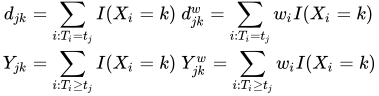
PROC LIFETEST computes the weighted log-rank test (Xie and Liu 2005, 2011) if you specify the WEIGHT statement. Let (upper T Subscript i Baseline comma delta Subscript i Baseline comma upper X Subscript i Baseline comma w Subscript i Baseline right-parenthesis comma i equals 1 comma ellipsis comma n comma denote an independent sample of right-censored survival data, where upper T Subscript i is the possibly right-censored time, delta Subscript i is the censoring indicator (delta Subscript i=0 if upper T Subscript i is censored and delta Subscript i=1 if upper T Subscript i is an event time), upper X Subscript i Baseline equals 1 comma ellipsis comma upper K for K different groups, and w Subscript i is the weight from the WEIGHT statement. Let t 1 less-than t 2 less-than midline-horizontal-ellipsis less-than t Subscript upper D be the distinct event times in the sample. At each t Subscript j Baseline comma j equals 1 comma ellipsis comma upper D, and for each 1 less-than-or-equal-to k less-than-or-equal-to upper K, let

StartLayout 1st Row 1st Column d Subscript j k Baseline equals sigma-summation Underscript i colon upper T Subscript i Baseline equals t Subscript j Baseline Endscripts upper I left-parenthesis upper X Subscript i Baseline equals k right-parenthesis 2nd Column Blank 3rd Column d Subscript j k Superscript w Baseline equals sigma-summation Underscript i colon upper T Subscript i Baseline equals t Subscript j Baseline Endscripts w Subscript i Baseline upper I left-parenthesis upper X Subscript i Baseline equals k right-parenthesis 2nd Row 1st Column upper Y Subscript j k Baseline equals sigma-summation Underscript i colon upper T Subscript i Baseline greater-than-or-equal-to t Subscript j Baseline Endscripts upper I left-parenthesis upper X Subscript i Baseline equals k right-parenthesis 2nd Column Blank 3rd Column upper Y Subscript j k Superscript w Baseline equals sigma-summation Underscript i colon upper T Subscript i Baseline greater-than-or-equal-to t Subscript j Baseline Endscripts w Subscript i Baseline upper I left-parenthesis upper X Subscript i Baseline equals k right-parenthesis EndLayout

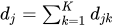
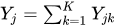
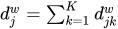
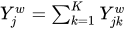
Let d Subscript j Baseline equals sigma-summation Underscript k equals 1 Overscript upper K Endscripts d Subscript j k and upper Y Subscript j Baseline equals sigma-summation Underscript k equals 1 Overscript upper K Endscripts upper Y Subscript j k denote the number of events and the number at risk, respectively, in the combined sample at time t Subscript j. Similarly, let d Subscript j Superscript w Baseline equals sigma-summation Underscript k equals 1 Overscript upper K Endscripts d Subscript j k Superscript w and upper Y Subscript j Superscript w Baseline equals sigma-summation Underscript k equals 1 Overscript upper K Endscripts upper Y Subscript j k Superscript w denote the weighted number of events and the weighted number at risk, respectively, in the combined sample at time t Subscript j. The test statistic is

v Subscript k Baseline equals sigma-summation Underscript j equals 1 Overscript upper D Endscripts left-parenthesis d Subscript j k Superscript w Baseline minus upper Y Subscript j k Superscript w Baseline StartFraction d Subscript j Superscript w Baseline Over upper Y Subscript j Superscript w Baseline EndFraction right-parenthesis comma k equals 1 comma ellipsis comma upper K

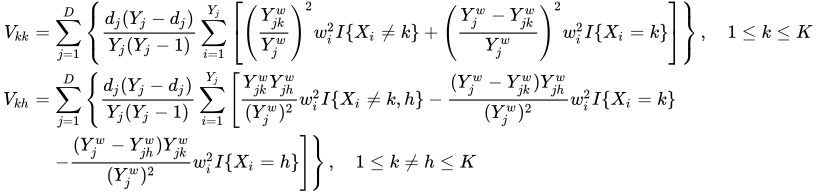
and the variance of v Subscript k and the covariance of v Subscript k and v Subscript h are, respectively,

StartLayout 1st Row 1st Column upper V Subscript k k 2nd Column equals 3rd Column sigma-summation Underscript j equals 1 Overscript upper D Endscripts StartSet StartFraction d Subscript j Baseline left-parenthesis upper Y Subscript j Baseline minus d Subscript j Baseline right-parenthesis Over upper Y Subscript j Baseline left-parenthesis upper Y Subscript j Baseline minus 1 right-parenthesis EndFraction sigma-summation Underscript i equals 1 Overscript upper Y Subscript j Baseline Endscripts left-bracket left-parenthesis StartFraction upper Y Subscript j k Superscript w Baseline Over upper Y Subscript j Superscript w Baseline EndFraction right-parenthesis squared w Subscript i Superscript 2 Baseline upper I left-brace upper X Subscript i Baseline not-equals k right-brace plus left-parenthesis StartFraction upper Y Subscript j Superscript w Baseline minus upper Y Subscript j k Superscript w Baseline Over upper Y Subscript j Superscript w Baseline EndFraction right-parenthesis squared w Subscript i Superscript 2 Baseline upper I left-brace upper X Subscript i Baseline equals k right-brace right-bracket EndSet comma 1 less-than-or-equal-to k less-than-or-equal-to upper K 2nd Row 1st Column upper V Subscript k h 2nd Column equals 3rd Column sigma-summation Underscript j equals 1 Overscript upper D Endscripts left-brace StartFraction d Subscript j Baseline left-parenthesis upper Y Subscript j Baseline minus d Subscript j Baseline right-parenthesis Over upper Y Subscript j Baseline left-parenthesis upper Y Subscript j Baseline minus 1 right-parenthesis EndFraction sigma-summation Underscript i equals 1 Overscript upper Y Subscript j Baseline Endscripts left-bracket StartFraction upper Y Subscript j k Superscript w Baseline upper Y Subscript j h Superscript w Baseline Over left-parenthesis upper Y Subscript j Superscript w Baseline right-parenthesis squared EndFraction w Subscript i Superscript 2 Baseline upper I left-brace upper X Subscript i Baseline not-equals k comma h right-brace minus StartFraction left-parenthesis upper Y Subscript j Superscript w Baseline minus upper Y Subscript j k Superscript w Baseline right-parenthesis upper Y Subscript j h Superscript w Baseline Over left-parenthesis upper Y Subscript j Superscript w Baseline right-parenthesis squared EndFraction w Subscript i Superscript 2 Baseline upper I left-brace upper X Subscript i Baseline equals k right-brace 3rd Row 1st Column Blank 2nd Column Blank 3rd Column minus StartFraction left-parenthesis upper Y Subscript j Superscript w Baseline minus upper Y Subscript j h Superscript w Baseline right-parenthesis upper Y Subscript j k Superscript w Baseline Over left-parenthesis upper Y Subscript j Superscript w Baseline right-parenthesis squared EndFraction w Subscript i Superscript 2 Baseline upper I left-brace upper X Subscript i Baseline equals h right-brace right-bracket right-brace comma 1 less-than-or-equal-to k not-equals h less-than-or-equal-to upper K EndLayout

Let upper V equals left-parenthesis upper V Subscript k h Baseline right-parenthesis. Under upper H 0, the weighted K-sample test has a chi squared statistic given by

chi squared equals left-parenthesis v 1 comma ellipsis comma v Subscript upper K Baseline right-parenthesis bold upper V Superscript minus Baseline left-parenthesis v 1 comma ellipsis comma v Subscript upper K Baseline right-parenthesis prime

with K – 1 degrees of freedom.

Stratified Tests

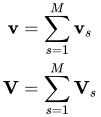
Suppose the test is to be stratified on M levels of a set of STRATA variables. Based only on the data of the sth stratum (s equals 1 comma ellipsis comma upper M), let bold v Subscript s be the test statistic (Klein and Moeschberger 1997, Section 7.5) for the sth stratum, and let bold upper V Subscript s be its covariance matrix. Let

StartLayout 1st Row 1st Column bold v 2nd Column equals 3rd Column sigma-summation Underscript s equals 1 Overscript upper M Endscripts bold v Subscript s 2nd Row 1st Column bold upper V 2nd Column equals 3rd Column sigma-summation Underscript s equals 1 Overscript upper M Endscripts bold upper V Subscript s EndLayout

A global test statistic is constructed as

chi squared equals bold v prime bold upper V Superscript minus Baseline bold v

Under the null hypothesis, the test statistic has a chi squared distribution with the same degrees of freedom as the individual test for each stratum.

Multiple-Comparison Adjustments

Let chi Subscript r Superscript 2 denote a chi-square random variable with r degrees of freedom. Denote phi and normal upper Phi as the density function and the cumulative distribution function of a standard normal distribution, respectively. Let m be the number of comparisons; that is,

StartLayout 1st Row  m equals StartLayout Enlarged left-brace 1st Row 1st Column StartFraction k left-parenthesis k minus 1 right-parenthesis Over 2 EndFraction 2nd Column normal upper D normal upper I normal upper F normal upper F equals normal upper A normal upper L normal upper L 2nd Row 1st Column k minus 1 2nd Column normal upper D normal upper I normal upper F normal upper F equals normal upper C normal upper O normal upper N normal upper T normal upper R normal upper O normal upper L EndLayout EndLayout

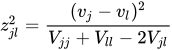
For a two-sided test that compares the survival of the jth group with that of lth group, 1 less-than-or-equal-to j not-equals l less-than-or-equal-to r, the test statistic is

z Subscript j l Superscript 2 Baseline equals StartFraction left-parenthesis v Subscript j Baseline minus v Subscript l Baseline right-parenthesis squared Over upper V Subscript j j Baseline plus upper V Subscript l l Baseline minus 2 upper V Subscript j l Baseline EndFraction

and the raw p-value is

p equals normal upper P normal r left-parenthesis chi 1 squared greater-than z Subscript j l Superscript 2 Baseline right-parenthesis

Adjusted p-values for various multiple-comparison adjustments are computed as follows:

  • Bonferroni adjustment:

    p equals normal m normal i normal n StartSet 1 comma m normal upper P normal r left-parenthesis chi 1 squared greater-than z Subscript j l Superscript 2 Baseline right-parenthesis EndSet
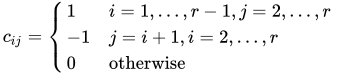
  • Dunnett-Hsu adjustment: With the first group being the control, let bold upper C equals left-parenthesis c Subscript i j Baseline right-parenthesis be the left-parenthesis r minus 1 right-parenthesis times r matrix of contrasts; that is,

    StartLayout 1st Row  c Subscript i j Baseline equals StartLayout Enlarged left-brace 1st Row 1st Column 1 2nd Column i equals 1 comma ellipsis comma r minus 1 comma j equals 2 comma ellipsis comma r 2nd Row 1st Column negative 1 2nd Column j equals i plus 1 comma i equals 2 comma ellipsis comma r 3rd Row 1st Column 0 2nd Column normal o normal t normal h normal e normal r normal w normal i normal s normal e EndLayout EndLayout

    Let bold upper Sigma identical-to left-parenthesis sigma Subscript i j Baseline right-parenthesis and bold upper R identical-to left-parenthesis r Subscript i j Baseline right-parenthesis be covariance and correlation matrices of bold upper C bold v, respectively; that is,

    bold upper Sigma equals bold upper C bold upper V bold upper C prime

    and

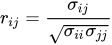
    r Subscript i j Baseline equals StartFraction sigma Subscript i j Baseline Over StartRoot sigma Subscript i i Baseline sigma Subscript j j Baseline EndRoot EndFraction

    The factor-analytic covariance approximation of Hsu (1992) is to find lamda 1 comma ellipsis comma lamda Subscript r minus 1 Baseline such that

    bold upper R equals bold upper D plus bold-italic lamda bold-italic lamda prime

    where bold upper D is a diagonal matrix with the jth diagonal element being 1 minus lamda Subscript j and bold-italic lamda equals left-parenthesis lamda 1 comma ellipsis comma lamda Subscript r minus 1 Baseline right-parenthesis prime. The adjusted p-value is

    p equals 1 minus integral Subscript negative normal infinity Superscript normal infinity Baseline phi left-parenthesis y right-parenthesis product Underscript i equals 1 Overscript r minus 1 Endscripts left-bracket normal upper Phi left-parenthesis StartFraction lamda Subscript i Baseline y plus z Subscript j l Baseline Over StartRoot 1 minus lamda Subscript i Superscript 2 Baseline EndRoot EndFraction right-parenthesis minus normal upper Phi left-parenthesis StartFraction lamda Subscript i Baseline y minus z Subscript j l Baseline Over StartRoot 1 minus lamda Subscript i Superscript 2 Baseline EndRoot EndFraction right-parenthesis right-bracket d y

    which can be obtained in a DATA step as

    p equals normal upper P normal upper R normal upper O normal upper B normal upper M normal upper C left-parenthesis quotation-mark normal upper D normal upper U normal upper N normal upper N normal upper E normal upper T normal upper T Baseline 2 quotation-mark comma z Subscript i j Baseline comma period comma period comma r minus 1 comma lamda 1 comma ellipsis comma lamda Subscript r minus 1 Baseline right-parenthesis period
  • Scheffé adjustment:

    p equals normal upper P normal r left-parenthesis chi Subscript r minus 1 Superscript 2 Baseline greater-than z Subscript j l Superscript 2 Baseline right-parenthesis
  • Šidák adjustment:

    p equals 1 minus StartSet 1 minus normal upper P normal r left-parenthesis chi 1 squared greater-than z Subscript j l Superscript 2 Baseline right-parenthesis EndSet Superscript m
  • SMM adjustment:

    p equals 1 minus left-bracket 2 normal upper Phi left-parenthesis z Subscript j l Baseline right-parenthesis minus 1 right-bracket Superscript m

    which can also be evaluated in a DATA step as

    p equals 1 minus normal upper P normal upper R normal upper O normal upper B normal upper M normal upper C left-parenthesis quotation-mark normal upper M normal upper A normal upper X normal upper M normal upper O normal upper D quotation-mark comma z Subscript j l Baseline comma period comma period comma m right-parenthesis period
  • Tukey adjustment:

    p equals 1 minus integral Subscript negative normal infinity Superscript normal infinity Baseline r phi left-parenthesis y right-parenthesis left-bracket normal upper Phi left-parenthesis y right-parenthesis minus normal upper Phi left-parenthesis y minus StartRoot 2 EndRoot z Subscript j l Baseline right-parenthesis right-bracket Superscript r minus 1 Baseline d y

    which can also be evaluated in a DATA step as

    p equals 1 minus normal upper P normal upper R normal upper O normal upper B normal upper M normal upper C left-parenthesis quotation-mark normal upper R normal upper A normal upper N normal upper G normal upper E quotation-mark comma StartRoot 2 EndRoot z Subscript j l Baseline comma period comma period comma r right-parenthesis period
Trend Tests

Trend tests (Klein and Moeschberger 1997, Section 7.4) have more power to detect ordered alternatives as

upper H 2 colon upper S 1 left-parenthesis t right-parenthesis greater-than-or-equal-to upper S 2 left-parenthesis t right-parenthesis greater-than-or-equal-to midline-horizontal-ellipsis greater-than-or-equal-to upper S Subscript k Baseline left-parenthesis t right-parenthesis comma t less-than-or-equal-to tau comma with at least one inequality

or

upper H 2 colon upper S 1 left-parenthesis t right-parenthesis less-than-or-equal-to upper S 2 left-parenthesis t right-parenthesis less-than-or-equal-to midline-horizontal-ellipsis less-than-or-equal-to upper S Subscript k Baseline left-parenthesis t right-parenthesis comma t less-than-or-equal-to tau comma with at least one inequality

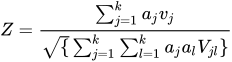
Let a 1 less-than a 2 less-than midline-horizontal-ellipsis less-than a Subscript k be a sequence of scores associated with the k samples. The test statistic and its standard error are given by sigma-summation Underscript j equals 1 Overscript k Endscripts a Subscript j Baseline v Subscript j and sigma-summation Underscript j equals 1 Overscript k Endscripts sigma-summation Underscript l equals 1 Overscript k Endscripts a Subscript j Baseline a Subscript l Baseline upper V Subscript j l, respectively. Under upper H 0, the z-score

upper Z equals StartFraction sigma-summation Underscript j equals 1 Overscript k Endscripts a Subscript j Baseline v Subscript j Baseline Over StartRoot left-brace EndRoot sigma-summation Underscript j equals 1 Overscript k Endscripts sigma-summation Underscript l equals 1 Overscript k Endscripts a Subscript j Baseline a Subscript l Baseline upper V Subscript j l Baseline right-brace EndFraction

has, asymptotically, a standard normal distribution. PROC LIFETEST provides both one-tail and two-tail p-values for the test.

Last updated: December 09, 2022