The LOGISTIC Procedure

Determining Observations for Likelihood Contributions

If you use events/trials MODEL statement syntax, split each observation into two observations. One has response value 1 with a frequency equal to the frequency of the original observation (which is 1 if the FREQ statement is not used) times the value of the events variable. The other observation has response value 2 and a frequency equal to the frequency of the original observation times the value of (trials–events). These two observations will have the same explanatory variable values and the same FREQ and WEIGHT values as the original observation.

For either single-trial or events/trials syntax, let j index all observations. In other words, for single-trial syntax, j indexes the actual observations. And, for events/trials syntax, j indexes the observations after splitting (as described in the preceding paragraph). If your data set has 30 observations and you use single-trial syntax, j has values from 1 to 30; if you use events/trials syntax, j has values from 1 to 60.

Suppose the response variable in a cumulative response model can take on the ordered values 1 comma ellipsis comma k comma k plus 1, where k is an integer greater-than-or-equal-to 1. The likelihood for the jth observation with ordered response value y Subscript j and explanatory variables vector bold x Subscript j is given by

StartLayout 1st Row 1st Column upper L Subscript j Baseline equals 2nd Column StartLayout Enlarged left-brace 1st Row 1st Column upper F left-parenthesis alpha 1 plus bold-italic beta prime bold x Subscript j Baseline right-parenthesis 2nd Column y Subscript j Baseline equals 1 2nd Row 1st Column upper F left-parenthesis alpha Subscript i Baseline plus bold-italic beta prime bold x Subscript j Baseline right-parenthesis minus upper F left-parenthesis alpha Subscript i minus 1 Baseline plus bold-italic beta prime bold x Subscript j Baseline right-parenthesis 2nd Column 1 less-than y Subscript j Baseline equals i less-than-or-equal-to k 3rd Row 1st Column 1 minus upper F left-parenthesis alpha Subscript k Baseline plus bold-italic beta prime bold x Subscript j Baseline right-parenthesis 2nd Column y Subscript j Baseline equals k plus 1 EndLayout EndLayout

where upper F left-parenthesis dot right-parenthesis is the logistic, normal, or extreme-value distribution function, alpha 1 comma ellipsis comma alpha Subscript k Baseline are ordered intercept parameters, and bold-italic beta is the common slope parameter vector.

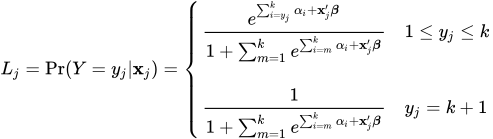
For the adjacent-category logit model, the likelihood for the jth observation with ordered response value y Subscript j and explanatory variables vector bold x Subscript j is given by

upper L Subscript j Baseline equals probability left-parenthesis upper Y equals y Subscript j Baseline vertical-bar bold x Subscript j Baseline right-parenthesis equals StartLayout Enlarged left-brace 1st Row 1st Column StartFraction e Superscript sigma-summation Underscript i equals y Super Subscript j Superscript Overscript k Endscripts alpha Super Subscript i Superscript plus bold x prime Super Subscript j Superscript bold-italic beta Baseline Over 1 plus sigma-summation Underscript m equals 1 Overscript k Endscripts e Superscript sigma-summation Underscript i equals m Overscript k Endscripts alpha Super Subscript i Superscript plus bold x prime Super Subscript j Superscript bold-italic beta Baseline EndFraction 2nd Column 1 less-than-or-equal-to y Subscript j Baseline less-than-or-equal-to k 2nd Row 1st Column StartFraction 1 Over 1 plus sigma-summation Underscript m equals 1 Overscript k Endscripts e Superscript sigma-summation Underscript i equals m Overscript k Endscripts alpha Super Subscript i Superscript plus bold x prime Super Subscript j Superscript bold-italic beta Baseline EndFraction 2nd Column y Subscript j Baseline equals k plus 1 EndLayout

where the alpha 1 comma ellipsis comma alpha Subscript k Baseline are not necessarily ordered.

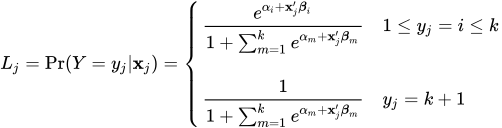
For the generalized logit model, letting the k plus 1st level be the reference level, the intercepts alpha 1 comma ellipsis comma alpha Subscript k Baseline are unordered and the slope vector bold-italic beta Subscript i varies with each logit. The likelihood for the jth observation with response value y Subscript j and explanatory variables vector bold x Subscript j is given by

upper L Subscript j Baseline equals probability left-parenthesis upper Y equals y Subscript j Baseline vertical-bar bold x Subscript j Baseline right-parenthesis equals StartLayout Enlarged left-brace 1st Row 1st Column StartFraction e Superscript alpha Super Subscript i Superscript plus bold x prime Super Subscript j Superscript bold-italic beta Super Subscript i Superscript Baseline Over 1 plus sigma-summation Underscript m equals 1 Overscript k Endscripts e Superscript alpha Super Subscript m Superscript plus bold x prime Super Subscript j Superscript bold-italic beta Super Subscript m Superscript Baseline EndFraction 2nd Column 1 less-than-or-equal-to y Subscript j Baseline equals i less-than-or-equal-to k 2nd Row 1st Column StartFraction 1 Over 1 plus sigma-summation Underscript m equals 1 Overscript k Endscripts e Superscript alpha Super Subscript m Superscript plus bold x prime Super Subscript j Superscript bold-italic beta Super Subscript m Superscript Baseline EndFraction 2nd Column y Subscript j Baseline equals k plus 1 EndLayout
Last updated: December 09, 2022