The LOGISTIC Procedure
TEST Statement
<label:> TEST equation1 <, equation2, …> </ option>;
The TEST statement tests linear hypotheses about the regression coefficients. The Wald test is used to perform a joint test of the null hypotheses  specified in a single TEST statement, where
  is the vector of intercept and slope parameters. When
  you should specify a CONTRAST statement instead.
Each equation specifies a linear hypothesis (a row of the  matrix and the corresponding element of the
  vector). Multiple equations are separated by commas. The label, which must be a valid SAS name, is used to identify the resulting output and should always be included. You can submit multiple TEST statements.
The form of an equation is as follows:
term< term
term  > <
> < term <term>>
where term is a parameter of the model, or a constant, or a constant times a parameter. Intercept and CLASS variable parameter names should be specified as described in the section Parameter Names in the OUTEST= Data Set. For multinomial response models, this form enables you to construct tests of parameters from specific logits. When no equal sign appears, the expression is set to 0. The following statements illustrate possible uses of the TEST statement:
proc logistic;
   model y= a1 a2 a3 a4;
   test1: test intercept + .5 * a2 = 0;
   test2: test intercept + .5 * a2;
   test3: test a1=a2=a3;
   test4: test a1=a2, a2=a3;
run;
Note that the first and second TEST statements are equivalent, as are the third and fourth TEST statements.
You can specify the following option in the TEST statement after a slash(/):
-
displays intermediate calculations in the testing of the null hypothesis
. These calculations include  bordered by
  and
and 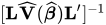 bordered by
  , where
  is the maximum likelihood estimator of and
  is the estimated covariance matrix of .
 For more information, see the section Testing Linear Hypotheses about the Regression Coefficients.