The MI Procedure
Descriptive Statistics
Suppose  is the
  matrix of complete data, which might not be fully observed,
  is the number of observations fully observed, and
  is the number of observations with observed values for variable
  .
.
With complete cases, the sample mean vector is
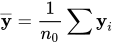
and the CSSCP matrix is

where each summation is over the fully observed observations.
The sample covariance matrix is

and is an unbiased estimate of the covariance matrix.
The correlation matrix  , which contains the Pearson product-moment correlations of the variables, is derived by scaling the corresponding covariance matrix:

where  is a diagonal matrix whose diagonal elements are the square roots of the diagonal elements of
  .
.
With available cases, the corrected sum of squares for variable is
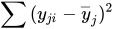
where 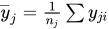 is the sample mean and each summation is over observations with observed values for variable .
The variance is
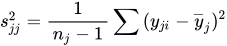
The correlations for available cases contain pairwise correlations for each pair of variables. Each correlation is computed from all observations that have nonmissing values for the corresponding pair of variables.