The MI Procedure
Monotone and FCS Regression Methods
The regression method is the default imputation method in the MONOTONE and FCS statements for continuous variables.
In the regression method, a regression model is fitted for a continuous variable with the covariates constructed from a set of effects. Based on the fitted regression model, a new regression model is simulated from the posterior predictive distribution of the parameters and is used to impute the missing values for each variable (Rubin 1987, pp. 166–167). That is, for a continuous variable  with missing values, a model

is fitted using observations with observed values for the variable and its covariates  ,
,  , …,
, …,  .
.
The fitted model includes the regression parameter estimates  and the associated covariance matrix
  , where
  is the usual
  inverse matrix derived from the intercept and covariates , , …, .
The following steps are used to generate imputed values for each imputation:
-
New parameters
 and
and  are drawn from the posterior predictive distribution of the parameters. That is, they are simulated from
  ,
,  , and . The variance is drawn as
where g is a
 random variate and
  is the number of nonmissing observations for . The regression coefficients are drawn as
where
 is the upper triangular matrix in the Cholesky decomposition,
 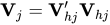 , and
, and  is a vector of
  independent random normal variates.
 -
The missing values are then replaced by

where
 are the values of the covariates and
  is a simulated normal deviate.