The MI Procedure
Multiple Imputation Efficiency
The relative efficiency (RE) of using the finite m imputation estimator, rather than using an infinite number for the fully efficient imputation, in units of variance, is approximately a function of m and  (Rubin 1987, p. 114):
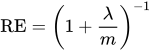
where mis the number of imputations and is the fraction of missing information.
Table 7 shows relative efficiencies with different values of m and .
Table 7: Relative Efficiencies
 |
||||||
|---|---|---|---|---|---|---|
| m | 10% | 20% | 30% | 50% | 70% | |
| 3 | 0.9677 | 0.9375 | 0.9091 | 0.8571 | 0.8108 | |
| 5 | 0.9804 | 0.9615 | 0.9434 | 0.9091 | 0.8772 | |
| 10 | 0.9901 | 0.9804 | 0.9709 | 0.9524 | 0.9346 | |
| 20 | 0.9950 | 0.9901 | 0.9852 | 0.9756 | 0.9662 | |
The table shows that if the fraction of missing information is modest, only a small number of imputations are needed. For example, if  , only three imputations are needed to have a 91% efficiency and five imputations are needed to have a 94% efficiency.
Last updated: December 09, 2022