The MIANALYZE Procedure
Combining Inferences from Imputed Data Sets
With m imputations, m different sets of the point and variance estimates for a parameter Q can be computed. Suppose that  and
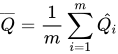
and  are the point and variance estimates, respectively, from the ith imputed data set, i = 1, 2, …, m. Then the combined point estimate for Q from multiple imputation is the average of the m complete-data estimates:
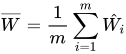
Suppose that  is the within-imputation variance,
which is the average of the m complete-data estimates:
is the within-imputation variance,
which is the average of the m complete-data estimates:
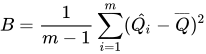
And suppose that B is the between-imputation variance:
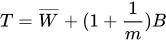
Then the variance estimate associated with  is the total variance (Rubin 1987)
The statistic 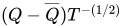 is approximately distributed as t with
  degrees of freedom (Rubin 1987), where
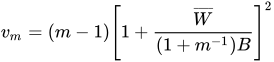
The degrees of freedom depend on m and the ratio
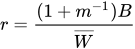
The ratio r is called the relative increase in variance due to nonresponse (Rubin 1987).
When there is no missing information about Q, the values of r and B are both zero. With a large value of m or a small value of r, the degrees of freedom will be large and the distribution of will be approximately normal.
Another useful statistic is the fraction of missing information about Q:
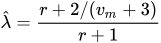
Both statistics r and  are helpful diagnostics for assessing how the missing data contribute to the uncertainty about Q.
When the complete-data degrees of freedom  are small, and there is only a modest proportion of missing data, the computed degrees of freedom, , can be much larger than , which is inappropriate. For example, with m = 5 and r = 10%, the computed degrees of freedom
  , which is inappropriate for data sets with complete-data degrees of freedom less than 484.
Barnard and Rubin (1999) recommend the use of adjusted degrees of freedom
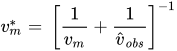
where  and
and  .
.
If you specify the complete-data degrees of freedom with the EDF= option, the MIANALYZE procedure uses the adjusted degrees of freedom,  , for inference. Otherwise, the degrees of freedom are used.