The MIANALYZE Procedure
Multivariate Inferences
Multivariate inference based on Wald tests can be done with m imputed data sets. The approach is a generalization of the approach taken in the univariate case (Rubin 1987, p. 137; Schafer 1997, p. 113). Suppose that  and
and  are the point and covariance matrix estimates for a p-dimensional parameter
  (such as a multivariate mean) from the
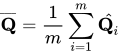
  imputed data set, i = 1, 2, …, m. Then the combined point estimate for from the multiple imputation is the average of the m complete-data estimates:
Suppose that  is the within-imputation covariance matrix,
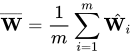
which is the average of the m complete-data estimates:
is the within-imputation covariance matrix,
which is the average of the m complete-data estimates:
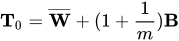
And suppose that  is the between-imputation covariance matrix:

Then the covariance matrix associated with  is the total covariance matrix
The natural multivariate extension of the t statistic used in the univariate case is the F statistic

with degrees of freedom p and

where

is an average relative increase in variance due to nonresponse (Rubin 1987, p. 137; Schafer 1997, p. 114).
However, the reference distribution of the statistic  is not easily derived. Especially for small m, the between-imputation covariance matrix is unstable and does not have full rank for
  (Schafer 1997, p. 113).
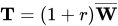
One solution is to make an additional assumption that the population between-imputation and within-imputation covariance matrices are proportional to each other (Schafer 1997, p. 113). This assumption implies that the fractions of missing information for all components of are equal. Under this assumption, a more stable estimate of the total covariance matrix is
With the total covariance matrix  , the F statistic (Rubin 1987, p. 137)

has an F distribution with degrees of freedom p and  ,
where
,
where

For  , PROC MIANALYZE uses the degrees of freedom in the analysis. For
  , PROC MIANALYZE uses
  , a better approximation of the degrees of freedom
given by Li, Raghunathan, and Rubin (1991):
, a better approximation of the degrees of freedom
given by Li, Raghunathan, and Rubin (1991):
