The NLMIXED Procedure
Modeling Assumptions and Notation
PROC NLMIXED operates under the following general framework for nonlinear mixed models. Assume that you have an observed data vector  for each of i subjects,
  . The are assumed to be independent across i, but within-subject covariance is likely to exist because each of the elements of is measured on the same subject. As a statistical mechanism for modeling this within-subject covariance, assume that there exist latent random-effect vectors
  of small dimension (typically one or two) that are also independent across i. Assume also that an appropriate model linking and exists, leading to the joint probability density function

where  is a matrix of observed explanatory variables and
  and
and  are vectors of unknown parameters.
Let  and assume that it is of dimension n. Then inferences about
  are based on the marginal likelihood function

In particular, the function

is minimized over numerically in order to estimate , and the inverse Hessian (second derivative) matrix at the estimates provides an approximate variance-covariance matrix for the estimate of . The function  is referred to both as the negative log likelihood function and as the objective function for optimization.
As an example of the preceding general framework, consider the nonlinear growth curve example in the section Getting Started: NLMIXED Procedure. Here, the conditional distribution  is normal with mean
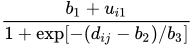
and variance  ; thus
  . Also,
  is a scalar and
  is normal with mean 0 and variance
  ; thus
  .
.
The following additional notation is also found in this chapter. The quantity  refers to the parameter vector at the kth iteration, the vector
  refers to the gradient vector
  , and the matrix
  refers to the Hessian
  . Other symbols are used to denote various constants or option values.
Nested Multilevel Nonlinear Mixed Models
The general framework for nested multilevel nonlinear mixed models in cases of two levels can be explained as follows. Let  be the response vector observed on subject j that is nested within subject i, where j is commonly referred as the second-level subject and i is the first-level subject. There are s first-level subjects, and each has
  second-level subjects that are nested within. An example is , which are the heights of students in class j of school i, where
  for each i and . Suppose there exist latent random-effect vectors
  and
and  of small dimensions for modeling within subject covariance. Assume also that an appropriate model that links and
  exists, and if you use the notation
  ,
,  , and
, and  , the joint density function in terms of the first-level subject can be expressed as

As defined in the previous section, the marginal likelihood function where is
Again, the function
is minimized over numerically in order to estimate . Models that have more than two levels follow similar notation.