The PLS Procedure
Regression Methods
All of the predictive methods implemented in PROC PLS work essentially by finding linear combinations of the predictors (factors) to use to predict the responses linearly. The methods differ only in how the factors are derived, as explained in the following sections.
Partial Least Squares
Partial least squares (PLS) works by extracting one factor at a time. Let  be the centered and scaled matrix of predictors and let
  be the centered and scaled matrix of response values. The PLS method starts with a linear combination
  of the predictors, where
  is called a score vector and
  is its associated weight vector. The PLS method predicts both
  and
and  by regression on :

The vectors  and
and  are called the X- and Y-loadings, respectively.
The specific linear combination is the one that has maximum covariance  with some response linear combination
  . Another characterization is that the X- and Y-weights and
  are proportional to the first left and right singular vectors of the covariance matrix
  or, equivalently, the first eigenvectors of
  and
and  , respectively.
This accounts for how the first PLS factor is extracted. The second factor is extracted in the same way by replacing and with the X- and Y-residuals from the first factor:
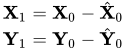
These residuals are also called the deflated  and
and  blocks. The process of extracting a score vector and deflating the data matrices is repeated for as many extracted factors as are wanted.
SIMPLS
Note that each extracted PLS factor is defined in terms of different X-variables  . This leads to difficulties in comparing different scores, weights, and so forth. The SIMPLS method of De Jong (1993) overcomes these difficulties by computing each score
  in terms of the original (centered and scaled) predictors . The SIMPLS X-weight vectors
  are similar to the eigenvectors of
  , but they satisfy a different orthogonality condition. The
  vector is just the first eigenvector
  (so that the first SIMPLS score is the same as the first PLS score), but whereas the second eigenvector maximizes

the second SIMPLS weight  maximizes

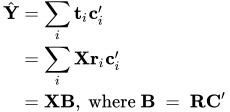
The SIMPLS scores are identical to the PLS scores for one response but slightly different for more than one response; see De Jong (1993) for details. The X- and Y-loadings are defined as in PLS, but since the scores are all defined in terms of , it is easy to compute the overall model coefficients  :
:
Principal Components Regression
Like the SIMPLS method, principal components regression (PCR) defines all the scores in terms of the original (centered and scaled) predictors . However, unlike both the PLS and SIMPLS methods, the PCR method chooses the X-weights/X-scores without regard to the response data. The X-scores are chosen to explain as much variation in as possible; equivalently, the X-weights for the PCR method are the eigenvectors of the predictor covariance matrix  . Again, the X- and Y-loadings are defined as in PLS; but, as in SIMPLS, it is easy to compute overall model coefficients for the original (centered and scaled) responses in terms of the original predictors .
Reduced Rank Regression
As discussed in the preceding sections, partial least squares depends on selecting factors  of the predictors and
  of the responses that have maximum covariance, whereas principal components regression effectively ignores
  and selects to have maximum variance, subject to orthogonality constraints. In contrast, reduced rank regression selects to account for as much variation in the predicted responses as possible, effectively ignoring the predictors for the purposes of factor extraction. In reduced rank regression, the Y-weights
  are the eigenvectors of the covariance matrix
  of the responses predicted by ordinary least squares regression; the X-scores are the projections of the Y-scores
  onto the X space.
Relationships between Methods
(View the complete code for this example.)
When you develop a predictive model, it is important to consider not only the explanatory power of the model for current responses, but also how well sampled the predictive functions are, since this affects how well the model can extrapolate to future observations. All of the techniques implemented in the PLS procedure work by extracting successive factors, or linear combinations of the predictors, that optimally address one or both of these two goals—explaining response variation and explaining predictor variation. In particular, principal components regression selects factors that explain as much predictor variation as possible, reduced rank regression selects factors that explain as much response variation as possible, and partial least squares balances the two objectives, seeking for factors that explain both response and predictor variation.
To see the relationships between these methods, consider how each one extracts a single factor from the following artificial data set consisting of two predictors and one response:
data data;
   input x1 x2 y;
   datalines;
    3.37651  2.30716        0.75615
    0.74193 -0.88845        1.15285
    4.18747  2.17373        1.42392
    0.96097  0.57301        0.27433
   -1.11161 -0.75225       -0.25410
   -1.38029 -1.31343       -0.04728
    1.28153 -0.13751        1.00341
   -1.39242 -2.03615        0.45518
    0.63741  0.06183        0.40699
   -2.52533 -1.23726       -0.91080
    2.44277  3.61077       -0.82590
;
proc pls data=data nfac=1 method=rrr;
   model y = x1 x2;
run;
proc pls data=data nfac=1 method=pcr;
   model y = x1 x2;
run;
proc pls data=data nfac=1 method=pls;
   model y = x1 x2;
run;
The amount of model and response variation explained by the first factor for each method is shown in Figure 10 through Figure 12.
Figure 10: Variation Explained by First Reduced Rank Regression Factor
| Percent Variation Accounted for by Reduced Rank Regression Factors |
||||
|---|---|---|---|---|
| Number of Extracted Factors |
Model Effects | Dependent Variables | ||
| Current | Total | Current | Total | |
| 1 | 15.0661 | 15.0661 | 100.0000 | 100.0000 |
Figure 11: Variation Explained by First Principal Components Regression Factor
| Percent Variation Accounted for by Principal Components |
||||
|---|---|---|---|---|
| Number of Extracted Factors |
Model Effects | Dependent Variables | ||
| Current | Total | Current | Total | |
| 1 | 92.9996 | 92.9996 | 9.3787 | 9.3787 |
Figure 12: Variation Explained by First Partial Least Squares Regression Factor
| Percent Variation Accounted for by Partial Least Squares Factors |
||||
|---|---|---|---|---|
| Number of Extracted Factors |
Model Effects | Dependent Variables | ||
| Current | Total | Current | Total | |
| 1 | 88.5357 | 88.5357 | 26.5304 | 26.5304 |
Notice that, while the first reduced rank regression factor explains all of the response variation, it accounts for only about 15% of the predictor variation. In contrast, the first principal components regression factor accounts for most of the predictor variation (93%) but only 9% of the response variation. The first partial least squares factor accounts for only slightly less predictor variation than principal components but about three times as much response variation.
Figure 13 illustrates how partial least squares balances the goals of explaining response and predictor variation in this case.
Figure 13: Depiction of First Factors for Three Different Regression Methods
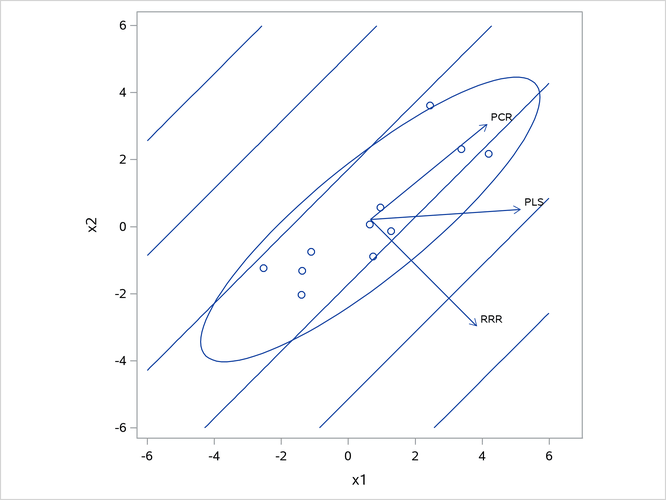
The ellipse shows the general shape of the 11 observations in the predictor space, with the contours of increasing y overlaid. Also shown are the directions of the first factor for each of the three methods. Notice that, while the predictors vary most in the x1 = x2 direction, the response changes most in the orthogonal x1 = -x2 direction. This explains why the first principal component accounts for little variation in the response and why the first reduced rank regression factor accounts for little variation in the predictors. The direction of the first partial least squares factor represents a compromise between the other two directions.