The POWER Procedure

Analyses in the COXREG Statement

Score Test of a Single Scalar Predictor in Cox Proportional Hazards Regression (TEST=SCORE)

The power-computing formula is based on Hsieh and Lavori (2000, equation (2) and the section "Variance Inflation Factor" on page 556).

Define the following notation for a Cox proportional hazards regression analysis:
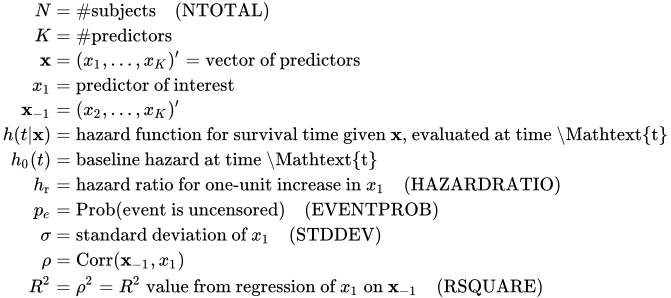
StartLayout 1st Row 1st Column upper N 2nd Column equals number-sign subjects left-parenthesis NTOTAL right-parenthesis 2nd Row 1st Column upper K 2nd Column equals number-sign predictors 3rd Row 1st Column bold x 2nd Column equals left-parenthesis x 1 comma ellipsis comma x Subscript upper K Baseline right-parenthesis prime equals vector of predictors 4th Row 1st Column x 1 2nd Column equals predictor of interest 5th Row 1st Column bold x Subscript negative 1 2nd Column equals left-parenthesis x 2 comma ellipsis comma x Subscript upper K Baseline right-parenthesis Superscript prime Baseline 6th Row 1st Column h left-parenthesis t vertical-bar bold x right-parenthesis 2nd Column equals hazard function for survival time given bold x comma evaluated at time reverse-solidus Mathtext left-brace t right-brace 7th Row 1st Column h 0 left-parenthesis t right-parenthesis 2nd Column equals baseline hazard at time reverse-solidus Mathtext left-brace t right-brace 8th Row 1st Column h Subscript normal r 2nd Column equals hazard ratio for one hyphen unit increase in x 1 left-parenthesis HAZARDRATIO right-parenthesis 9th Row 1st Column p Subscript e 2nd Column equals normal upper P normal r normal o normal b left-parenthesis event is uncensored right-parenthesis left-parenthesis EVENTPROB right-parenthesis 10th Row 1st Column sigma 2nd Column equals standard deviation of x 1 left-parenthesis STDDEV right-parenthesis 11th Row 1st Column rho 2nd Column equals normal upper C normal o normal r normal r left-parenthesis bold x Subscript negative 1 Baseline comma x 1 right-parenthesis 12th Row 1st Column upper R squared 2nd Column equals rho squared equals upper R squared value from regression of x 1 on bold x Subscript negative 1 Baseline left-parenthesis RSQUARE right-parenthesis EndLayout

The Cox proportional hazards regression model is

StartLayout 1st Row 1st Column log left-parenthesis h left-parenthesis t vertical-bar bold x slash h 0 left-parenthesis t right-parenthesis right-parenthesis 2nd Column equals beta bold x 2nd Row 1st Column Blank 2nd Column equals beta 1 x 1 plus midline-horizontal-ellipsis plus beta Subscript upper K Baseline x Subscript upper K EndLayout

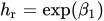
You can convert a regression coefficient to a hazard ratio by using the equation h Subscript normal r Baseline equals exp left-parenthesis beta 1 right-parenthesis.
The hypothesis test of the first predictor variable is

StartLayout 1st Row 1st Column upper H 0 colon 2nd Column h Subscript normal r Baseline equals 1 2nd Row 1st Column upper H 1 colon 2nd Column StartLayout Enlarged left-brace 1st Row 1st Column h Subscript normal r Baseline not-equals 1 comma 2nd Column two hyphen sided 2nd Row 1st Column h Subscript normal r Baseline less-than 1 comma 2nd Column upper one hyphen sided 3rd Row 1st Column h Subscript normal r Baseline greater-than 1 comma 2nd Column lower one hyphen sided EndLayout EndLayout

The upper and lower one-sided cases are expressed differently than in other analyses. This is because h Subscript normal r Baseline greater-than 1 corresponds to a negative correlation between the tested predictor and survival and thus, by the convention used in PROC POWER for regression analyses, the lower side.

The approximate power is

normal p normal o normal w normal e normal r equals StartLayout Enlarged left-brace 1st Row 1st Column normal upper Phi left-parenthesis z Subscript alpha Baseline minus sigma StartRoot upper N p Subscript e Baseline left-parenthesis 1 minus upper R squared right-parenthesis EndRoot log left-parenthesis h Subscript normal r Baseline right-parenthesis right-parenthesis comma 2nd Column upper one hyphen sided 2nd Row 1st Column 1 minus normal upper Phi left-parenthesis z Subscript 1 minus alpha Baseline minus sigma StartRoot upper N p Subscript e Baseline left-parenthesis 1 minus upper R squared right-parenthesis EndRoot log left-parenthesis h Subscript normal r Baseline right-parenthesis right-parenthesis comma 2nd Column lower one hyphen sided 3rd Row 1st Column normal upper Phi left-parenthesis z Subscript StartFraction alpha Over 2 EndFraction Baseline minus sigma StartRoot upper N p Subscript e Baseline left-parenthesis 1 minus upper R squared right-parenthesis EndRoot log left-parenthesis h Subscript normal r Baseline right-parenthesis right-parenthesis plus 1 minus normal upper Phi left-parenthesis z Subscript 1 minus StartFraction alpha Over 2 EndFraction Baseline minus sigma StartRoot upper N p Subscript e Baseline left-parenthesis 1 minus upper R squared right-parenthesis EndRoot log left-parenthesis h Subscript normal r Baseline right-parenthesis right-parenthesis comma 2nd Column two hyphen sided EndLayout

For the one-sided cases, a closed-form inversion of the power equation yields an approximate total sample size
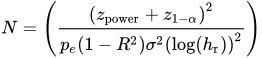
upper N equals left-parenthesis StartFraction left-parenthesis z Subscript normal p normal o normal w normal e normal r Baseline plus z Subscript 1 minus alpha Baseline right-parenthesis squared Over p Subscript e Baseline left-parenthesis 1 minus upper R squared right-parenthesis sigma squared left-parenthesis log left-parenthesis h Subscript normal r Baseline right-parenthesis right-parenthesis squared EndFraction right-parenthesis

For the two-sided case, the solution for N is obtained by numerically inverting the power equation.

Last updated: December 09, 2022