The POWER Procedure
Analyses in the CUSTOM Statement
The first of the following subsections specifies notation for the analyses in the CUSTOM statement, and the remaining subsections show power formulas and special cases equivalent to analyses elsewhere in PROC POWER or PROC GLMPOWER for each type of test statistic distribution.
Notation
Table 35 displays notation for the analyses in the CUSTOM statement.
Table 35: Common Notation
| Symbol | Description | Associated Option |
|---|---|---|
| N | Total sample size | NTOTAL= |
 |
Test degrees of freedom | TESTDF= |
| p | Model degrees of freedom | MODELDF= |
 |
Primary noncentrality for  or F distribution or F distribution |
PRIMNC= |
 |
Primary noncentrality for t or normal distribution | PRIMNC= |
 |
Partial correlation between  variables in a set variables in a set  and a variable Y, adjusting for and a variable Y, adjusting for  variables in a (possibly empty) set variables in a (possibly empty) set  and assuming multivariate normality and assuming multivariate normality |
CORR= |
 |
Scalar multiplier of primary noncentrality | PNCMULT= |
 |
Scalar multiplier of critical value | CRITMULT= |
 |
Significance level | ALPHA= |
Noncentral Chi-Square Distribution (DIST=CHISQUARE)
The power is computed as

The sample size is computed by numerically inverting the power formula.
The logistic regression analysis in the LOGISTIC statement is a special case in which  and
and  . The two-sided Wilcoxon-Mann-Whitney test (TWOSAMPLEWILCOXON) is a special case in which
  .
.
Correlation Coefficient Distribution Assuming Multivariate Normal Data (DIST=CORR)
The distribution of the correlation coefficient given the value of is shown in (Johnson, Kotz, and Balakrishnan 1995, Chapter 32). The one-sided cases are restricted to .
The power is computed as
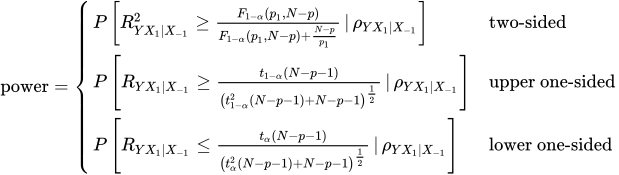
The sample size is computed by numerically inverting the power formula.
The Pearson correlation analysis that assumes joint multivariate normality (ONECORR DIST=T MODEL=RANDOM) and the multiple regression analysis that assumes joint multivariate normal predictors (MULTREG MODEL=RANDOM) are special cases.
Noncentral F Distribution (DIST=F)
The power is computed as

The sample size is computed by numerically inverting the power formula.
The two-sided contrast in one-way analysis of variance (ONEWAYANOVA) is a special case in which and . The following analyses are special cases in which :
multiple regression that assumes fixed predictors (MULTREG MODEL=FIXED)
overall F test in one-way analysis of variance (ONEWAYANOVA)
Type III F test in a fixed-effect univariate linear model (PROC GLMPOWER)
multivariate Type III F test in a fixed-effect multivariate linear model (PROC GLMPOWER)
Normal Distribution (DIST=NORMAL)
The power is computed as
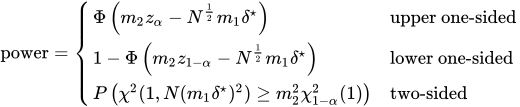
The sample size is computed by numerically inverting the power equation.
Cox proportional hazards regression (COXREG) and the log-rank test (TWOSAMPLESURVIVAL) are special cases in which and . The Wilcoxon-Mann-Whitney test (TWOSAMPLEWILCOXON) is a special case in which . Other special cases occur among the tests for binomial proportions (ONESAMPLEFREQ, PAIREDFREQ, and TWOSAMPLEFREQ).
Noncentral T Distribution (DIST=T)
The power is computed as

The sample size is computed by numerically inverting the power formula.
The standard t tests in the ONESAMPLEMEANS and PAIREDMEANS statements are special cases in which  and . The pooled t test (TWOSAMPLEMEANS) is a special case in which
  and . The Pearson correlation analysis that assumes fixed X values (ONECORR DIST=T MODEL=FIXED) is a special case in which and
  , where
  is the number of variables that are partialed out. The one-sided contrast in one-way analysis of variance (ONEWAYANOVA) is special case in which and
  , where G is the number of groups.